The Honest Answer First
Sleep tracking needs a sensor on your body, so the best apps for it are the ones bundled with a wearable: Apple Health if you wear an Apple Watch, the Fitbit app, Oura, or Whoop. A phone sitting on your nightstand can guess at movement and sound, but it can't read your heart rate variability or blood oxygen while you're asleep, so its numbers are rougher. None of these apps, wearable or not, will actually improve your sleep. They report on it after the fact. That's a useful but limited thing to own.
My Zen Zone doesn't track sleep at all, and we'd rather say that plainly than pretend otherwise. It's built for the part a tracker can't see or influence: the 20 to 60 minutes before your eyes close, when your mind is either winding down or spinning. That window decides more about your night than any graph you'll look at in the morning.
How Sleep Tracking Actually Works
Wearable trackers combine an accelerometer, which picks up movement, with an optical heart rate sensor, which estimates beats per minute and, from the pattern of those beats, something called heart rate variability. Some also measure blood oxygen. From these three inputs the software infers which stage of sleep you're probably in: light, deep, or REM. It's a statistical guess dressed up as a reading.
The evidence on how accurate that guess is remains thin and mixed. Consumer trackers are compared against clinical polysomnography, the full EEG setup used in sleep labs, and they generally do a reasonable job estimating total time asleep but a much shakier one at staging, especially distinguishing REM from light sleep. They also tend to overestimate how much sleep you actually got. None of this makes them useless. It just means the score on your screen is an approximation, not a diagnosis, and shouldn't be read like one.
What Most Sleep-Tracking Articles Get Wrong
Most round-ups of sleep tracking apps compare battery life and sensor specs and stop there. What they rarely mention is a pattern researchers have started calling orthosomnia: an unhealthy fixation on getting a good sleep score that itself becomes a source of anxiety. You wake up, check the number before you've even sat up, and if it's low you carry that verdict into the day, or worse, into the next bedtime as a fear of repeating it.
Sleep scores also fluctuate night to night for reasons that have nothing to do with sleep quality: a glass of wine, a late meal, a warm room, even how the sensor sat on your wrist. Treating one night's number as meaningful feedback is a bit like judging your fitness from one bathroom-scale reading. The trend over a month tells you more than any single night, and the app rarely frames it that way.
The Gap No Tracker Can Close
A tracker starts recording useful data once you're actually asleep. It has nothing to say about the part before that, and that part is where most people's sleep problems actually live: the racing mind, the mental replay of the day, the phone scroll that keeps the brain alert past the point it should be winding down. You can own the most accurate sensor on the market and it still won't quiet a busy head at 11pm.
This is the gap sound can close, and it's worth being specific about why. A consistent, low-stimulation audio cue gives an anxious brain something simple to attend to instead of tomorrow's inbox. It also masks the small environmental noises, a radiator ticking, traffic outside, a partner's breathing, that keep light sleepers half-alert. Neither of those effects will show up as a metric anywhere. That doesn't make them imaginary.
What Actually Helps in That Window
The detail that matters most is tempo. Most sleep-oriented tracks sit around 60 to 70 beats per minute, roughly a resting heart rate, because music with a strong beat well above that tends to keep the body slightly activated even when the melody is soft. Simple instrumentation matters too: a solo piano or a slow pad with no sudden dynamic swings won't startle you back to alertness the way a track with a dramatic key change or a swelling string section can. We've written more on the mechanics of this in our piece on the best music for sleep, but the short version is that predictability is the whole point. A brain looking for permission to switch off responds better to a track it already half-recognises than to something novel and attention-grabbing.
Sound Layering Beats a Fixed Playlist
Most sleep apps hand you a fixed track or a looped ambient bed and that's the end of the customisation. The mixer in My Zen Zone works differently: rain, a low drone, and a distant thunder layer, say, each on its own slider, so you can build the exact density of sound your room and your night actually need rather than accepting someone else's mix.
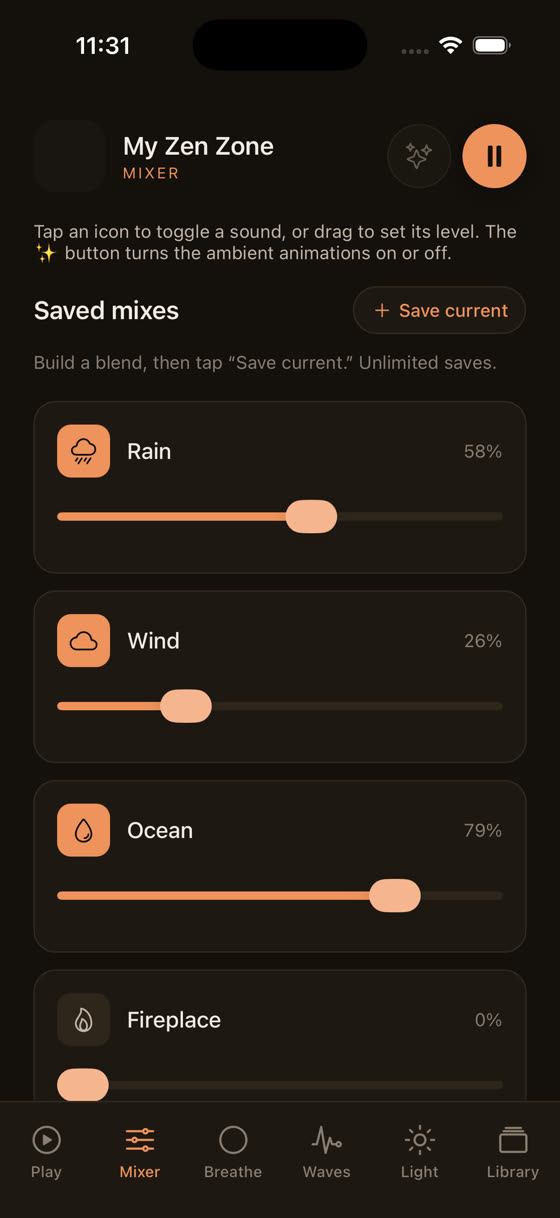
Watching those levels move live makes the idea obvious in a way a description doesn't.
That same layering is what makes our guided sessions different from most meditation apps too: the voice sits as its own level over the music instead of replacing it, so a sleep talk-down doesn't have to mean the music stops.
The Rest of the Wind-Down Routine
Sound is one piece. Breath pace is another, and it's underused. A 4-6 pattern, breathing in for four counts and out for six, nudges the nervous system toward rest because the longer exhale is what triggers the body's calming response. It takes about two minutes to feel the difference.
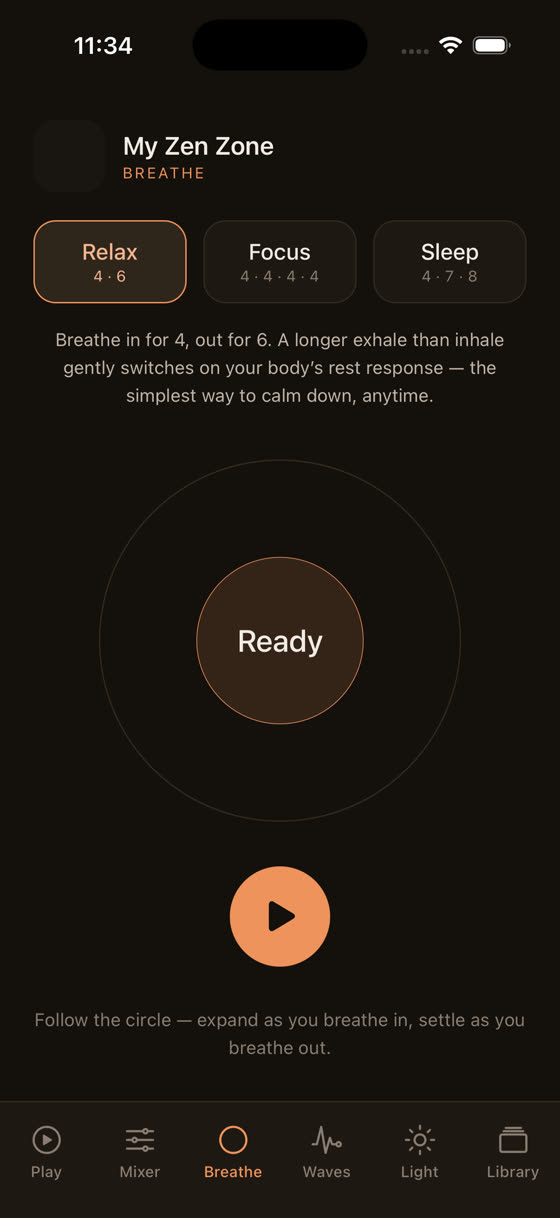
Light matters as much as either, and it's the one most people ignore entirely, scrolling a bright phone screen until the second before they try to sleep. A dimmer, warmer visual cue in the last few minutes signals to the body that the day is actually ending.
Using a Tracker and a Sound App Together
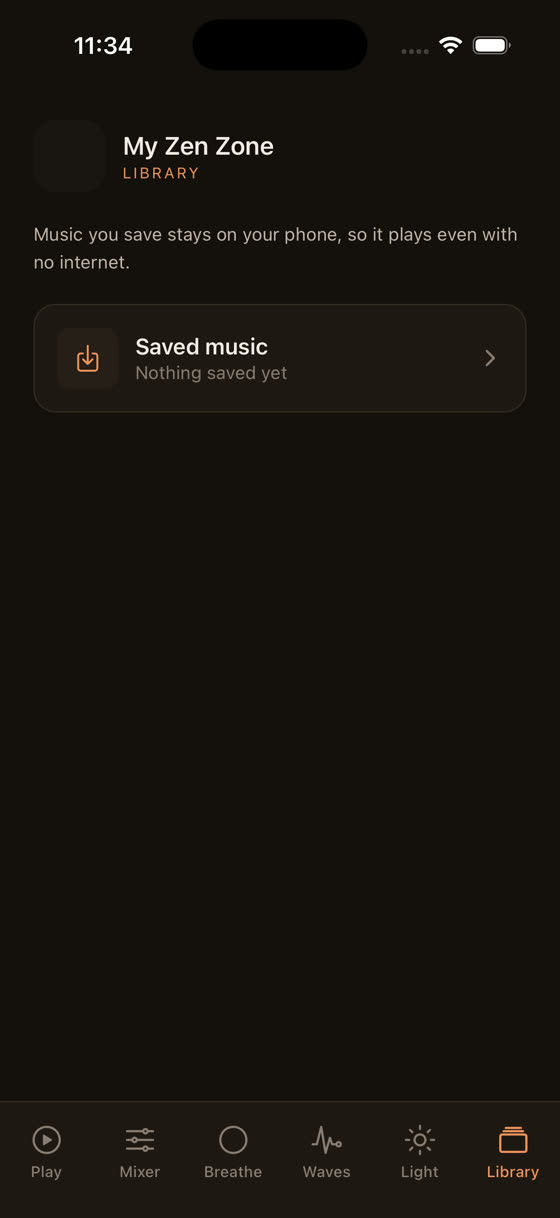
These two things aren't in competition. A tracker is a rear-view mirror, useful for spotting patterns over weeks: a stretch of late bedtimes, a run of restless nights after a certain kind of evening. Check it once in the morning, look at the week's trend, and leave it there. Use something else nightly as the actual ritual: pick a track, set the sleep timer so it fades out rather than playing all night, and let that be the fixed point your evening builds around. Because the library adds new material every two weeks and everything downloads for offline listening, it works as well on a plane with no signal as it does at home, and it doesn't turn stale after a month of nightly use the way a ten-track playlist does. You can see the full range at myzenzone.app or start with the app itself if you want to try it tonight rather than read about it.
What to Do Differently Tonight
Two small changes are worth more than any new gadget. First, stop checking your sleep score right before bed if you're in the habit of it; save it for the morning, glanced at once, not dwelt on. Second, pick one track or one mixer combination and use it every night for two weeks rather than switching sounds constantly. The repetition is what builds the association between that specific sound and sleep, the same way a lullaby works for a child. A tracker will tell you, weeks later, whether that habit changed anything. But you'll likely feel the difference in the room long before the graph shows it.
Common questions
Are sleep tracking apps actually accurate?
They're reasonably good at estimating total sleep time and decent at flagging obvious wake-ups, but weaker at distinguishing sleep stages like REM from light sleep compared with lab EEG studies. Treat the nightly score as a rough estimate and look at trends over weeks rather than reacting to any single night's number.
Will listening to music affect my sleep tracker's readings?
Not directly. Trackers read movement and heart signals, not audio, so music playing in the background won't skew the data itself. What it can do is help you fall asleep faster and more calmly, which may show up indirectly as less tossing and a steadier heart rate early in the night.
Can My Zen Zone track my sleep stages?
No, and we don't try to. The app is built for the wind-down window before sleep, with a mixer, breathing pattern, and sleep timer, rather than for measuring what happens once you're asleep. Pair it with a wearable's tracking app if you want that side of the picture too.
What's a normal sleep score, and should I worry about a low one?
There's no universal "normal" since scoring algorithms differ between apps and brands. A single low score after one bad night, a late meal, or a warm room usually isn't meaningful on its own. It's worth paying attention to only if a pattern of low scores persists over a couple of weeks.
Does nature sound or white noise actually help you fall asleep faster?
Evidence here is limited but points toward a real, modest effect, mostly through masking sudden environmental noises like traffic or a partner shifting in bed, which otherwise nudge light sleepers toward waking. It's not a guaranteed fix, but for many people it removes one of the more common causes of disrupted sleep.