The Short Answer
Scroll through r/GetStudying, r/ADHD, r/WFH or r/productivity and the same names keep surfacing: brain.fm, Endel, myNoise, and increasingly apps like My Zen Zone that let you build your own mix instead of pressing play on someone else's. There is no single "best" app, and anyone who tells you there is hasn't read enough of these threads. What actually helps depends on what's breaking your focus in the first place: too much ambient noise, too much silence, a mind that keeps wandering, or a task that needs a different tempo than the one you're playing.
What the Threads Actually Agree On
Strip away the brand names and the same handful of preferences show up in nearly every thread. No lyrics, or at least none in a language you understand well enough to parse. Something repetitive rather than surprising, because a chord change or key shift pulls attention the same way a phone buzzing on the desk does. A tempo somewhere near a resting heart rate, roughly 60-70 bpm, for anything needing sustained concentration. And a healthy skepticism toward claims of making you smarter through sound alone. Commenters who've tried binaural beats for months tend to say "it's fine background noise" rather than "it changed my output."
That skepticism is worth keeping. Music can help you sit down and stay seated. It is not going to write the report for you.
The Mechanism Most Articles Skip
Tempo entrainment is the closest thing to a real explanation, and even that has limited evidence behind it. A steady, unchanging beat gives your attention something predictable to rest against, so less of it gets spent monitoring the room for change. That's why a track with a key change every sixteen bars is worse for deep work than one that simply continues. It's also why silence isn't automatically better than music: silence has its own unpredictability, a door closing, a chair creaking, and your brain still has to check on those.
For reading or writing, the 60-70 bpm range with minimal percussion tends to work best. For repetitive admin tasks, sorting email, filling in spreadsheets, a slightly faster 90-100 bpm track with a light rhythmic pulse can help you move through the work rather than lull you out of it. This is where most "best focus music" lists get lazy: they recommend one playlist for every kind of work, when deep work and shallow work want different things underneath them.
Where Reddit Gets It Wrong
The threads are useful but have blind spots. The biggest one: most recommendations assume you want music, when a lot of people posting "nothing works" actually need masking noise, not melody. Brown noise, rain, a fan on a shelf. If your problem is a neighbour's TV or an open-plan office, a wash of pink or brown noise does more than any composed track, because it covers a frequency range rather than competing with one.
The second blind spot is habituation. A track that helped in week one can turn into wallpaper by week four, and your brain stops using it as an anchor. This is part of why we release new tracks every two weeks instead of treating the catalogue as finished. If something's gone stale, there's usually something newer that hasn't been played into the background yet.
Build Your Own Mix Instead of Trusting Someone Else's
The other thing missing from most app recommendations is control. A playlist is a fixed decision made by someone else about what your afternoon should sound like. A mixer lets you decide, sound by sound, what you actually need right now: rain a little louder, the piano pulled back, a low drone underneath to cover the noise from the street.
That's the difference worth naming: most apps hand you a finished track. My Zen Zone gives you the layers separately, so you're balancing rain against a synth pad against a soft rhythmic pulse until it sits right for your own ears, not for the average listener the playlist was built for. For a deeper look at tempo and instrumentation specifically for studying, see music for focus and study.
Different Work Needs Different Sound
Coding wants something closer to white space than melody, a low, unresolved pad with no percussion, so a chord change doesn't distract you mid-thought. Reading dense material benefits from solo piano at a slow tempo, with real space between the notes. Admin work, the kind where your hands are busy but your mind is bored, can actually take a light rhythmic pulse, almost like a walking pace, because it keeps you moving through the list instead of drifting.
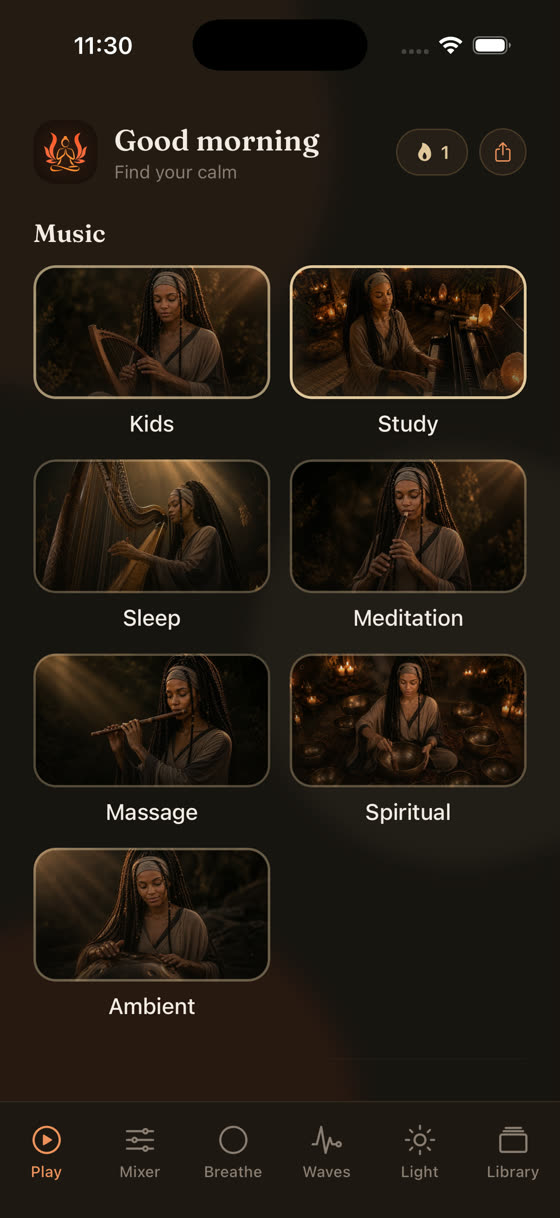
This is part of why the app is split into separate worlds for focus, calm, sleep and meditation rather than one undifferentiated "relaxing music" bucket. What helps you fall asleep at ten at night is the wrong tool at ten in the morning, and treating them the same is how a lot of "focus music" ends up putting people to sleep at their desks instead.
Brainwave Tones: What's Real and What Isn't
Binaural beats and isochronic tones come up in almost every one of these Reddit threads, usually with someone insisting they've found the frequency that unlocks deep focus. The honest answer is that the evidence for binaural beats measurably changing brain states in any useful way is thin and mixed at best, and we won't claim otherwise. What we can say is that a low, steady tone under your usual focus track is unobtrusive, and some people find it easier to settle into a work session with a slight hum underneath than with nothing at all.
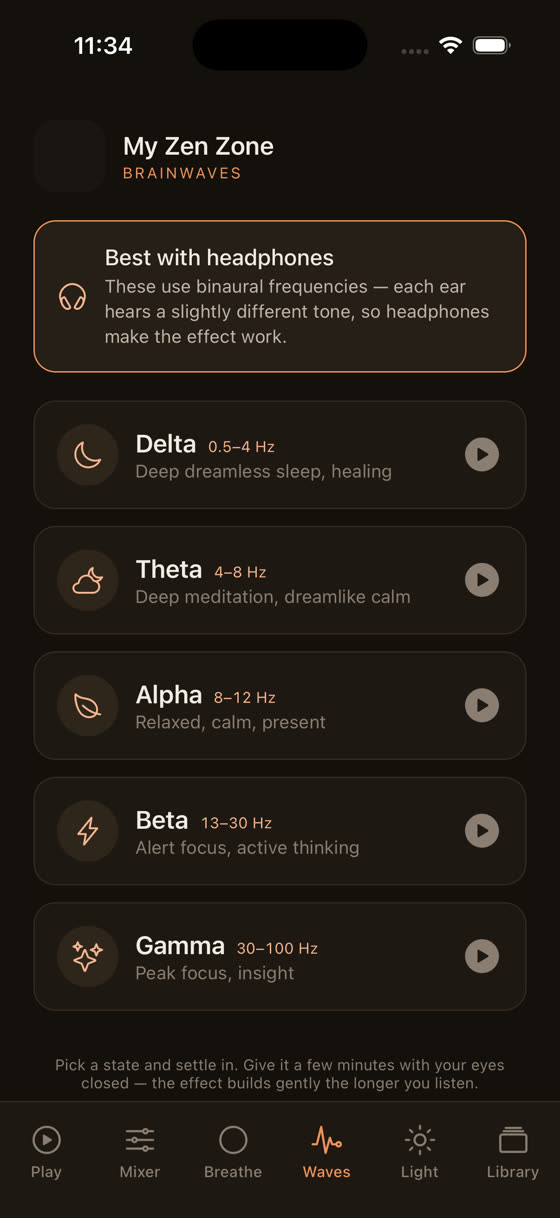
If you try the brainwave tones in the app, treat it the way you'd treat a new coffee order: worth testing on a low-stakes day, not something to bet an important deadline on.
What We Do Differently
Every track in My Zen Zone is written and recorded by one composer, not licensed from a stock library or generated to fill a category. That matters more than it sounds, because the tempo and instrumentation choices across the focus section are consistent, built by someone thinking specifically about what a working brain needs rather than what sounds nice in an ad. The library runs to hundreds of tracks now, with new ones added every two weeks, so the habituation problem above has an actual answer: there's always somewhere new to go when the current playlist stops working.
Downloads work offline, so a train commute or a flaky office wifi doesn't interrupt a deep work block halfway through. A subscription also opens the full library in a browser, so the same mixer and tracks are there on a work laptop, not locked to a phone. If sleep is the other half of your focus problem, and for a lot of people it is, poor focus during the day traces straight back to a bad night, our guide to music for sleep covers the tempo and instrumentation side of that separately.
What To Actually Try Tonight or Tomorrow Morning
Skip the search for one perfect track. Instead, build a low layer of rain or brown noise as a floor, then add a slow, sparse instrumental on top at a level where you'd struggle to hum the melody back. That combination, noise underneath, sparse music above, covers both problems: it masks the unpredictable stuff outside your control and gives your attention a steady surface to rest on.
Try a slower tempo for reading and writing, a slightly faster one for admin tasks, and notice which one actually gets you further into the task rather than which one you enjoyed listening to. Those aren't always the same track. If you want to start from a built library rather than a blank mixer, the app is free to try and the whole focus section is a reasonable place to begin, or you can look through the full catalogue first at myzenzone.app.
Common questions
Does background music actually help with ADHD focus, or is that just anecdotal?
Mostly anecdotal, and the research is thin. Some people find a steady instrumental layer helps because it gives external stimulation less room to compete for attention; others need silence or pure masking noise instead. There's no guarantee either way, so it's worth testing on a low-stakes day rather than betting a deadline on it.
Is there a free way to try My Zen Zone before subscribing?
Yes, the app is free to download with a selection of tracks available to try. A subscription unlocks the full library of hundreds of tracks, the mixer, offline downloads, and browser access, so you can test whether the approach suits you before committing to anything.
How loud should focus music be compared to my own thoughts?
Quieter than most people set it. If you could hold a conversation over it without raising your voice, that's roughly right. Focus music works best as a floor under your attention, not a foreground element competing for it.
Does music with lyrics ever actually work for concentration?
For very routine, low-cognitive tasks, sometimes, because the language centres in your brain aren't being taxed much either way. For reading or writing, lyrics tend to compete directly with the verbal processing you're already using, which is why instrumental tracks are the safer default for that kind of work.
What should I use if my house is noisy, not quiet, while I'm trying to focus?
Lean on masking noise rather than melody. A layer of rain or brown noise set higher than usual, with a sparse instrumental track underneath, covers unpredictable household sound far better than music alone, which is exactly the situation a mixer with separate levels is built for.