There isn't one single "best" free binaural beats app, because the beats themselves are the smallest part of what makes any session work. What matters more is whether the app lets you control volume between the tone and whatever else is playing, whether you can save sessions offline, and whether the frequency you're choosing actually matches what you're trying to do. My Zen Zone includes a brainwave tones section alongside its full music library, free to try, and I'll explain exactly how to use it properly below.
What a binaural beat actually is
This part gets mangled constantly, so let's be precise. A binaural beat isn't a sound you can record and play through a single speaker. It's an illusion your brain creates when your left ear hears one pure tone, say 200 Hz, and your right ear hears a slightly different one, say 210 Hz. Your brain perceives the 10 Hz difference between them as a phantom pulsing beat. That only happens with stereo headphones. Play the same file through a phone speaker and the effect simply isn't there, which is the single most common mistake people make and the main reason a lot of free apps get one-star reviews that have nothing to do with the app itself.
The frequency of that phantom beat is supposed to correspond to brainwave ranges: delta around 1-4 Hz for deep sleep, theta 4-8 Hz for meditative or drowsy states, alpha 8-12 Hz for relaxed alertness, and beta or gamma above that for focus and alertness. The idea is entrainment, your brain's electrical activity gradually syncing toward the frequency of the beat. It's a tidy theory. The evidence for it is considerably messier than most blog posts admit.
What the research actually shows, honestly
Some small studies report reduced anxiety or improved subjective relaxation with binaural beats in the theta and delta range. Other studies, equally small, find no measurable effect on sleep onset or EEG activity beyond what you'd get from any quiet, repetitive sound. There is no large, consistent body of evidence proving binaural beats reliably change brain states in a way that's different from plain relaxing audio. I won't tell you they'll fix your sleep or sharpen your focus, because nobody can honestly promise that. What I can tell you, from making audio for a living, is that a steady, low-information soundscape at the right volume does measurably help most people settle, whether the mechanism is entrainment or just having something predictable to listen to instead of your own thoughts.
Free versus paid, and what you're actually choosing between
Free binaural beats apps tend to fall into two camps. The first gives you a handful of preset tones, maybe five or six, looped on repeat with no way to adjust volume against background noise. The second locks the actual useful features, offline downloads, a sleep timer, the ability to layer a tone under music, behind a paywall after a week. Neither is dishonest exactly, but neither is built around how people actually use this stuff at 11pm with a phone on 4% battery and a partner asleep next to them.
What you want from a free tier is enough to test whether the whole approach even works for you before you commit to anything. That means a real selection of tones across delta, theta and alpha ranges, not just one default track, and a way to blend it with something else, because very few people want forty-five minutes of a pure sine-wave pulse with nothing underneath it.
Blending matters more than the beat itself
This is the bit most binaural beats apps get wrong entirely. A bare tone, on its own, is clinical and a bit grating for a lot of people within ten minutes. What works better in practice is a binaural tone sitting quietly under a texture, rain, a low drone, soft piano, at a level where the tone is doing its job but isn't the only thing you're hearing.
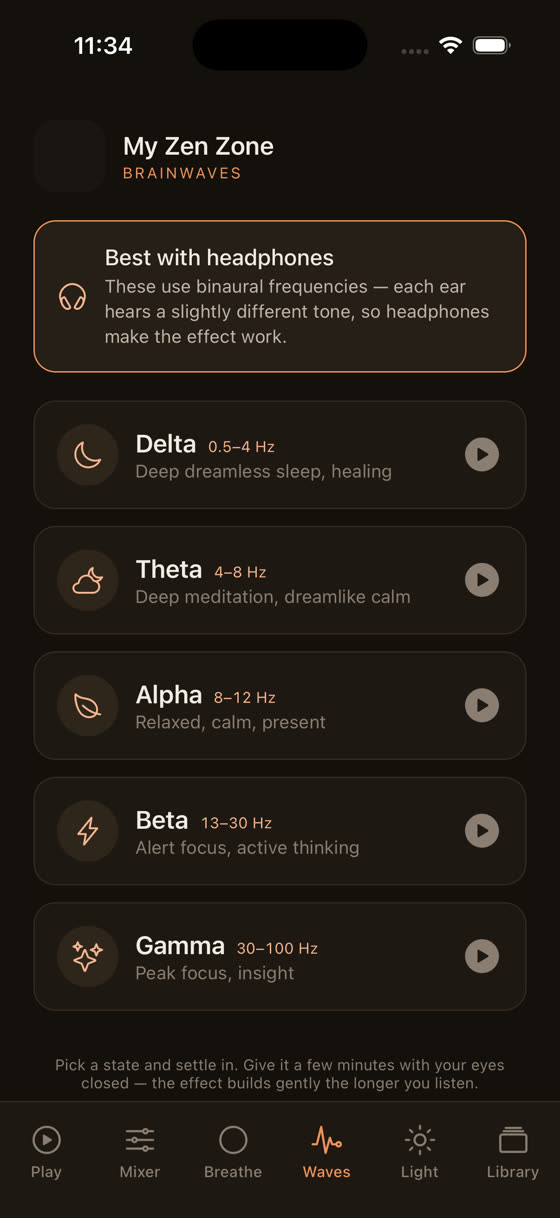
In My Zen Zone's brainwave tones section you pick the range, delta for sleep, theta for meditation, alpha for a calmer kind of focus work, and from there you're free to bring in a nature layer or a music bed underneath it using the mixer, each sound on its own independent level. That's the actual difference worth naming here. Most apps give you one fixed file. This gives you three or four elements you balance yourself until it sits right for your ears, your room, and what you're trying to do.
Watch what happens when those levels move in real time: the tone stays constant while rain fades up and a low pad fades in underneath, and the whole thing changes character without a single new file being loaded. That's the point of a mixer over a playlist. You're not choosing between six finished tracks, you're building the one that works for you tonight, which might be different from what worked last Tuesday.
How to actually use this tonight, not in theory
If you're trying binaural beats for sleep, here's the practical version, skipping the theory. Use proper stereo headphones or decent wired earbuds, not your phone speaker and not a single Bluetooth earbud missing its pair. Choose a delta or low-theta tone, somewhere around 2-6 Hz. Keep the volume low, quieter than you think you need, loud background audio of any kind tends to keep people awake rather than help them drift off. Set a sleep timer so the audio stops rather than looping all night, because a tone running at 3am into your sleeping brain for eight hours straight isn't what any of the research, thin as it is, was actually testing. Give it quarter of an hour to twenty minutes before deciding whether it's doing anything for you, rather than switching tracks every ninety seconds, which defeats the whole premise of a repetitive, predictable sound settling your nervous system.
For focus work during the day, alpha or low-beta ranges paired with something closer to 60-70 bpm underneath, roughly resting heart rate, tends to work better than silence for sustained desk work, in my experience making this stuff for years. We've written more on that specific combination in our piece on music for focus and study, if that's the half of this you're actually here for.
Isochronic tones, the honest alternative
Worth mentioning: isochronic tones are a cousin of binaural beats that pulse a single tone on and off at a set rate, rather than relying on two slightly different frequencies in each ear. They work through regular speakers, no headphones required, which makes them considerably more practical for a shared bedroom or an office. Some people find the on-off pulsing more noticeable and therefore more distracting than a binaural blend; others find it easier to actually feel working. If headphones all night genuinely aren't realistic for you, this is worth trying before writing off the whole category.
Where this fits with everything else in the library
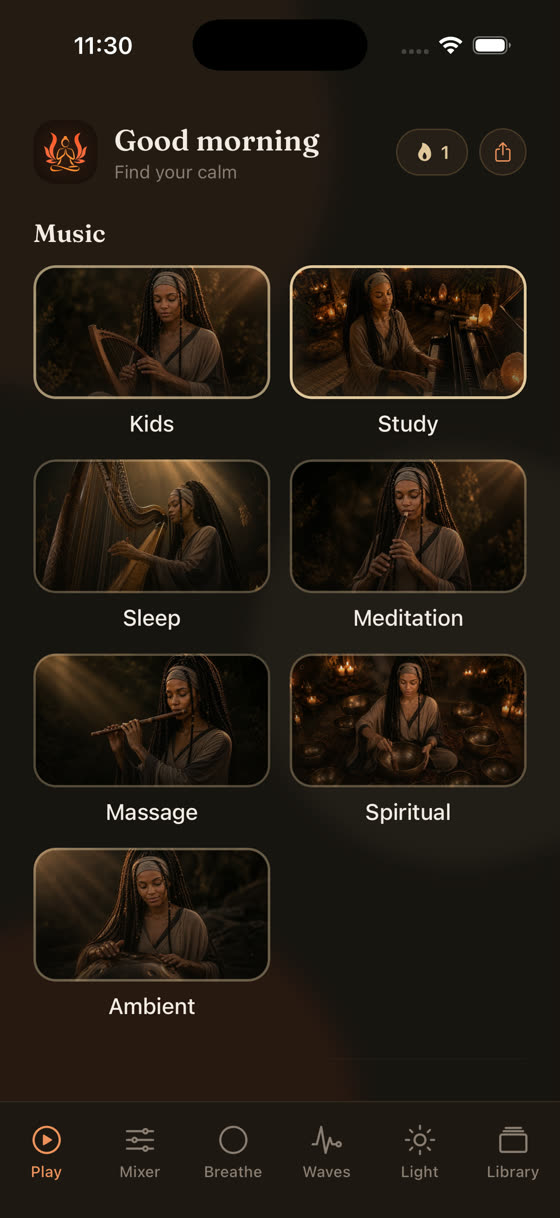
Binaural tones are one corner of a much bigger library here, sitting alongside sleep, focus, meditation and calm music, each built as its own distinct world rather than one long undifferentiated playlist. If tones alone don't do it for you, that's fine, that's exactly why the rest of the app exists: slow, structured music for sleep works through a completely different mechanism, melody and repetition rather than frequency entrainment, and plenty of people respond better to one than the other. New tracks get added roughly every two weeks, all composed and recorded by one musician rather than licensed stock audio, so the library keeps growing rather than looping the same forty tracks indefinitely.
The honest bottom line
Try binaural beats properly, with real headphones, at low volume, for a genuine twenty-minute stretch, before deciding they're not for you. Don't expect a guaranteed effect, because the evidence doesn't support that promise and nobody reputable should be making it. Do expect that a quiet, steady, low-information soundscape, tone-based or not, generally beats silence or scrolling your phone right before sleep. You can try the full mixer and tone library free, across iPhone, Android or in a browser, at myzenzone.app/get, or have a look at what's actually inside at myzenzone.app.
Common questions
Do binaural beats work without headphones?
No, not as true binaural beats. The effect depends on each ear receiving a slightly different frequency, which only works through stereo headphones or earbuds. Play the same audio through a phone speaker and both ears hear the identical mixed signal, so there's no phantom beat to perceive, just a steady tone.
What frequency is best for sleep?
Delta range, roughly 1-4 Hz, is the one most associated with deep sleep in the entrainment theory, with theta (4-8 Hz) sometimes used for the drowsy transition into sleep. Keep volume low and use a sleep timer rather than letting anything loop at full volume all night.
Can binaural beats be harmful?
For most healthy adults, listening at a reasonable volume isn't considered risky. People with epilepsy or certain seizure conditions are sometimes advised to be cautious with rhythmic audio stimulation generally, so if that applies to you, it's worth checking with a doctor first rather than assuming it's fine.
Is there a difference between binaural beats and isochronic tones?
Yes. Binaural beats use two slightly different frequencies, one per ear, and need headphones to work. Isochronic tones pulse a single tone on and off at a set rate and work through regular speakers. Some people find isochronic tones easier to notice working; others find the pulsing more distracting.
How long should I listen before I notice anything?
Give it at least 15-20 minutes of uninterrupted listening rather than switching tracks every minute. The evidence for binaural beats is mixed and modest at best, so treat it as one tool among several, alongside dimmer light, a wind-down routine, and quieter screens, rather than something that works instantly on its own.