The best free guided meditation is the one you'll actually finish, not the one with the most five-star reviews. In practice that means something short, ten minutes or less to start, with a voice that paces itself to your breath rather than racing through a script, and background sound you can hear clearly instead of fighting through a wall of music. Free is a perfectly good place to begin. It just has edges worth knowing before you build a nightly habit around it.
Most people searching this term are stressed, tired, or both, and they want something that works tonight, not a philosophy lesson. So let's get specific about what makes a guided session good, what free tiers usually get wrong, and how to use one properly instead of just pressing play and hoping.
What "free" actually gets you
Free guided meditation on most apps means one of three things: a handful of sessions before a paywall appears, a full library with ads dropped into the middle of the audio, or a stripped-down version of a paid catalogue meant to get you subscribing within a week. None of these are scams exactly, but they shape the experience more than people expect. An ad breaking in at minute six of a body scan does the opposite of what the session was trying to do. Your heart rate had just started to settle, and now there's a jingle.
The honest version: free tiers exist to convert you, not to relax you. That's fine as a starting point. Just don't judge the whole idea of guided meditation on a rushed, interrupted free sample. The format itself is sound. The delivery is often where things fall apart.
Why the voice-to-pacing ratio matters more than the script
A guided meditation script could be read by anyone. What actually changes how your body responds is pacing: how long the guide holds silence between instructions, whether breath cues match a rhythm your body can follow, and whether the voice itself sits at a steady, unhurried pace, roughly the cadence of someone speaking at 120 to 140 words per minute, well below normal conversational speed.
A common breath pattern used in guided sessions is a 4-6 count, four seconds in through the nose, six seconds out through the mouth, which nudges you toward a slower overall breathing rate than most people default to when anxious. It's not a trick, it's just physiology: longer exhales are associated with a calmer nervous system state than short, shallow ones.
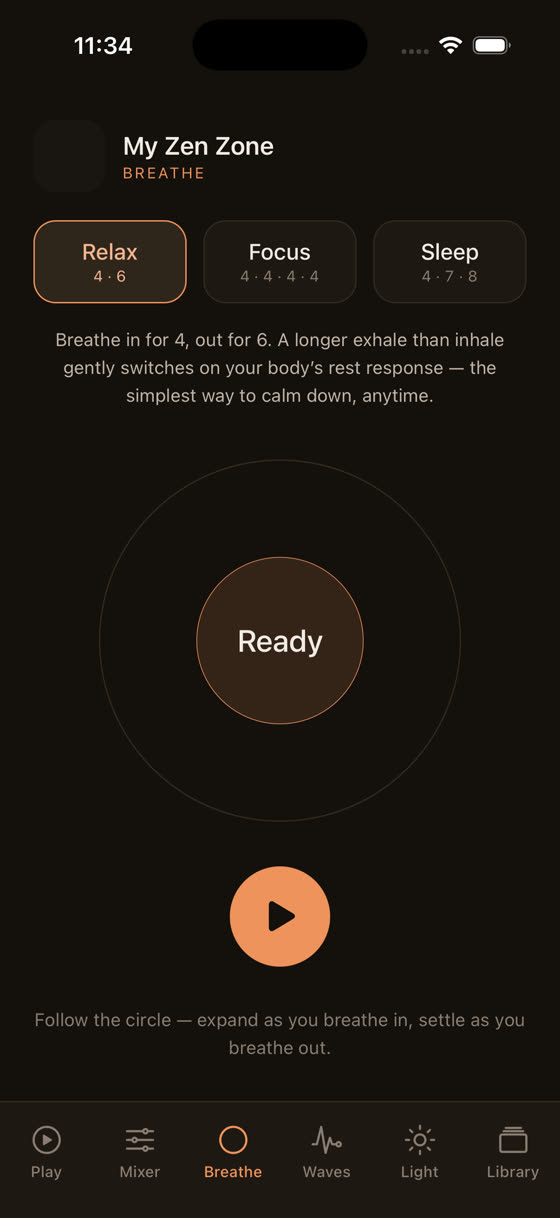
Good guided meditation respects that pacing and doesn't rush you past it to fit a tidy ten-minute runtime. Bad guided meditation reads the same script twice as fast because someone decided ten minutes was the right length regardless of what's actually being asked of the listener.
The mistake almost every free app makes
Here's the part most "best free guided meditation" roundups skip entirely. In nearly every app, the voice and the music are baked into a single audio file. You get one volume slider. If the music is too loud, the voice gets swallowed. If you turn the voice up, the music turns into mush behind it. And when the guide stops talking for a minute of silence, as good scripts do, the music often jumps in volume to fill the gap, which is jarring if you were actually sinking into it.
We built guided sessions differently: the voice, the music, and any nature sound are separate layers, each with its own level you can move independently, live, while it's playing. Want the guide quieter and the music fuller for the last two minutes of silence? Drag one slider. Want just music with no voice tomorrow night using the same session? Mute it. Nobody is forcing the music to stop so a voice can talk; the voice is simply laid over whichever soundscape you've already set up.
Nature sound shouldn't be a single fixed loop
A lot of free guided meditations ship with one background texture, usually rain, at one fixed volume, and that's the whole offer. Some people find rain soothing. Others find it grating after four minutes, especially the synthetic, looped kind with an audible seam where it restarts. The fix isn't picking a "better" nature sound. It's being able to blend several at levels that suit you.
In our mixer, you can run rain low, wind barely audible, and a distant ocean layer underneath a guided voice, each on its own fader, and save that combination for next time. That's a genuinely different experience from a single static loop, and it's the kind of detail that decides whether a session gets used once or becomes part of a routine. If you want the deeper mechanics of why layered sound works better than a single track for sleep specifically, we cover that in our piece on music for sleep.
What the evidence actually says
It's worth being straightforward here. The research on guided meditation and apps generally is real but limited: most studies are small, short, and funded in ways that make broad claims risky. Nobody should promise you better sleep, lower anxiety, or improved focus as a guaranteed outcome from ten minutes of audio. What's reasonably well supported is narrower: slow, paced breathing is associated with short-term calming of the autonomic nervous system, and a consistent wind-down routine, meditation or otherwise, is associated with easier sleep onset for a lot of people. That's a modest claim, and it's the honest one.
How to actually use a free session tonight
If you're trying this tonight rather than just reading about it, a few things change the outcome more than picking the "right" app:
- Use headphones or a speaker close enough that you're not straining to hear quiet passages, especially with a breath-paced guide.
- Set a sleep timer so the session, or whatever follows it, doesn't keep running at 2am. Running audio all night isn't necessary and can fragment sleep for some people.
- Don't multitask through it. A guided session with a phone screen lit up next to you for notifications defeats most of the point.
- Pick a consistent time, not a random one when you remember. The habit does more than any single session.
When free stops being enough
Free is genuinely fine for trying the format and working out whether a particular voice, pace, and style suits you. Where it tends to run out is variety: the same three sessions on loop for months get stale, and stale meditation is meditation you stop doing. Our library runs into the hundreds of tracks and sessions, with new music added roughly every two weeks, so the free sampler is a fraction of what's actually there. A subscription opens the full catalogue, offline downloads for flights or spotty signal, and the whole thing in a browser too, not just the phone. You can see the full range at myzenzone.app or go straight to the download if you want to try the mixer and layered sessions yourself.
A simple test for any guided meditation app
Before committing to a routine with any app, free or paid, try this: start a session, and halfway through, try to turn the music down without stopping the voice. If you can't, you're locked into someone else's mix, not yours. That single test tells you more about whether an app will actually fit your evenings than any list of features ever will.
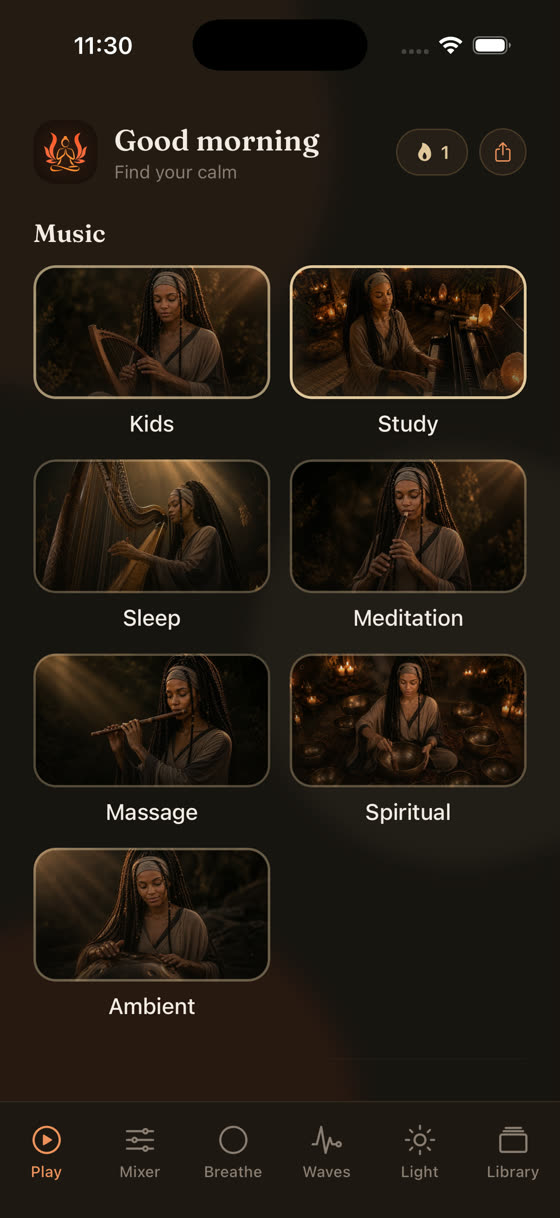
Our home screen keeps meditation, sleep, focus, and calm as separate worlds rather than one blended playlist, partly because what helps you drop off at 11pm is rarely what helps you concentrate at 2pm. If focus is actually the thing you're after rather than sleep, our focus and study piece goes into tempo and instrumentation choices that matter there instead.
Common questions
Is guided meditation actually better than just listening to calm music?
Neither is objectively better; they do different jobs. A guided voice gives you something to follow when your mind is loud, which helps some people more than silence or music alone. Others find the voice itself distracting and prefer pure music or nature sound. Worth trying both and noticing which one actually quiets your thoughts rather than assuming one is superior.
How long should a guided meditation be for beginners?
Five to ten minutes is a reasonable starting length. Longer sessions sound more impressive but are easier to abandon halfway through, which teaches you that meditation doesn't finish, not a useful lesson. Build consistency at a short length first, then extend the time once sitting still for ten minutes stops feeling like an effort.
Can guided meditation replace sleep medication or therapy?
No, and no reputable source should claim otherwise. Guided meditation is a relaxation tool, not a treatment for insomnia, anxiety disorders, or other clinical conditions. It can sit alongside medical care as a calming routine, but anyone dealing with persistent sleep or mental health problems should talk to a doctor rather than relying on an app alone.
Why does the background music in some apps suddenly get louder during the meditation?
That usually happens because the voice and music are mixed into a single audio file, so when the spoken part pauses, the fixed music track fills the silence and sounds louder by contrast. Apps with separate voice and music layers avoid this because you control each level independently instead of inheriting whatever balance was baked in.