The short answer
If you want meditation with no subscription at all, three apps handle it honestly: Insight Timer's free tier, Medito, and Smiling Mind. None of them lock a full guided session behind a paywall, and none of them nag you every session to upgrade. That's the direct answer. The longer answer is about what "free" actually buys you, because it's rarely the same experience as the version you'd pay for, and for some people that gap matters more than the price.
What "free" usually means in a meditation app
Free, in this category, tends to mean one of three things: a smaller library rotated for everyone, ads before or after a session, or a fixed catalogue that stopped growing the day the app hit a stable version. None of these are dealbreakers on their own. A ten-minute breathing exercise doesn't need three hundred variations. But if you're using an app most nights, the seams start to show: the same three sleep tracks, the same narrator's voice, the same twelve-minute body scan you now know by heart before it finishes.
The apps worth trying if you want free, forever
Three names come up honestly, without an asterisk hiding a catch:
- Insight Timer — the free tier is genuinely large, built on thousands of user-submitted and teacher-submitted sessions. The trade-off is quality control: length, audio quality, and teaching style vary a lot from track to track, because it's closer to a platform than a curated library.
- Medito — a nonprofit, fully free app with a structured beginner course. Smaller library, but every session is made to a consistent standard, which matters if you're new and don't want to sift through hundreds of options.
- Smiling Mind — Australian, nonprofit, free, with programmes aimed at both adults and younger users. Good if you want structure over choice.
All three are worth a week of your time before you spend a penny on anything. If they cover what you need, stop reading and go use one tonight.
Does the app itself matter?
Research on meditation apps specifically is thinner than the marketing around them, and I won't pretend otherwise. Most studies looking at mindfulness are about the practice itself, not about which piece of software delivers it. There's no solid evidence that a paid app produces a different outcome than a free one, and anyone telling you otherwise is guessing. What does seem to matter, from every account I've read and from watching people actually use these things, is consistency: whether you keep opening the app at all. A free app with occasional ads that gets you to sit down every night beats a beautifully produced paid library you open twice and abandon.
Where free apps run into a ceiling
The limit usually isn't the meditation itself. It's everything around it. Free apps rarely give you a mixer to blend a voice with background sound at your own levels — you get the session as recorded, at the volume the teacher chose. They rarely offer offline downloads for a flight or a spotty signal. And because most run on donations or ad revenue rather than subscriptions, new material tends to arrive slowly, if at all. A free library from three years ago is often still the same library today.
Why paid libraries exist at all
Original music and voice work cost money to make properly. A single well-recorded ambient track, played and mixed by a person rather than assembled from a sample pack, can take a day or more. That's the honest reason subscription apps exist: someone is being paid to keep making the thing. At My Zen Zone the library is built by one musician working full time, which is why it runs to hundreds of tracks across sleep, focus, meditation and calm, and why new music lands every two weeks rather than once a year. It's a subscription, not a free app, and I'd rather say that plainly than dress it up. The reason to consider it isn't that it's free. It's what the subscription actually buys you.
The feature most free apps don't have
Almost every meditation app, free or paid, stops the music and plays a voice instead. My Zen Zone does the opposite: the guided session is a separate layer that plays over the music, and you control both independently.
Watch what happens when the voice fades and the music underneath keeps its own shape rather than snapping back to full volume — that's the difference between a session that feels stitched together and one that feels composed.
The same logic runs through the sound mixer, where rain, a low drone, and a single instrument can each sit at a different level you set yourself, rather than a fixed blend someone else decided on.
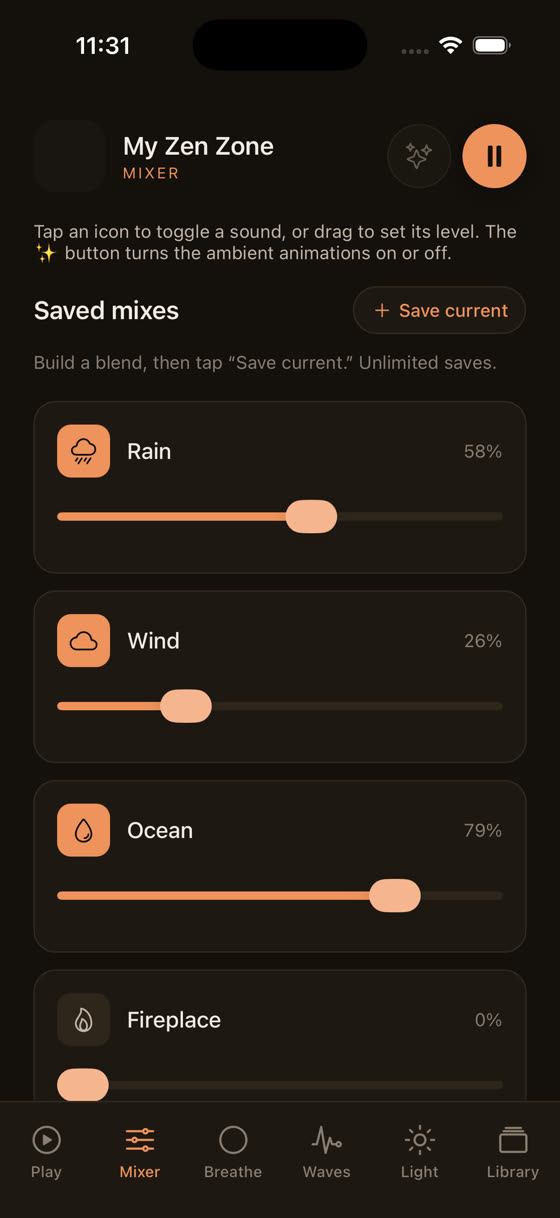
None of the three free apps above give you that kind of control. That's not a knock on them — it's a different kind of product, built by different teams for a different budget.
Matching the tool to the moment, not just the price
A free breathing app is fine for a five-minute reset at your desk. It's less fine at eleven at night when what you actually need is forty minutes of music that doesn't loop obviously and doesn't cut to silence right when you're finally drifting off. If sleep is the actual problem you're solving, it's worth reading what actually works for sleep before picking any app, free or not, because the wrong tempo or a track that ends abruptly at minute six will do more damage than any subscription fee. The same goes for focus: background music for deep work has different requirements again, covered in this piece on music for focus and study, and a free app built for guided meditation usually wasn't designed with either in mind.
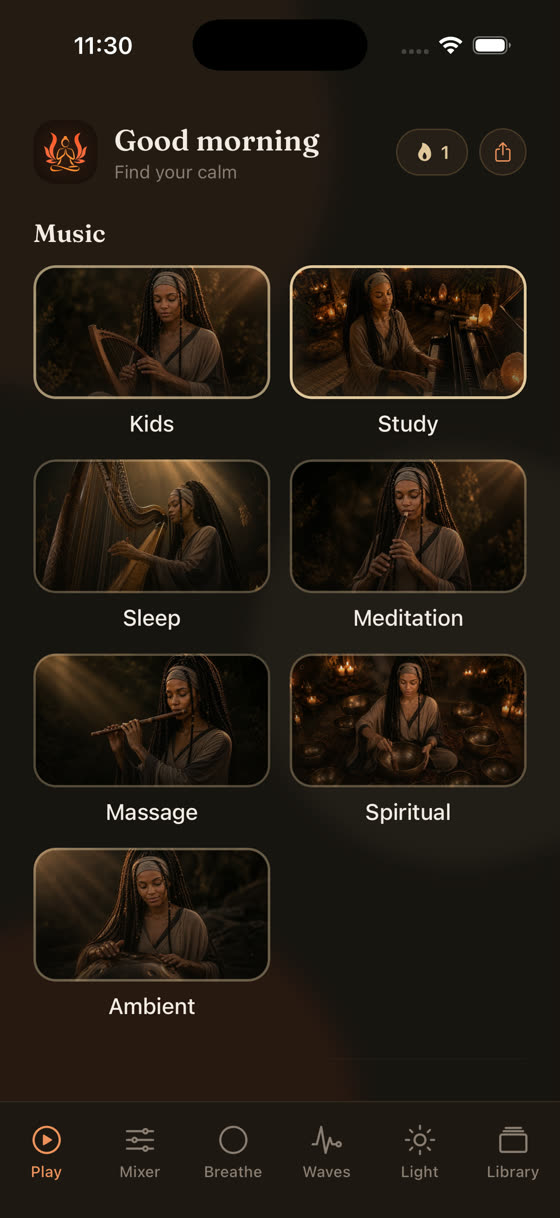
Each category sitting as its own space, rather than one long undifferentiated list, is a small thing that makes a real difference once you're choosing between sleep, focus, and calm on different nights.
A framework for tonight
Ask yourself three questions before you download anything. First, do you meditate most nights or a couple of times a month? If it's occasional, a free app is plenty. Second, do you need music underneath the voice, or is silence fine? If silence is fine, most free apps handle that well. Third, does the same handful of tracks bother you after a month, or are you someone who's happy to repeat a good thing? If repetition wears on you, that's the real argument for a growing library, not the meditation content itself.
Try Medito or Smiling Mind for a week if you haven't already; they cost nothing and neither will try to convert you mid-session. If you find yourself wanting more control over the sound, more new material, or music that sits under a voice rather than replacing it, that's the point to look at My Zen Zone, where a free trial through the app will show you within a few sessions whether the difference is worth paying for. There's no single correct answer here. There's only the honest trade-off: free and fixed, or paid and growing.
Common questions
Is Insight Timer really free or does it push a subscription?
The core library is genuinely free, with thousands of sessions you can use without paying. There's an optional paid tier, Insight Timer Plus, with extra courses and offline downloads, but it's not required to get real use out of the app. Most people can meditate regularly on the free version alone.
Do free meditation apps have ads during a session?
It depends on how the app is funded. Ad-supported free apps usually place ads before or after a session, not in the middle of one. Nonprofit apps like Medito and Smiling Mind, funded by donations, tend to run with no ads at all. Check an app's funding model before assuming either way.
Can I just use meditation music without any app at all?
Yes, plenty of people play meditation or sleep music straight from YouTube or Spotify. What you lose is control: no mixer to blend layers yourself, no sleep timer that fades out cleanly, no offline downloads for flights, and audio quality and length that vary wildly between uploads.
Why does My Zen Zone charge a subscription if there are free options?
Because the library is composed and recorded by one musician working full time, with new tracks added every two weeks, and that takes ongoing paid work to sustain. Free apps are a perfectly reasonable choice for many people. The subscription is there for anyone who wants a library that keeps growing and a mixer they control themselves.
What's the real difference between meditation music and a guided meditation?
Meditation music is instrumental, meant to sit under silence or your own practice with no instruction. A guided meditation adds a spoken voice leading you through breathing or a body scan. Most apps play one or the other; My Zen Zone lets you run both together as separate layers you balance yourself.