Search Reddit for this and the same five names come up: Insight Timer, Medito, Smiling Mind, the UCLA Mindful app, and sometimes Healthy Minds Program. That's the honest answer. Insight Timer has the biggest free library by a wide margin, Medito is fully free with no upsell because it's run as a nonprofit, and the other three are backed by universities or health bodies, which is why people trust them. If you only want the shortest possible answer, start with Medito or Insight Timer's free tier and see if either sticks for two weeks.
What the threads don't tell you is which one will actually work for your situation, and that's the more useful question.
What Reddit Actually Gets Right
Reddit is good at flagging apps with a genuine free tier versus ones that dangle a seven-day trial and then lock everything behind a paywall. That distinction matters more than most "best of" articles admit. Insight Timer's catalogue is enormous because thousands of independent teachers upload sessions, so quality varies wildly, but the sheer volume means you will eventually find three or four voices you actually like. Medito's appeal is different: it's a small, deliberately curated library, built by a team that isn't trying to upsell you on anything, which is rare enough to be worth naming.
The other thing the community gets right is warning people off apps that gate basic features like a sleep timer or downloads for offline use behind a subscription. Those aren't luxury extras. If you're using an app at 11pm to fall asleep, you need the audio to stop on its own, and you need it to work without a signal on a train or in a room with bad wifi.
What Every "Best Free App" Thread Skips
Almost none of these threads distinguish between mindfulness practice and background sound for sleep or focus. They get lumped together because they live in the same app store category, but they solve different problems. A ten-minute breathing session is a discrete exercise you do once. Music for falling asleep or for two hours of deep work needs to run continuously, adapt to the room, and not demand your attention. Recommending the same app for both is a bit like recommending the same shoe for sprinting and standing all day at a desk.
Reddit also under-rates one practical detail: most free mindfulness apps give you a single, fixed audio file. One voice, one background track, no way to adjust the balance. If the narrator's voice is too quiet against the rain sound, or too loud against it, you're stuck. That's a small thing until it's the reason you stop using the app after a week.
Why Free Rarely Stays Entirely Free
Most of these apps run on a freemium model, and it's worth understanding why before you commit an hour of your evening to setting one up. Insight Timer keeps most guided sessions free but sells a subscription for structured multi-day courses and offline downloads. Smiling Mind is free because it's funded by an Australian non-profit with a public health mandate, which is unusually generous but also means development is slower and the library is smaller. UCLA Mindful is free and always has been, but it's a handful of recordings, not a growing library. None of this is a criticism exactly. It's just worth knowing that "free" on Reddit usually means "free with limits," and the limits are different for every app on the list.
The Mechanism Nobody Explains
Here's the part almost no article touches: why does a guided session work on some nights and do nothing on others? Mindfulness apps generally use one of two mechanisms. The first is attentional anchoring, giving your mind a single point of focus, usually the breath, so it has less room to spiral. The second is physiological pacing, using a voice or tone to slow your breathing rate toward roughly six breaths a minute, which nudges your heart rate down with it. A 4-6 breathing pattern, in for four counts, out for six, is one of the more reliable versions of this and doesn't require any special skill.
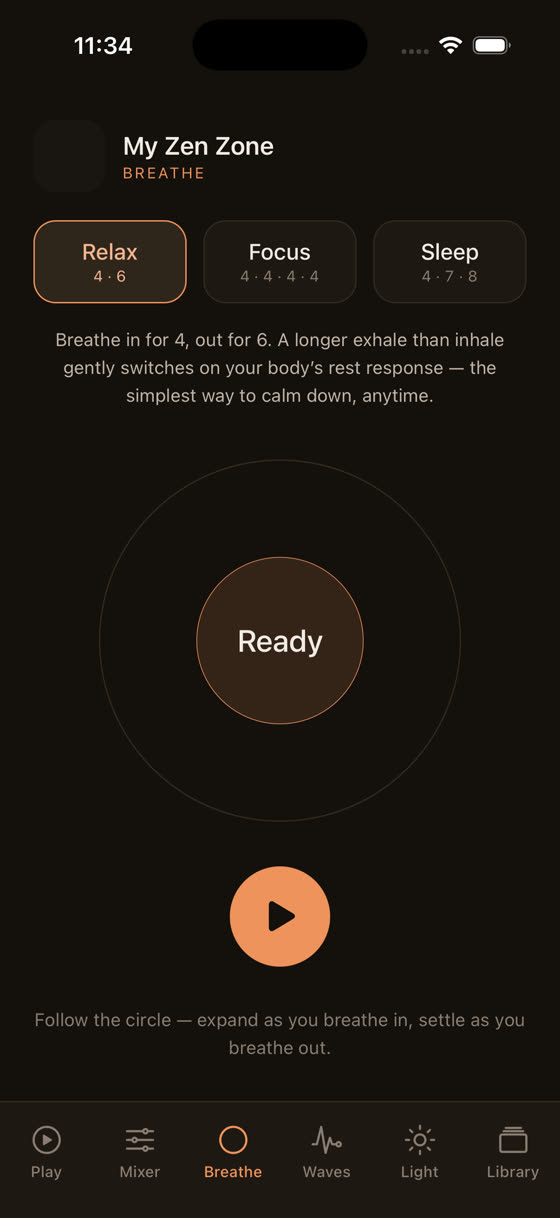
The exception is when your mind is already too loud for an anchor to hold. On those nights, a voice asking you to "notice the breath" can feel like static. That's when plain instrumental music, without instruction, sometimes works better, because there's nothing to fail at.
Guided Meditation vs Music-Only: The Real Debate
This split shows up constantly in Reddit comments and it's a legitimate one. Some people find a voice grounding. Others find it intrusive, especially at night, when a stranger's calm narration is the last thing that helps them switch off. Most free apps force you to pick one lane: either a spoken session with a fixed music bed underneath, or plain instrumental tracks with nothing guiding you.
We built My Zen Zone around the idea that you shouldn't have to choose. A guided session plays as a separate layer over the music rather than replacing it, so you can turn the voice down and let the music carry on, or mute the music and keep just the voice.
That's the difference between a fixed recording and a mix you control in real time, and it's one most free apps simply don't offer, because building it takes a proper audio engine, not just a playlist.
What To Actually Check Before You Download Anything Tonight
Skip the ranking and look at four things directly. Does it have a sleep timer that actually stops playback, not just fades the screen? Can you download sessions for offline use, or does it need a live connection every time? Is the free tier a genuinely usable amount of content, or three sessions and then a wall? And can you adjust the volume of voice against background sound separately, or is it baked into one file? If an app fails three of those four, it's probably not worth building a habit around, free or not.
Where a Music-First App Fits Into This
My Zen Zone isn't trying to compete with Insight Timer's library of thousands of independent teachers, and it isn't a guided-meditation app first. It's built around original instrumental music, composed and recorded by one musician, with new tracks added every fortnight rather than in occasional bursts. If what you actually need most nights is music for sleep rather than a voice talking you through anything, that's a different, narrower, more useful tool. You can read more on how tempo and instrumentation affect sleep specifically in our piece on the best music for sleep, and the same logic for concentration is covered in music for focus and study.
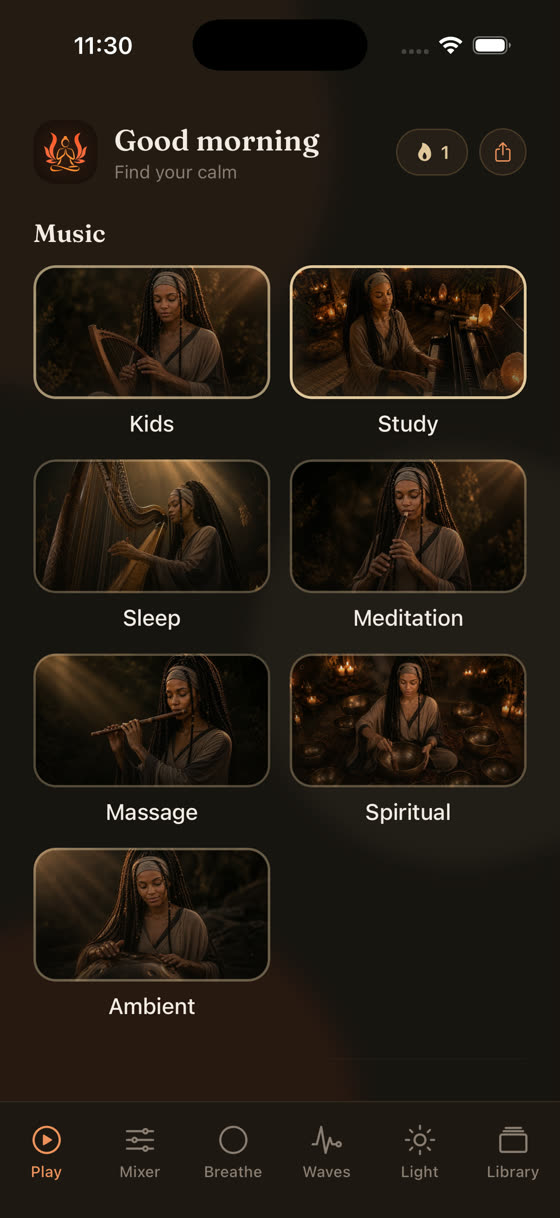
The mixer is the part that tends to surprise people coming from free apps. Instead of one fixed track, you set independent levels for rain, a drone, and a soft instrumental layer, then save that exact mix for next time.
A Worked Example: Two Different Nights
Say you've got a work deadline tomorrow and you're lying awake running through the presentation. A voice-guided body scan might actually make this worse, because it asks you to focus inward, right where the anxious loop already lives. Plain music at 60-70 bpm, roughly a resting heart rate, with no lyrics and no instruction, tends to work better here, because it gives your ears something to follow without giving your thoughts something to argue with.
Now say it's a Sunday evening and you're not anxious, just wired from screens. A short guided session, five to ten minutes, breath-paced, works well precisely because your mind has room to follow instructions without a running loop competing for space. Same person, same app, two different tools depending on the night. That's the strongest case for choosing something with a mixer and layered guided sessions rather than a single fixed track: you're not locked into one approach regardless of what your evening actually needs. If you want to try that setup, the app is free to start, and the full library including the fortnightly additions is available at myzenzone.app.
Common questions
Is Insight Timer actually free or is that misleading?
Most of the guided session library is genuinely free, which is why Reddit recommends it so often. The subscription is for structured multi-day courses, offline downloads, and some premium teacher content. For casual use, the free tier is enough to build a real habit before you'd ever need to pay.
What's the actual difference between a mindfulness app and a sleep or focus music app?
Mindfulness apps are built around discrete exercises, usually a guided voice walking you through breath or body awareness. Music apps are built for continuous background listening while you sleep, work, or study. They solve different problems, even though app stores file them under the same category.
Does background music actually help with meditation, or is that just marketing?
Evidence here is thin and mostly based on small studies, so it's worth being cautious about strong claims. What's more established is that slower tempos and steady, predictable rhythms can support slower breathing, which is part of why calm instrumental music is widely used as a backdrop rather than a cure.
Can I use a free mindfulness app for sleep too?
You can, but check for a sleep timer that stops playback rather than just dimming the screen, and offline downloads so it doesn't need signal overnight. Many mindfulness apps weren't designed with continuous overnight listening in mind, so those two features are worth testing before you rely on one.
Why does My Zen Zone charge if there are free alternatives?
Every track is composed and recorded in-house rather than licensed stock audio, and the library grows every two weeks. The subscription funds that ongoing production and unlocks the full mixer, guided sessions layered over music, offline downloads, and browser access, which free apps generally don't combine in one place.