The best guided meditation on YouTube is whichever one matches what your body actually needs tonight, not the one with the most views. A 20-minute body scan at 2pm when you're wired from a bad meeting needs a different pace and tone than a sleep script at 11pm when you just want the thinking to stop. There is no single channel that wins both jobs, and most "top 10" lists treat guided meditation like a genre instead of a tool with specific settings.
That said, there are real, consistent markers of a good session, and real, structural problems with using YouTube as the delivery method for something you want to do every night. Both are worth knowing before you build a habit around a platform that was built to sell your attention, not protect it.
What "Best" Actually Means Here
A good guided meditation does three things reliably: it paces its instructions to your breath rather than a script timer, it leaves real silence between cues instead of narrating constantly, and it matches its background music to the task. For sleep, that usually means a drone or pad sitting around 50-60 bpm, nothing with a clear beat. For focus or a quick reset during the day, a slightly more present texture works, something with enough movement to anchor attention without pulling it away from the voice.
The voice itself matters more than people expect. Flat, overly soft "meditation voice" reads as performative after the fifth minute. The sessions that actually hold people are the ones where the narrator sounds like they're genuinely relaxed themselves, not reading from a teleprompter in a hushed tone. That's a production choice, and it's one reason quality varies so wildly between uploads with similar titles and similar view counts.
Where YouTube Guided Meditation Falls Apart
The content can be excellent and the platform can still work against you. Three things happen on YouTube that don't happen anywhere else:
- Ads mid-session. A 20-minute sleep meditation with a pre-roll ad and a mid-roll ad at minute 9 is not a 20-minute sleep meditation. It's an adrenaline spike wrapped around one.
- Screen light. Even with the video paused and audio playing, most phones keep the screen bright enough to matter, and reaching over to manage that wakes you up more than the meditation calms you down.
- Autoplay drift. This is the big one. YouTube's algorithm doesn't know you fell asleep eleven minutes into a sleep meditation. It keeps playing whatever it predicts you'll watch next, and that's frequently unrelated content with a different tempo, a different voice, sometimes a different genre entirely by 3am.
None of this is a knock on the people making the meditations. It's a mismatch between a platform built for discovery and a use case that needs predictability and silence at the end.
The Autoplay Problem, Specifically
Worth sitting with this one a bit longer because it undoes the entire point of a sleep meditation. You fall asleep during the guided breathing, which is the goal. Then the video ends, autoplay kicks in, and twenty minutes later you're three videos deep into something loud, bright-thumbnailed, and completely unrelated, still playing into a dark room. Sleep architecture doesn't need silence exactly, but it does need consistency, and an algorithm optimising for watch time is the opposite of consistent. A proper sleep timer that just stops, full stop, at a set length does more for sleep quality than almost any other single change in a nightly routine.
Sleep, Focus, and Calm Need Different Scripts
This is the part most "best guided meditation" roundups skip entirely, because they're built around one list rather than one goal at a time. A session meant to help you fall asleep should get quieter and slower as it goes, with longer gaps near the end and eventually no voice at all, just the music. A session meant to help you focus before a deadline should be shorter, more structured, and end with a clear cue back into the task rather than trailing off. A general calm-down session for a stressful afternoon sits somewhere between the two. Using the same 20-minute sleep script for a midday reset usually feels wrong, slightly off-tempo for what you actually need, even if you can't immediately say why.
If you're building separate routines for sleep and for work, it's worth reading how the two differ in more depth: see what actually helps with sleep versus what helps with focus and studying. They are not the same problem wearing different clothes.
A Different Way to Layer Voice and Music
Most guided meditation, on YouTube or anywhere else, is recorded as one fixed file: voice and music baked together at whatever ratio the editor chose. If the voice is too quiet, you strain to hear it. If the music is too loud, it fights the instructions. You get no control once it's rendered.
My Zen Zone does this differently. Every guided session plays as a separate layer over the music, not instead of it, so you set the voice, the music, and any nature sound each at their own level and the mix stays yours for the whole session.
That clip shows a guided session running with its own play button and its own fader, sitting on top of the music bed rather than replacing it. Pull the voice down to almost nothing and you've got ambient music with an occasional whispered cue. Push it up and it's close to a straight narrated session. Same recording, different experience depending on what the moment needs.
The same mixing logic runs through the rest of the library, not just guided sessions. Three nature sounds, each with an independent level, let you build a background that's actually yours rather than picking from a dropdown of presets.
Watching those levels move live is a faster way to understand the feature than any description of it. It's the thing a fixed YouTube upload structurally cannot offer, because the mix is locked the moment the video is rendered.
Breathing as a Starting Point, Not Just Background
A lot of guided meditations spend their first two minutes walking you through a breathing pattern before the main script starts. That part, specifically, works well as a standalone tool even without twenty more minutes of narration. A 4-6 pattern, in for four counts, out for six, run for even ninety seconds, measurably slows things down before you've committed to a full session.
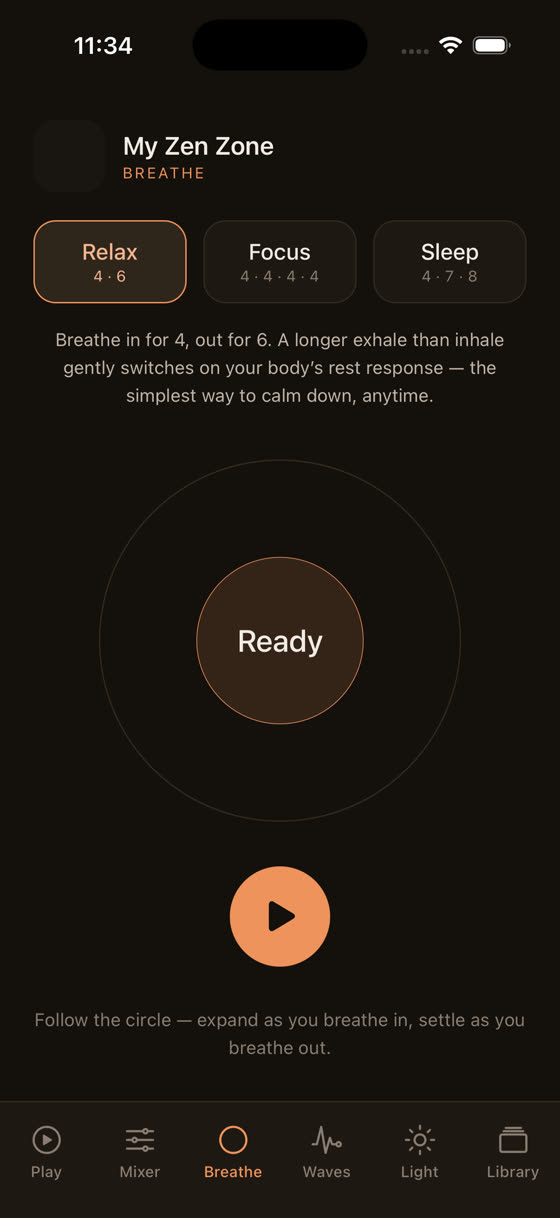
The breathing screen in the app runs that pattern visually, which removes the need to count in your head while also trying to relax, something that sounds simple and is actually a small source of friction in a lot of guided meditations. Pair that with offline downloads and there's no buffering, no ad, and no autoplay queue waiting at the end to undo the whole thing.
What To Actually Do Tonight
If you've been relying on YouTube for guided meditation, keep doing it for the discovery, there's genuinely good free material out there, but add one safeguard before bed: a hard stop. Set a timer, pick a session length you'll actually finish, and don't leave the device on a platform that's designed to keep recommending once you're gone. New music gets added to the library every two weeks here, so if a track stops working for you after a month of nightly use, which does happen, there's always something newer to replace it rather than starting over on YouTube's search page. You can see the whole shape of the library, sleep, focus, meditation, and calm as their own separate spaces, at myzenzone.app, or go straight to get the app and try the mixer on tonight's session.
Common questions
Is guided meditation on YouTube actually effective?
The content can be genuinely good, pacing and voice quality vary a lot by creator. The bigger issue is the platform: ads breaking up a session, screen light staying on, and autoplay queuing unrelated content once it ends. The meditation itself isn't the weak point, the delivery around it often is.
Why do I wake up to something completely different after falling asleep to a YouTube meditation?
That's autoplay. Once your chosen video ends, YouTube's algorithm selects what plays next based on predicted watch time, not on what would actually continue a sleep session. It has no way of knowing you're asleep, so it keeps playing, often something with a different tempo or volume entirely.
What's the difference between guided meditation and ambient sleep music?
Guided meditation uses spoken instruction to direct attention or breathing, usually for a fixed length. Ambient sleep music has no voice and is meant to run longer, sometimes all night, without requiring you to follow anything. Many people use both: a short guided session to wind down, then music alone to actually sleep.
Can I use the same guided meditation for sleep and for daytime focus?
You can, but it usually won't fit well. Sleep scripts slow down and quiet toward the end, ending in near-silence. Focus sessions tend to be shorter and end with a clear cue back into the task. Using a sleep script at your desk often feels slightly wrong-paced even if the reason isn't obvious.