A six-year-old made to sit through a twenty-minute guided meditation, eyes darting round the room, thumb picking at the duvet, is not calming down. He is enduring it. The best meditation app for kids is not the one with the biggest back catalogue of cartoon mascots or bedtime stories. It's the one that lets you shorten a session to three minutes, turn the narrator's voice down under the music instead of off entirely, and change the whole approach tomorrow night when tonight's choice stops working. That flexibility matters more than any single "kids" feature, because what calms a child at five rarely calms the same child at eight, and what works on a Tuesday can fall flat on a Wednesday.
What Actually Calms a Child, Not Just Occupies Them
There's a difference between occupying a child's attention and lowering their actual state of arousal, and a lot of apps confuse the two. A busy story with a talking fox keeps a child listening, but it doesn't necessarily slow their breathing or heart rate. What tends to do that is external pacing: a voice, a rhythm, a piece of music moving more slowly than the child's current state, which the nervous system gradually falls in step with. A resting heart rate in a young child is higher than an adult's, often 70 to 100 beats a minute depending on age, so the target isn't the same 60 bpm you'd use for a tired adult. But the principle holds: something around 60 to 70 bpm played consistently, without sudden jumps in volume or tempo, gives an agitated child something steadier to match than their own internal noise.
Where Most "Kids Meditation" Apps Get It Wrong
Most of them are built around fixed-length stories that can't be shortened, which is a problem when your actual window before a meltdown or a missed bedtime is closer to four minutes than fifteen. The mascot format wears thin fast, too. A child latches on to a character for a few weeks and then wants nothing to do with them, and the app has no answer beyond a new season of the same format. Voice and music are usually glued together at one fixed level, so if the narration grates on a particular night, you lose the music as well. Offline playback is often missing, which matters more than it sounds when the actual use case is a car journey or a flight with no signal.
The One Control That Actually Changes the Outcome
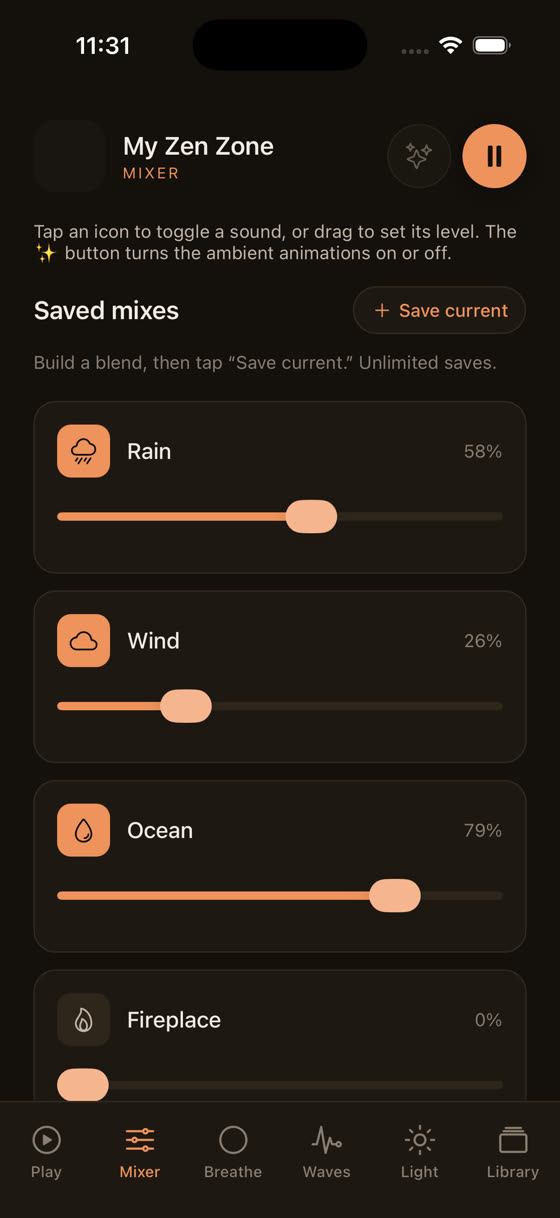
The single feature that makes the most practical difference isn't a story or a voice. It's being able to move the voice, the music and any background sound independently, so you can build the session around the specific child in front of you rather than the one the app assumed. Some nights a child wants direction and the voice needs to sit forward. Other nights the voice itself is the irritant and what actually settles them is just the music and a low layer of rain, with the narration turned almost to nothing.
My Zen Zone's guided sessions work this way by design: Voice, Music and any nature sound each have their own level, so the narration plays over the music rather than replacing it, and you can rebalance it live rather than committing to whatever mix the app decided for you.
Matching the Session to the Actual Moment
A bedtime wind-down needs something different from a pre-exam panic, and treating them the same is where a lot of "one meditation fits all" apps fall down. For the last twenty minutes before lights out, low tempo instrumental music with the room dimmed does more work than a narrated story, and there's more on the mechanics of that in our piece on music for sleep. For a child stuck on homework and getting frustrated, a steady instrumental track without lyrics or a narrator tends to hold attention better than anything with words competing for the same channel; we cover the reasoning in music for focus and study. For an actual meltdown or a panicky morning before school, a visual breathing pattern gives a child something to follow with their eyes as well as their ears, which helps when words alone aren't landing.
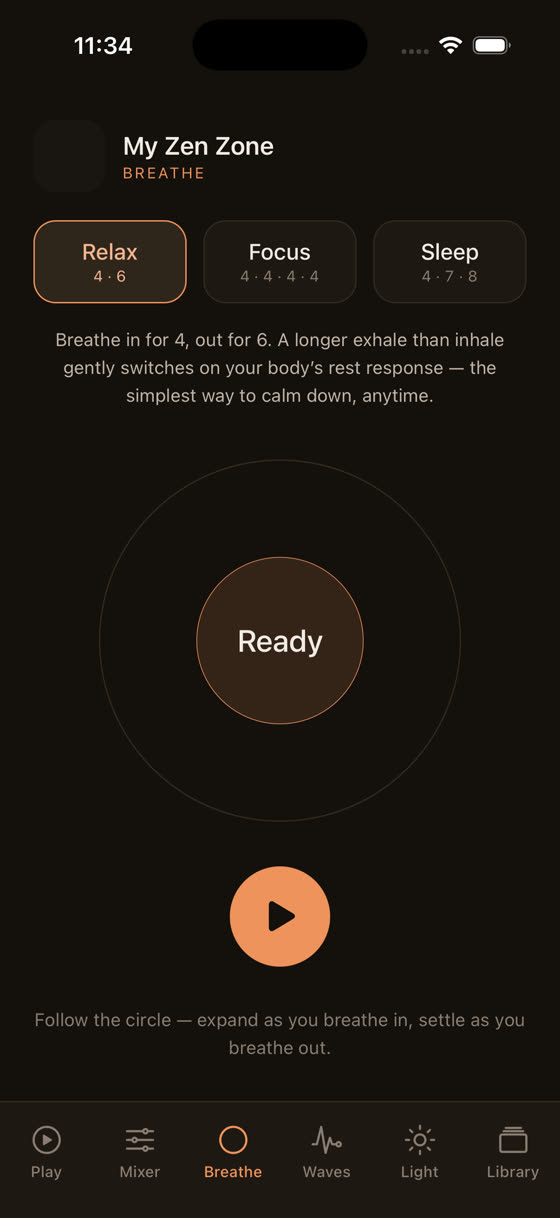
The 4-6 pattern, breathe in for four, out for six, is simple enough for a young child to copy along with the shape on screen, and the longer exhale is doing the actual physiological work.
The Sound Itself: Tempo, Instruments, What to Avoid
Real instruments, recorded rather than generic synth pads, tend to hold a child's attention without over-stimulating it, largely because they have the small imperfections a synth loop doesn't. The bigger thing to watch for is dynamic surprises: a sudden cymbal swell or a dramatic key change designed to hold an adult listener's interest can startle a child who was just starting to settle. The same goes for layered nature sound that includes unpredictable elements like sharp bird calls or distant thunder. Rain, and low, continuous ocean or wind, tend to sit underneath music without pulling focus, which is worth knowing if you're building your own mix rather than using a preset.
Building a Routine a Child Will Actually Keep
Consistency matters more than finding the perfect track. A child who hears the same category, the same rough shape of session, at the same point in the evening, starts to associate the routine itself with winding down, independent of which specific piece is playing.
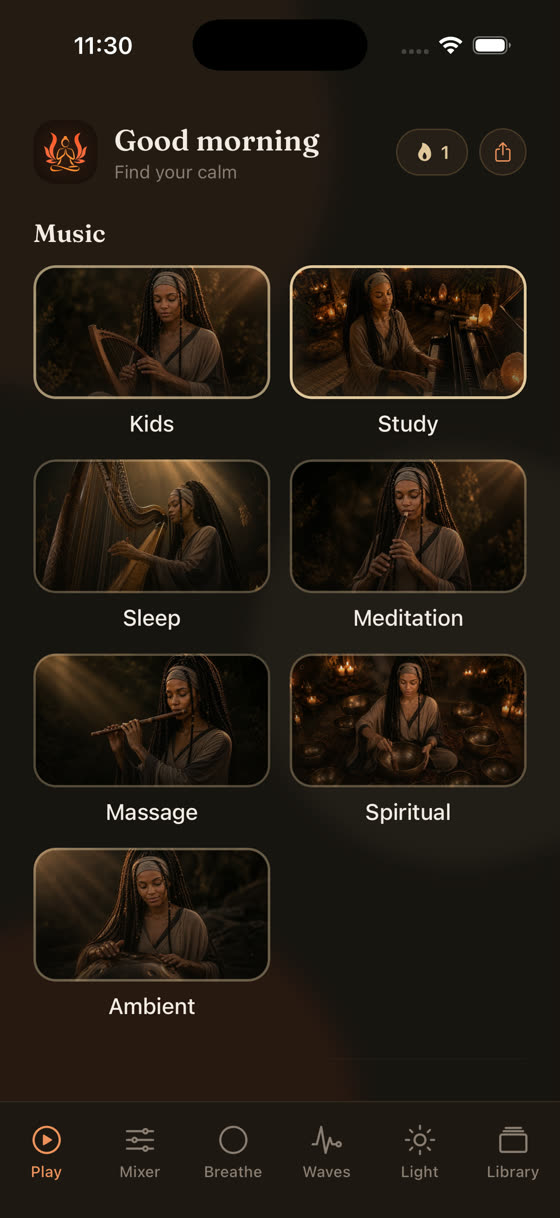
Letting an older child pick their own balance of voice, music and nature sound, rather than handing them a finished mix, tends to get more buy-in than any amount of parental insistence that this particular track is the calming one. Ownership of the choice does some of the work that the content itself can't.
What the Evidence Actually Says
It's worth being straightforward here: research specifically on meditation apps and children is thin, and where studies exist on breathing exercises or mindfulness for anxiety in kids, results are mixed and hard to generalise from one child to the next. We don't make clinical claims and nothing here is a substitute for advice from a paediatrician or child psychologist if a child's anxiety or sleep is a persistent problem rather than an occasional one. What we're describing is a tool for building a calmer routine, not a treatment.
How My Zen Zone Fits Into This
We didn't build My Zen Zone as a kids' app with mascots and merchandise, and we're not going to pretend it is one. What it is: a large, growing library of original music, composed and recorded by one musician rather than licensed in bulk, with the mixer and layering controls described above, offline downloads for car journeys and flights with no signal, and new tracks added every fortnight so a child who latches onto something doesn't run out of it in a month. A subscription also opens the full library in a browser, useful if the family computer is easier to manage at bedtime than a phone. You can see the whole thing at myzenzone.app or go straight to the download and try building a three-minute mix tonight rather than committing to a twenty-minute one.
Common questions
What age can kids start using a meditation app?
There's no fixed age, but most children can follow a simple breathing pattern or a short piece of calming music from around four or five. Younger than that, the music itself, without any narration, tends to work better than a guided session, since following spoken instructions is harder before that age.
Is My Zen Zone designed specifically for children?
No. It's a general relaxation music library built for sleep, focus and calm across all ages, not a dedicated kids' app with characters or stories. Families use it by adjusting session length and the voice-to-music balance to suit a child, rather than relying on content built specifically for them.
How long should a meditation session be for a child?
Shorter than most apps default to. Three to six minutes is realistic for a young child before attention drifts, and it's better to end while they're still settled than to push through a longer session and lose them halfway. Length matters less than doing it consistently at the same point each evening.
Should the voice be louder or quieter than the music for a child?
That depends entirely on the child and the night. Some children need clear direction and want the voice forward; others find narration irritating and settle faster with it turned right down under the music. This is exactly why separate volume control over voice, music and background sound matters more than any fixed preset.
Can background music distract a child instead of calming them?
It can, if the track has sudden dynamic swings, key changes, or unpredictable nature sounds like sharp birdsong or thunder. Steady, low-tempo instrumental music without those surprises tends to sit in the background rather than pulling attention, which is the difference between calming music and merely different noise.