The short answer
If you search Spotify for meditation music right now, the useful results tend to fall into three buckets: slow ambient drone tracks, singing bowl recordings with long decay, and hybrid piano-plus-nature-sound pieces. Search terms like \"Tibetan bowls,\" \"ambient drone,\" or \"deep meditation\" will get you somewhere reasonable. That's the honest answer. The less obvious part is that Spotify's whole model, built around playlists, algorithmic autoplay and ad breaks on the free tier, works against the exact state you're trying to reach when you sit down to meditate.
None of this makes Spotify useless for the purpose. It makes it a decent starting point and a poor long-term tool, especially once you want to combine music with a guided voice, or build a soundscape rather than press play on someone else's playlist.
What actually makes music work for meditation
There's a reason certain tracks feel right and others don't, even when both are labelled \"meditation music.\" It comes down to a few measurable things. Tempo sits low, usually 50 to 70 bpm, close to a resting heart rate, with no strong rhythmic pulse to entrain your attention. There's rarely a clear melodic hook. Tension-and-release patterns, the kind pop and film music use to hold your attention, are exactly what you don't want here, because they keep the mind engaged and waiting for the next event.
Instead, good meditation music sustains. A single drone, a bowed string held for thirty seconds, a bowl struck once and left to decay naturally. The instrumentation matters less than the absence of forward motion. Once you know this, you can judge any track in ten seconds: does it want to go somewhere, or is it content to just sit there with you.
Where Spotify's structure works against you
Three specific things get in the way. First, ads on the free tier, which land at the worst possible moment, usually eight or nine minutes into a sit when you've actually settled. Second, autoplay: once your chosen playlist ends, Spotify picks the next thing based on what's popular with other listeners, not on what you were doing, and it can hand you something with a beat or a vocal that yanks you straight out of the state you built. Third, and this is the one most reviews skip, there's no way to run a spoken guided meditation underneath your own chosen instrumental track without stopping the music entirely. You get the voice, then silence, then you have to manually restart the music. It's a small thing that breaks a session more than it should.
A library built by one person, not an algorithm
My Zen Zone takes a different approach to the same problem. All of the music, hundreds of tracks and growing, is composed and recorded by a single musician, not licensed in bulk or assembled from stock libraries. That matters for meditation specifically because it means a consistent sense of tempo, key and restraint across the whole catalogue, rather than the tonal whiplash you get scrolling between playlists made by different artists with different intentions. New tracks are added every two weeks, so the library keeps growing without losing that single point of view.
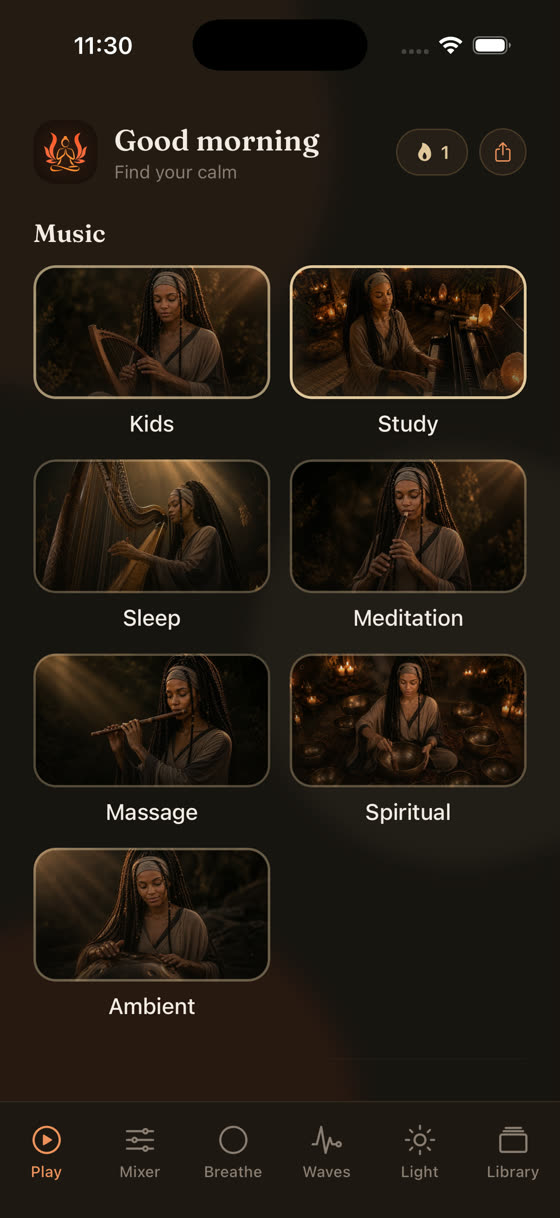
Each category, sleep, focus, meditation, calm, sits as its own space rather than one long undifferentiated scroll, which makes it easier to find something built for stillness rather than for background productivity or falling asleep, which are related but not identical goals. If you're choosing between the two, our piece on music built for sleep versus meditation is worth a look, since the tempo and structure differ more than people expect.
Building your own layer instead of picking a playlist
The bigger structural difference is the mixer. Instead of picking one finished track and hoping it holds up for twenty minutes, you can set rain at a low level, a drone underneath it, and a bowl overtone sitting just above both, each on its own independent slider.
Watching the levels move in real time makes it obvious why this matters more than it sounds. A track that felt slightly too busy at full volume can drop into the background at 30% while the rain sound takes the foreground, and the whole thing stops feeling like \"music playing\" and starts feeling like an environment you're sitting inside. That's a genuinely different experience to hitting play on a Spotify playlist and adjusting nothing but overall volume.
Guided meditation that doesn't stop the music
This is the feature most people don't realise is missing until they've used it. On Spotify, and on most meditation apps, a guided session is one audio file: voice and a bed of music baked together, fixed, unchangeable. If the voice is too quiet or the music too loud, you live with it.
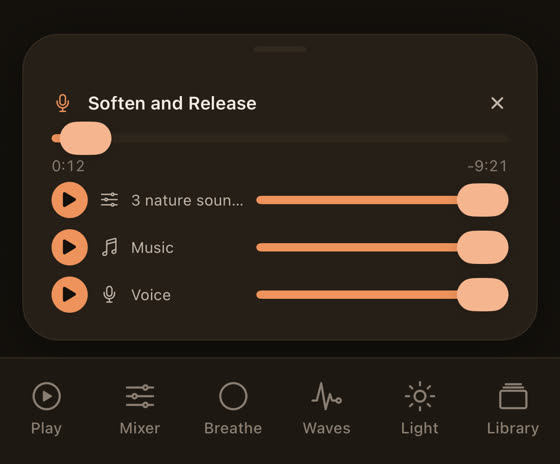
Here, a guided session is three separate layers, Voice, Music and nature sound, each with its own level and its own play button. Turn the music down and let the voice carry more weight during a body scan, then bring it back up for the silence between prompts. The music never has to stop and restart just because someone's talking over it.
What to actually do tonight
If you're choosing a track cold, favour drone and bowl over anything with a discernible melody line. Set a timer rather than relying on a track ending naturally, since a fixed length gives your session a clear edge rather than a slow fade into autoplay. Download whatever you use most often for offline listening, so a dropped connection mid-session isn't the thing that pulls you out of it. And if part of your practice is a breathing pattern before you settle, a visual pacer removes the guesswork of counting in your head.
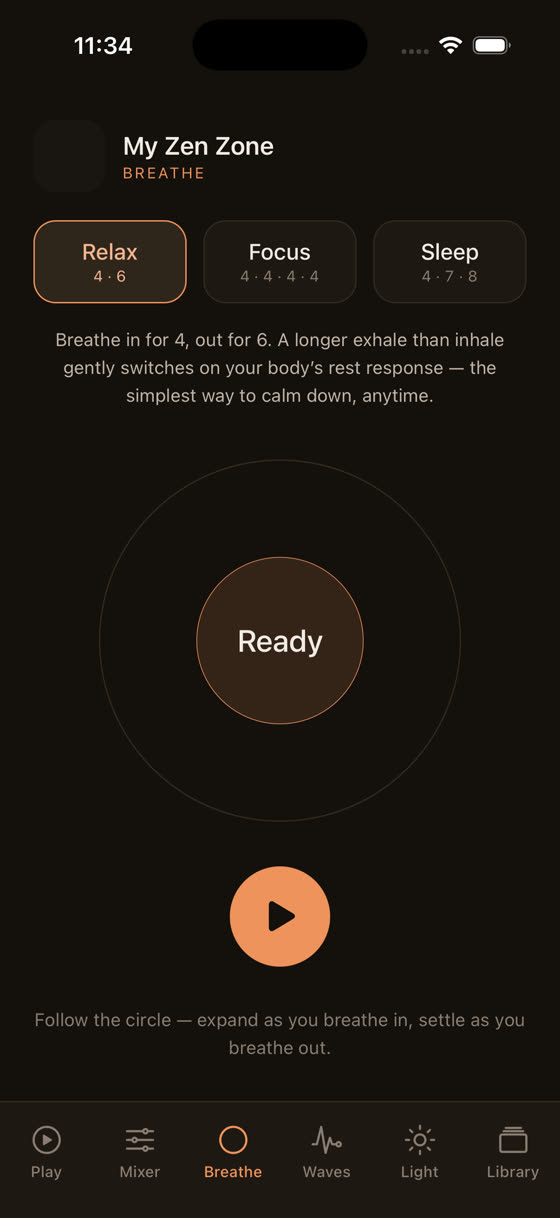
A 4-6 pattern, four counts in, six counts out, is a reasonable starting point for winding down before meditation proper begins, and having it on screen means you're not splitting attention between counting and settling.
Where the evidence actually stands
It's worth being straightforward here: the research on music and meditation outcomes is thin and mixed. There isn't strong evidence that any specific tempo or instrument produces a particular measurable effect, and we won't claim otherwise. What we can say, based on how people actually describe their own sessions, is that music without lyrics, without a strong beat, and without abrupt changes tends to get out of the way rather than compete for attention. That's a modest claim, not a medical one, and it's the honest basis for everything above.
If focus rather than stillness is today's actual goal, the considerations are different again, and what works for focus and study covers where that overlaps and where it doesn't. Either way, the full mixer, guided layers and growing library are available through the app, or explore the catalogue first at myzenzone.app.
Common questions
Is Spotify Premium worth it just for meditation music?
If meditation is the only reason, probably not on its own. Premium removes ads and autoplay interruptions, which fixes the worst issue, but you still won't get per-layer mixing or guided voice sitting over your own chosen track. It's a reasonable free-tier starting point rather than a purpose-built tool.
What tempo is best for meditation music?
Roughly 50 to 70 bpm, close to a resting heart rate, works well for most people, though there's no strict rule. What matters more than the exact number is the absence of a strong rhythmic pulse or melodic build, since those tend to hold attention rather than let it settle.
Can I use nature sounds instead of music for meditation?
Yes, and plenty of people prefer it. Rain, wind and water lack the melodic structure that can distract, though some find total silence-adjacent sound harder to settle into than a low drone. Layering both at low levels, rather than choosing one, is worth trying before deciding.
Does guided meditation work better with or without background music?
It's genuinely personal. Some people find music underneath a guided voice softens the silences between prompts; others find it competes for attention. Being able to adjust the music level independently of the voice, rather than accepting a fixed mix, is the only way to actually find out which one suits you.