Two different questions are hiding in this search
If you typed "best music learning app for beginners" hoping to learn piano, guitar, or how to read a stave, My Zen Zone is not that. There are apps built specifically for finger placement, chord shapes, and ear training, and if that is your goal, look for one of those instead. I'd rather tell you that in the first line than waste your time.
But a lot of people land on this exact phrase meaning something quieter: they want to learn how to use music, not how to play it. They know background sound helps them sleep, or work, or calm down before a meeting, but they've never worked out how to do it properly. They put on a random "chill" playlist, get an advert or a vocal track thirty seconds later, and give up. That's the beginner problem worth solving, and it's the one this post actually answers.
What a beginner needs to learn about using music, not making it
Using music intentionally is a small skill, and almost nobody teaches it. It comes down to three things: picking the right tempo for the state you want, choosing instrumentation that won't hijack your attention, and controlling volume and layering so the sound sits in the background instead of the foreground. None of this requires musical training. It requires a library built for the purpose and a bit of patience the first few times.
Most people's only reference point is a commercial playlist app, where tracks were written for listening, not for working or sleeping. A song built around a hook and a vocal is designed to pull your attention toward it. That's the opposite of what you want at 11pm or at your desk during a deadline.
The mistake almost every beginner makes
The most common error is treating all "relaxing music" as one category. Sleep music, focus music, and meditation music are not interchangeable, even though they sound similar to an untrained ear. Music that helps you drift off is usually slow, repetitive, and low in dynamic range, so your brain stops waiting for something to happen. Music that helps you concentrate needs enough structure to feel alive without asking for your attention. A beginner who plays the wrong one for the wrong task usually blames the music, when really they picked the wrong tool for the job.
The second mistake is volume. New listeners tend to play everything at one flat level, sound and voice and nature noise all fighting for space. A rain track at the same volume as a spoken meditation will drown it out, or vice versa. Once you understand that each layer needs its own level, the whole experience changes.
The mechanics worth understanding before you press play
Tempo matters more than genre. Music built around 60 to 70 beats per minute, close to a resting heart rate, tends to work well for winding down, which is why so much of our sleep music sits in that range. Focus music usually runs a little faster, 70 to 90 bpm, enough momentum to keep your mind from wandering without pulling it toward the music itself.
Instrumentation matters just as much. Lyrics are the biggest culprit in broken concentration, because language processing competes directly with whatever you're reading or writing. That's why most tracks built for study and focus avoid vocals almost entirely, leaning on piano, soft synth pads, or slow strings instead. For sleep, even simpler works better: long sustained tones, minimal melody, nothing that resolves into a hook your brain wants to follow.
Learning to layer sound instead of just pressing play
This is the part most apps skip, and it's the single biggest thing a beginner can learn. Real environments are layered. A quiet room still has traffic hum, a fan, distant voices. Recreating that with a single flat music track never feels quite right, which is why we built a mixer instead of a playlist.
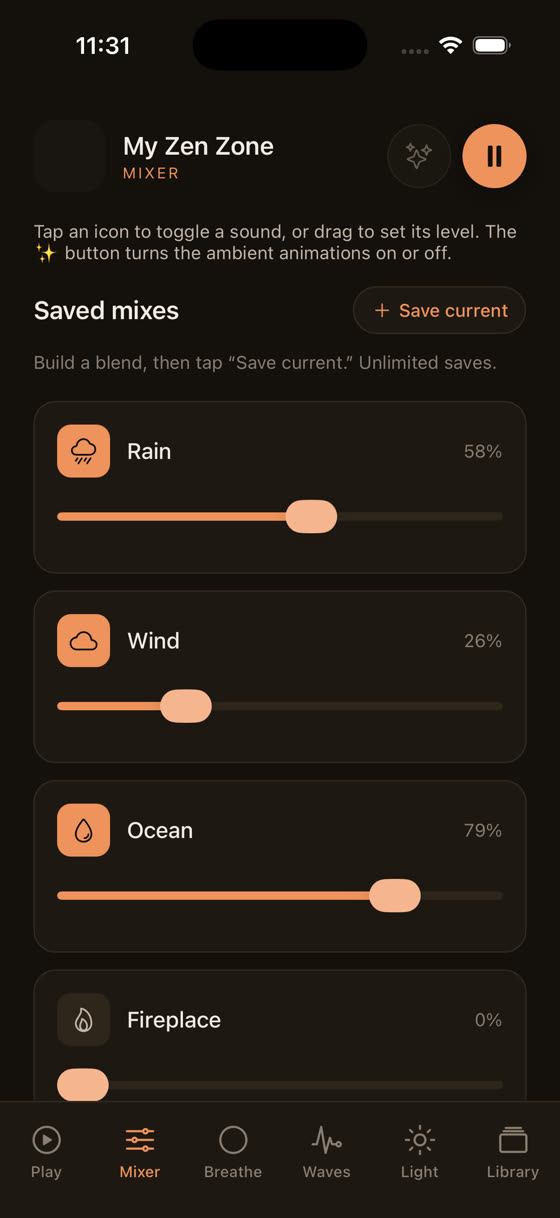
Here you can bring in rain, ocean, and the music track together, each on its own slider, and find the balance that actually works for your room tonight rather than accepting a fixed mix someone else chose. Watching the levels move is the fastest way to understand why this matters.
The same idea applies to guided sessions. Most meditation apps stop the music entirely when a voice comes in, which feels abrupt and undoes the calm you'd just built. Ours doesn't. The voice sits as its own layer over the music and any nature sound, so you can lower the narration and let the music carry on, or bring the voice forward when you need the guidance more.
Where this fits into an actual day
A beginner doesn't need a complicated routine, just a consistent one. Mornings or mid-afternoon slumps are where focus music earns its place, something steady enough to sit under two hours of work without becoming wallpaper you forget or a distraction you can't ignore. In the evening, the goal flips: less structure, lower volume, longer fade times.
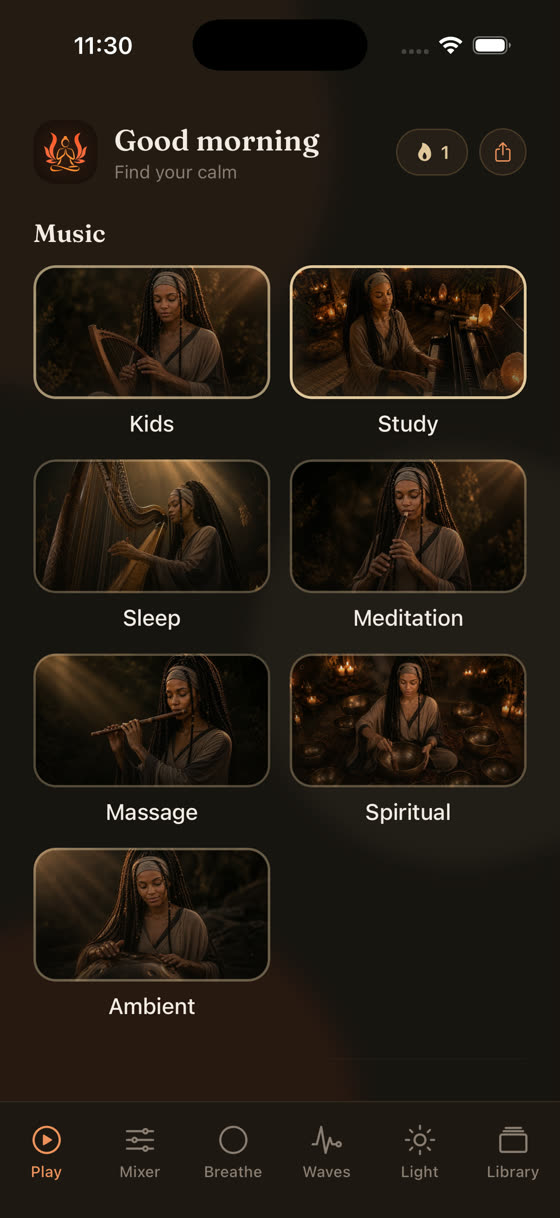
The home screen splits sleep, focus, meditation, and calm into their own separate spaces, partly because switching between them mid-session breaks the mood you've built, and partly because a beginner shouldn't have to hunt through one giant undifferentiated list to find the right thing for right now.
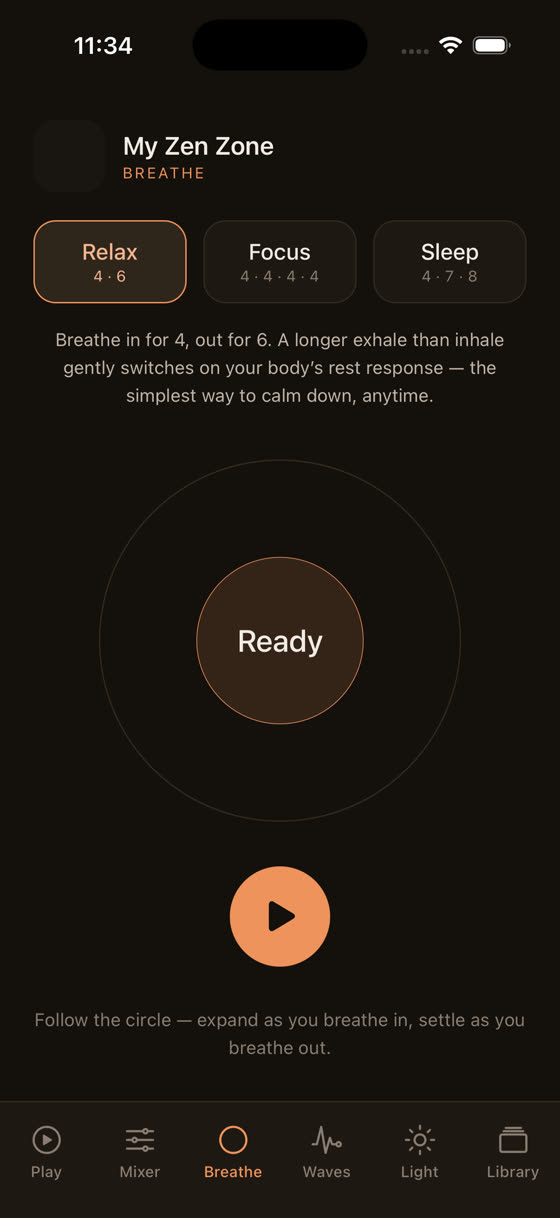
For winding down specifically, pairing music with a dimming light screen and a slow breathing pattern gives your body two additional cues that it's time to slow down, not just your ears.
What to actually do tonight
Don't try to build a perfect routine on day one. Pick one situation, tonight's sleep or tomorrow's first work block, and just test the mixer for five minutes. Bring in one nature sound, add one music track underneath, and adjust the levels until you stop noticing them as separate things. That's the point where it's working.
Because the library adds new music every two weeks, all composed and recorded by one person rather than pulled from a stock catalogue, it's also worth revisiting tracks you dismissed early on. Ears adjust. What felt too sparse in week one often feels exactly right by week three, once you've learned what you're actually listening for.
If any of this sounds useful, the full library, including the mixer, guided layered sessions, and offline downloads, is available through the app, or you can browse the whole thing first at myzenzone.app before deciding.
Common questions
Is there an app that actually teaches you to play music, not just listen to it?
Yes, but that's a different category entirely, usually built around instrument tutorials, chord recognition, or ear training. My Zen Zone is a listening tool, built for sleep, focus, meditation, and calm, not for learning an instrument. If you want the latter, look specifically for apps marketed as instrument or music theory trainers.
How long does it take to notice a difference from using background music this way?
Most people notice something within the first few sessions, mainly because they've finally matched the right tempo and mix to the right task. Building it into a genuine habit, where your brain associates a particular sound with settling down or focusing, tends to take a couple of weeks of reasonably consistent use.
Do I need headphones for this to work?
No. A phone speaker or a small room speaker works fine for background layering, and for sleep it's often better than headphones, which can feel intrusive overnight. Headphones help more for focus work in noisy environments, where you're trying to mask distraction rather than just add ambience.
What if I don't like any of the tracks in a category?
That's worth listening for specifically, since taste in ambient and relaxation music varies more than people expect. The library grows every two weeks with new material from the same composer, so it's worth checking back rather than assuming the whole category isn't for you after one or two tracks.