The short answer
The music that helps most with anxiety is instrumental, sits around 60-80 beats per minute, and stays consistent for the whole listen rather than shifting mood or genre every few tracks. Lyrics pull your attention into language processing, which is the opposite of what you want when your mind is already racing. A lot of Spotify's anxiety playlists get the genre right and the details wrong: they mix tempos, insert ads mid-track, and hand the next song to an algorithm that has no idea you were finally starting to settle.
Why tempo matters more than genre
Your heart rate responds to the pace of what you're hearing, a mild version of a real physiological effect called entrainment. A track built around a resting heart rate, roughly 60 to 70 bpm, gives your body something slower to match instead of fighting the pace your nervous system is already running at. This is why a pretty acoustic guitar piece can still feel wrong for anxiety if it's built on a faster, syncopated rhythm, and why a plain sustained synth pad at 55 bpm can do more for you than something objectively more sophisticated.
Instrumentation matters too, though less than tempo. Piano and soft strings tend to work because they have long, predictable decay. A drum kit or anything percussive with sharp transients keeps your attention alert in a way that undercuts the calming effect, even at a slow tempo. This is worth knowing because a lot of playlists labelled "calm" are really just quiet pop, acoustic covers with the same rhythmic structure as the original.
Where curated playlists fall short
Three things break the effect on most streaming playlists. First, ads, which arrive without warning and are louder and faster than anything around them, a small jolt exactly when you don't want one. Second, inconsistency: a 40-track playlist someone built two years ago will drift across genres, tempos and even quality of recording, because it was assembled once and never revisited with anxiety specifically in mind. Third, no control. You get the whole mix as the composer or curator made it, at one volume, with no way to bring a layer up or down to suit tonight rather than the average night.
Building the sound around what you actually need
The fix isn't a better playlist, it's control. A single piece of music with a rain layer underneath sounds completely different from the same piece with a low drone underneath instead, and different again with both barely audible and your own breathing doing most of the work. Most apps give you one fixed file. We built ours around a mixer, so you can bring a rain layer up, drop the music down, and find the exact balance that works for your ears tonight rather than accepting someone else's average.
That clip shows three layers moving independently while the track keeps playing. It's a small thing to see in a screen recording and a genuinely different experience to sit with for twenty minutes, because anxiety rarely wants exactly the same sound two nights running.
When the anxiety is thoughts, not just tension
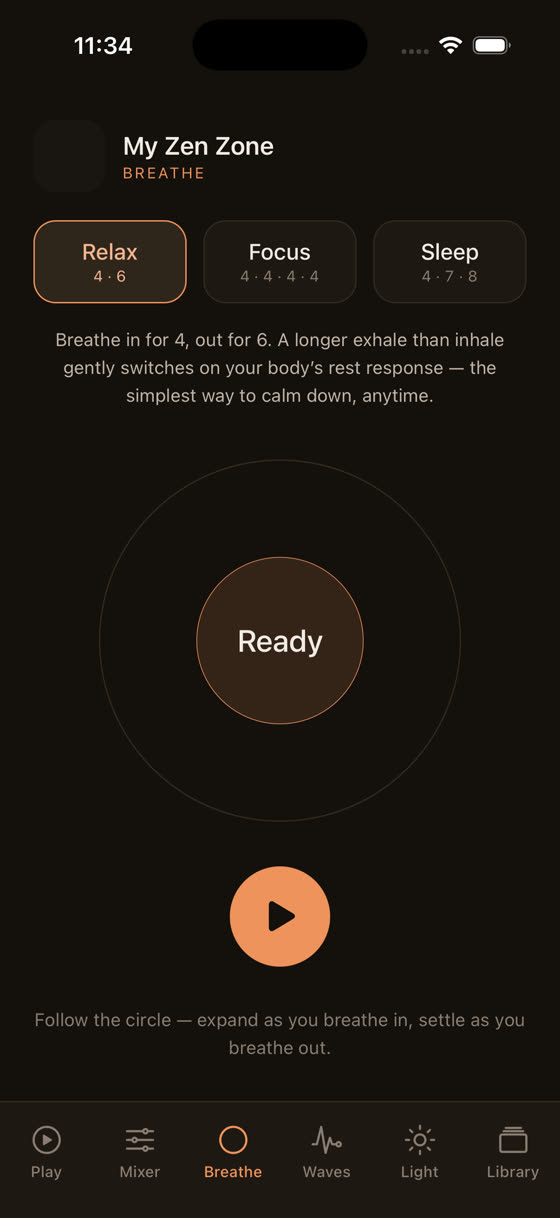
Music alone doesn't always reach racing thoughts. Sometimes what actually helps is something to do with your attention, not just something to listen to. A short breathing pattern, in for four counts and out for six, does more for that specific flavour of anxiety than any track will, because it gives your attention a job instead of a target to avoid. We built a breathing screen with a 4-6 pattern for exactly this, something to follow with your eyes while the exhale runs slightly longer than the inhale, which is the part that actually nudges your nervous system down a gear.
Guided sessions can help too, but only if they don't stop the music to talk at you, which is what most apps do. Ours plays the voice as a separate layer over the music rather than instead of it, so you can bring the guidance down to almost nothing once you've settled and let the music carry on without a jarring switch back to silence or an ad.
Morning anxiety and nighttime anxiety are not the same problem
Anxiety before a meeting and anxiety at 1am are different jobs and want different music. Daytime anxiety, the kind that shows up before something specific, usually responds better to something with light structure and low arousal rather than total stillness, close to what you'd want for concentration; our piece on music for focus and study covers tempo choices that work here too. Nighttime anxiety, the kind that keeps you turning tasks over in bed, wants the opposite: minimal structure, no build, nothing that resolves or changes, which is most of what we cover in our piece on music for sleep. Using the same track for both is one of the more common mistakes people make, then wondering why it half-works.
What to actually try tonight
Pick one piece of instrumental music, ideally under 70 bpm, and commit to it for the full session rather than skipping after thirty seconds because it doesn't feel dramatic enough. Anxiety wants novelty and stimulation; the fix is often the opposite of what your attention is asking for. Turn any lyric-based music off entirely for this specific purpose, even music you love, because the part of your brain that processes words is the part you're trying to quiet.
- Set a device to airplane mode or use offline downloads so no notification or ad interrupts the fifteen minutes you've set aside.
- Bring in one nature layer, rain or a low drone, at a level quiet enough that you'd only notice it if it stopped.
- If your thoughts won't settle with music alone, switch to a short breathing pattern before returning to the track.
- Use a sleep timer if this is happening at night, so the music fades rather than looping past the point where you've actually fallen asleep.
Being honest about what music can and can't do
The evidence for music reducing anxiety in the moment is reasonably solid for short-term, subjective calm; it's much thinner for anything longer-term or clinical, and we won't claim otherwise. Music is a tool for the twenty minutes you're using it, not a treatment. If anxiety is frequent, severe, or interfering with sleep and work on a regular basis, that's worth raising with a GP or therapist rather than solving with a playlist, however good the playlist is.
What we do differently
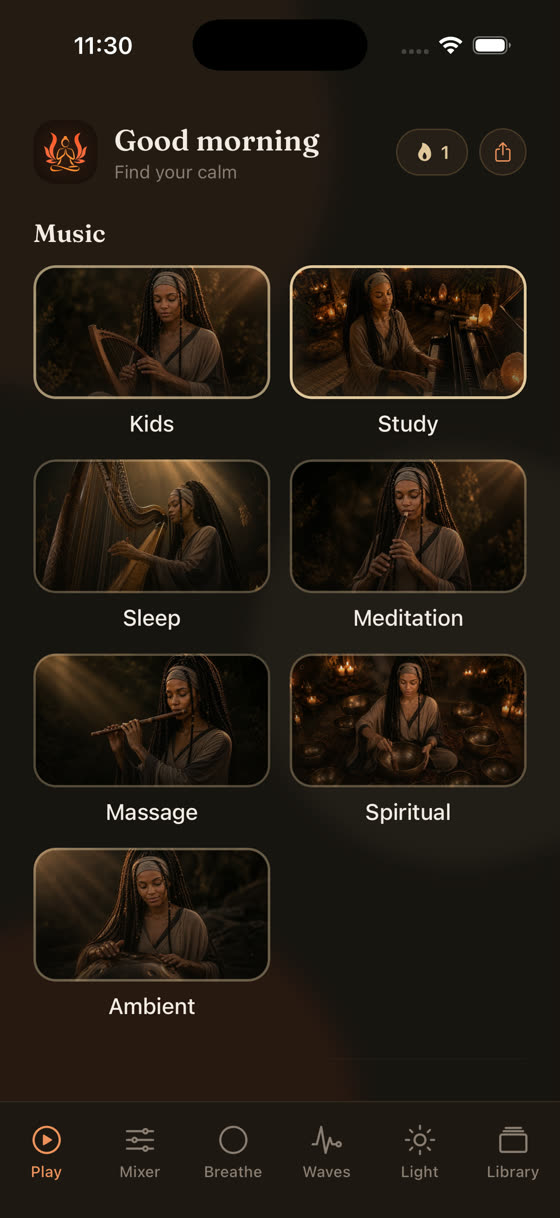
Every track in the library is composed and recorded by one musician, so the tempo and instrumentation stay genuinely consistent within a category rather than swinging between contributors the way crowd-curated playlists do. New music arrives every two weeks, no ads ever interrupt a session, and everything can be downloaded for offline listening, which matters more than people expect once you've had a track cut out mid-breath. You can see the shape of the whole library, sleep, focus, meditation and calm each as their own space, on the home screen.
If any of this sounds like what you've been trying to get out of a Spotify playlist without quite managing it, the full library and mixer are available through the app, or you can look through what's there first at myzenzone.app.
Common questions
Is instrumental music better than music with lyrics for anxiety?
For most people, yes, particularly when anxiety involves racing or repetitive thoughts. Lyrics engage language processing, which competes with the part of your brain you're trying to quiet. Instrumental music, especially without sharp percussion, gives your attention less to grab onto and more room to settle.
Can white noise or nature sounds work as well as music for anxiety?
Often better for some people, particularly for tension rather than racing thoughts, because there's no melody to follow or anticipate. A low rain or drone layer under quiet music, adjusted to your own level, tends to outperform either one alone, which is the main reason a mixer is more useful than a fixed track.
How long should I listen to calming music for anxiety to notice anything?
Ten to twenty minutes is a reasonable window to judge whether a track or approach is working, rather than switching after thirty seconds because nothing dramatic has happened. Anxiety easing off is usually a gradual, quiet shift, not a sudden change you'll notice mid-listen.
Does binaural or brainwave music actually help with anxiety?
Evidence here is limited and mostly self-reported rather than clinically established. Some people find low-frequency tones genuinely settling, particularly alongside a slow ambient track; others notice nothing. It's worth trying as one option among several rather than relying on it as a guaranteed fix.