Apple Music's nature sound catalogue is mostly compilation albums — things titled "Rain Sounds for Deep Sleep" or "Thunderstorm, Vol. 4" — uploaded by production libraries and sold like any other record. The rain is fine. The ocean is fine. The problem isn't the recordings, it's the format they're trapped in.
A streaming music app is built to play one track, then suggest another. It isn't built to let a 45-minute rain loop sit quietly under a separate music track while you fall asleep, and it isn't built to fade both out at 2am when a sleep timer runs out. You get a single stream, at a single volume, until autoplay hands you something else you didn't choose.
What's actually in the Apple Music nature sounds catalogue
Search "nature sounds" and you'll mostly find three things: field recording loops (rain, forest, waves), white or brown noise albums, and ambient music that uses nature textures as a backdrop rather than the main event. The loops themselves are often decent quality — some licensed from real location recordings, some synthesised to sound close enough. Loop length varies wildly, from 10-minute tracks clearly meant for a single use to 8-hour "no loop" uploads designed to get you through a full night without a noticeable seam.
That seam is the detail most "best of" lists skip entirely. A 3-minute rain loop that repeats all night has a moment, every 3 minutes, where your brain — half-asleep but still listening — notices the pattern. It's subtle, but it's enough to keep a light sleeper from settling fully. Long, slowly evolving loops avoid this. Short ones, however well recorded, work against the exact thing you bought them for.
The real limitation: you can't mix anything
Even with a perfect rain recording, you're stuck with it alone, or swapping it out entirely for music. You can't run rain at a low level under a slow piano track, or blend ocean waves with a drone pad tuned for sleep. Apple Music plays tracks. It doesn't let you build a sound.
This matters more than it sounds. Most people don't actually want pure rain for three hours — they want rain under something with a bit of melodic movement, pitched low enough not to pull attention. Or they want two nature layers together, waves plus distant thunder, at different volumes, without either one dominating.
That's the gap a dedicated relaxation app closes. In My Zen Zone, every sound sits on its own layer with its own level — rain, music, a low drone, a second nature texture — and you build the mix yourself rather than accepting whatever ratio a producer baked into one file. It sounds like a small difference. In practice it's the whole difference between a track you tolerate and one you actually fall asleep to.
Matching the sound to what you're actually doing
Nature sounds get used for at least three different jobs, and they shouldn't all use the same recording. For sleep, you want something low and unchanging — rain or waves with no sudden dynamic shifts, nothing that spikes in volume and pulls you back toward alertness. For focus, white noise or steady rain works because it masks office chatter without carrying a melody your brain tries to follow; a tune, even a quiet one, competes for attention in a way static noise doesn't. For general calm or a short reset, something with a bit more texture — wind through trees, a stream, birdsong at a distance — gives the mind somewhere gentle to rest without numbing it out entirely.
If you're building a wind-down routine specifically for bed, it's worth reading what actually makes music work for sleep rather than assuming any quiet track will do — tempo, key, and the absence of surprising instrumentation all matter more than genre. And if the use case is concentration rather than sleep, the tempo and structure you want are almost the opposite; music for focus and study covers why repetitive, low-variation tracks outperform anything with a hook.
Volume balance is the detail nobody mentions
Here's a practical mistake: running nature sounds at the same volume as the music underneath. It should almost never be equal. Rain or waves generally want to sit 15-25% below the music level, low enough that you'd struggle to describe the sound if asked, high enough that you'd notice its absence. Too loud and it becomes its own competing layer; too quiet and it's pointless. Getting this balance right by ear, on the fly, for your specific room and your specific night, is something a fixed album simply can't offer — you get whatever ratio was mixed at mastering, forever.
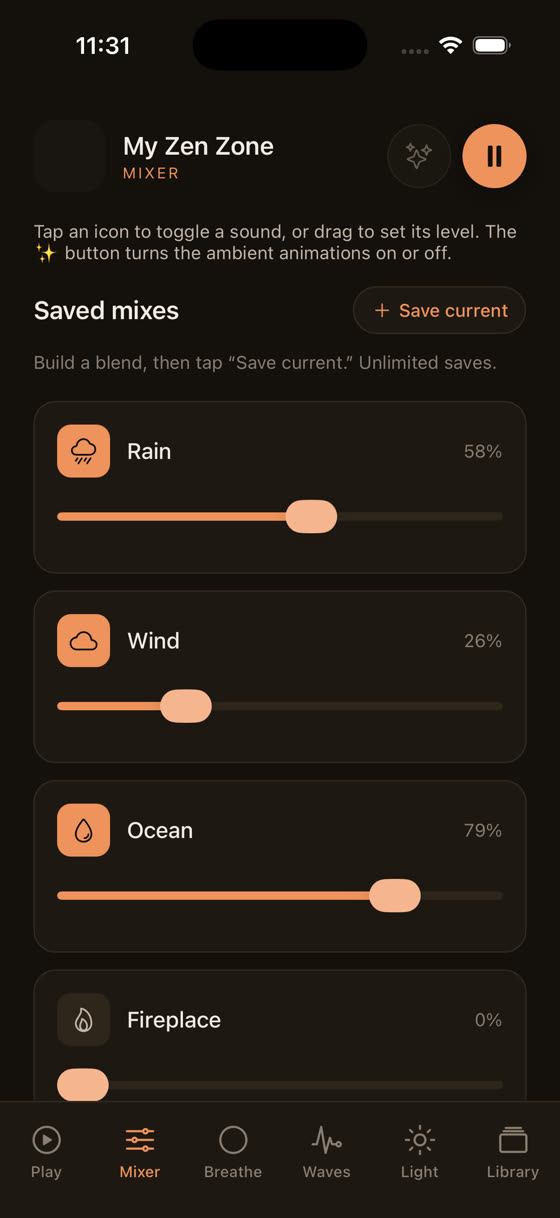
Being able to nudge rain down two notches while music stays where it is, or bring a second nature layer in halfway through, is the kind of control that turns background noise into something closer to a custom composition. It takes about ten seconds to set once you've found a combination you like, and it's saved for next time.
Building a proper night-time routine around it
A loop by itself, however well chosen, is only half of a wind-down. The things around it matter: a timer so the sound actually stops instead of looping until morning, downloads so a bad signal at midnight doesn't cut the rain off mid-night, and some visual signal to your body that it's time to slow down.
The light screen in My Zen Zone is built for that last part — dim, slow-shifting colour with no interface to interact with, paired with whatever sound you've mixed, so there's nothing left to do but lie there. Combine that with a sleep timer set to 45 or 60 minutes and the rain fades out right around when you'd be dropping into deeper sleep anyway, rather than running at full volume until 6am.
Why a fixed catalogue runs out faster than you'd think
One underrated reason streaming nature sounds stop working after a few weeks: habituation. The same rain loop, night after night, becomes wallpaper your brain tunes out — which sounds good until it tunes out a little too well and you're lying awake out of sheer familiarity rather than calm. A library that only has the dozen tracks you already know doesn't solve this.
My Zen Zone adds new material every two weeks, composed and recorded by one in-house musician rather than licensed from a stock library, so the sleep and nature categories keep moving rather than sitting static. You're not stuck rotating the same three rain tracks for a year.
What to actually try tonight
Skip searching "best nature sounds" and picking the top result. Instead, pick a low-level rain or wave track, layer a slow, unchanging piece of music underneath it at roughly a quarter of its volume, set a 45-minute timer, and dim the lights before you start rather than after. That combination — not any single "best" track — is what actually gets people to sleep. You can build and save that exact setup in a few taps through My Zen Zone, or just go straight to get the app and try it against whatever you're currently using.
Common questions
Does Apple Music have a dedicated nature sounds category?
Not really a formal one. You'll find nature sounds scattered across sleep and ambient playlists, plus individual albums uploaded by production libraries. There's no built-in way to browse by sound type, mix two sounds together, or layer a nature track under music without switching away from it entirely.
Is white noise better than rain sounds for sleep?
Neither is universally better; they do different jobs. White noise is flatter and better at masking sudden household or street noise. Rain and waves have more texture and feel more natural to listen to for long stretches. Many people prefer rain for falling asleep and steady white noise for staying asleep through disruption.
Can I download nature sounds for offline use on Apple Music?
Yes, if you have an active subscription, most tracks and albums can be downloaded for offline playback. The limitation isn't offline access, it's flexibility — you still get one fixed track or album at a time, with no way to adjust its internal balance or blend it with a second sound.
How loud should nature sounds be compared to the music?
As a starting point, keep nature sounds 15-25% quieter than the music layer. You want them felt rather than noticed — loud enough to mask silence and sudden noise, quiet enough that you couldn't describe exactly what's playing if someone asked you five minutes in.
Do nature sounds actually help with anxiety or tinnitus?
Many people find steady background sound genuinely calming or useful for masking tinnitus-related ringing, but evidence here is limited and individual response varies a lot. Treat it as one tool among several rather than a guaranteed fix, and don't expect it to replace advice from a doctor or audiologist.