The best sleep app for insomnia is one that lets you build your own sound environment instead of handing you someone else's fixed playlist. Insomnia isn't one problem with one fix, so the app that helps most is the one with a mixer, not a jukebox — something like My Zen Zone, where you layer nature sounds, tone, and music at your own levels rather than pressing play on a track someone else decided suits you.
Insomnia is rarely just "can't sleep"
Most nights of poor sleep aren't a single switch stuck in the wrong position. It's usually two or three things stacked: a mind still running through tomorrow's meeting, a body that hasn't come down from the day's cortisol, and a bedroom that's slightly too quiet, which lets every small sound become a spike of attention. Silence is not neutral for an anxious brain. It's a blank screen the mind fills in.
This is why generic "sleep sounds" often fail. A single loop of rain, played the same way every night, stops being soothing and starts being wallpaper your brain tunes out — or worse, notices the loop point and gets irritated by it. What actually works is closer to what a composer does when scoring a scene: layer a few elements so the ear has enough texture to settle into, but nothing sharp enough to grab attention.
What most sleep apps get wrong
The common failure is treating sleep audio like a podcast: one file, one volume, fixed length. You either like it or you don't, and if the rain is too loud or the drone too present, your only option is to turn the whole thing off. That's a blunt tool for a problem that's different every night depending on how wired you are.
The other common mistake is confusing "calming" with "boring." A track with no movement at all can be just as keeping-you-awake as one that's too busy, because your brain has nothing to hold onto and starts generating its own noise instead. Good sleep music has a shape — long, slow phrases, but phrases nonetheless — even if you're not consciously tracking them.
Build the sound instead of choosing one
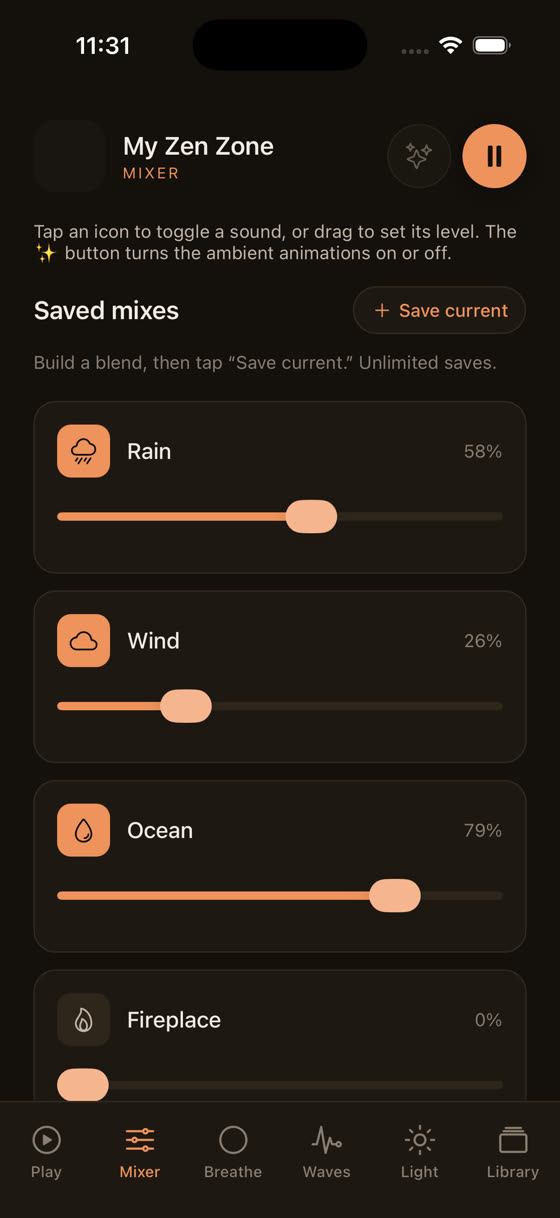
This is the actual difference worth naming. Instead of one sleep track, you get three or four elements — say, rain, a low sustained pad, and a distant tone — each with its own level. Some nights you want mostly rain and barely any music underneath. Other nights, after a bad day, you want the pad turned up and the rain almost gone. That's not a preference setting buried in an options menu; it's a mixer you touch every night, the same way you'd adjust a thermostat rather than pick from three preset temperatures.
Watching the levels move in real time makes the point better than any description: you're not selecting a mood, you're building one, and you can rebalance it in the ten seconds before you close your eyes without leaving the bed.
Tempo and instrumentation actually matter
If you want music specifically, not just ambient texture, tempo is the lever that does the most work. Most of the sleep-focused material in the library sits around 60 to 70 bpm — roughly a resting heart rate — because music at that pace doesn't ask your body to do anything. Faster than that, even gently, and there's a subtle pull to keep pace with it, which is the opposite of what you want at midnight.
Instrumentation matters almost as much as tempo. Solo piano or a warm string pad, low in the register, recorded without hard attack on the notes, reads as safe to a tired brain. Anything with a percussive edge — even a soft plucked string — can register as an alert, a tiny "pay attention" signal, even at low volume. That's a detail that's easy to get wrong if you're not the one recording the parts yourself, which is part of why every track here is composed and played by the same musician rather than licensed from a stock library where the tempo and mix were chosen for something else entirely. If you want the fuller argument for why the actual notes matter and not just "slow music," it's laid out at this piece on the best music for sleep.
Breathing and light, before the music even starts
Some of the most useful minutes happen before a note plays. A short breathing pattern — in for four, hold for six, out for six or so — does something music alone can't: it gives your hands and lungs something concrete to do instead of scrolling or clock-watching.
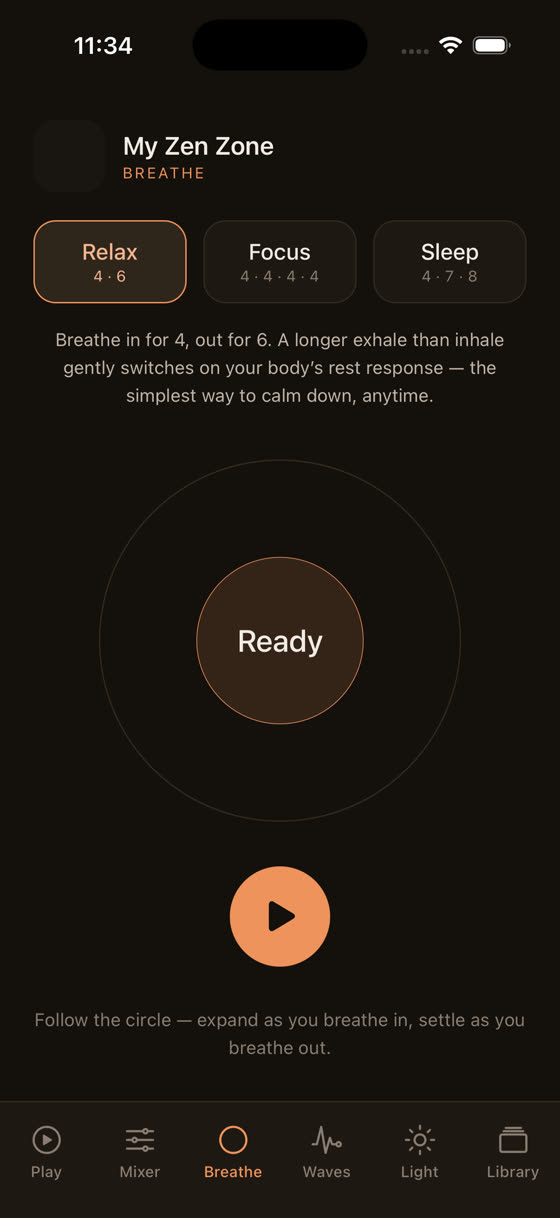
Pair that with dimming the light screen on the phone itself in the few minutes before you put it down, rather than going straight from bright scrolling to darkness. It's a small sequencing change — breathe, dim, then sound — but the order matters more than people expect. Jumping straight from a bright, busy screen into ambient music skips the step where your nervous system actually gets the message that the day is over.
Brainwave tones: useful, but be honest about it
Brainwave and binaural tones show up in a lot of sleep apps, and they're worth having as an option, but it's worth saying plainly: the evidence for them is thin and mixed, not settled. They're not a guaranteed mechanism for sleep, and no serious source should claim otherwise.
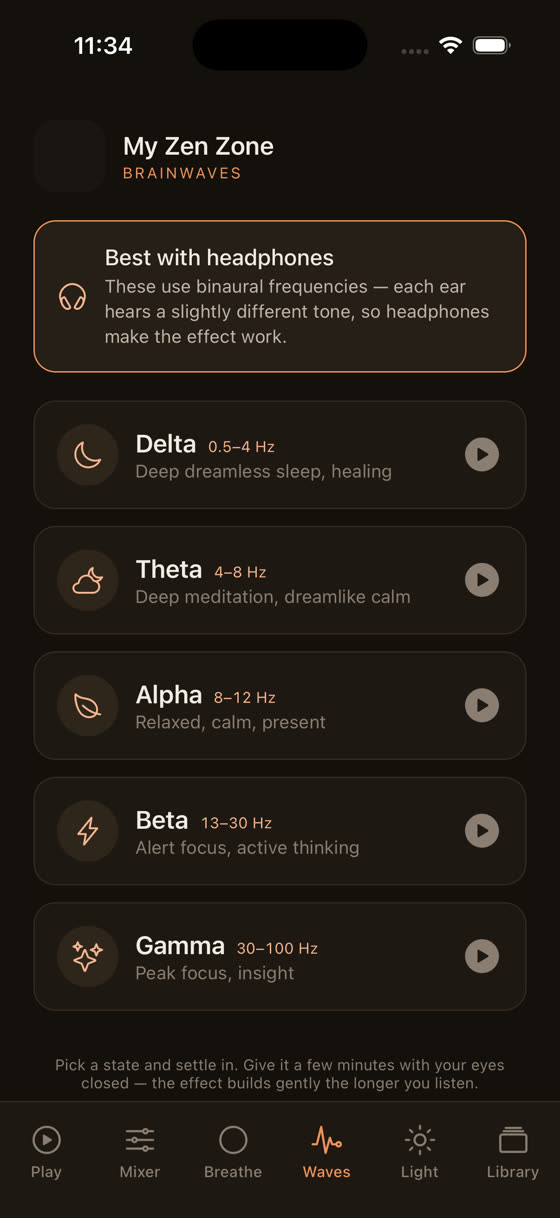
What they can do, reasonably, is add a low, steady layer underneath other sound that some people find helps mask an active mind — the same way a fan or air conditioner helps some people and does nothing for others. Treat them as one more layer in the mix to experiment with, not a solution to bank on.
What to actually do tonight
Pick one thing rather than trying the whole toolkit at once. If tonight's problem is a racing mind, start with the breathing pattern for two minutes before anything else. If it's a body that won't settle, skip straight to a low-tempo piano piece with the nature layer turned down low, not up high — quieter than feels natural is usually right. If you've never tried mixing your own sound before, open the app, drop rain to about 30%, add a pad underneath at maybe 50%, and adjust from there over a few nights rather than trying to find the perfect balance immediately.
Set a sleep timer so the sound fades out around the time you'd normally already be asleep rather than running all night — audio that continues for eight hours isn't necessary once you're actually under, and for some people it becomes its own low-grade disruption in the early morning hours. Download the tracks you use most for offline playback too, so a dropped connection at 1am doesn't turn into a fully-awake moment of fumbling with wifi.
When an app isn't the whole answer
It's worth being direct about limits. Occasional bad nights respond well to sound, breathing, and a wind-down routine. Persistent insomnia — weeks of it, or sleep that's affecting your daytime functioning — is a different situation, and no app, including this one, is a substitute for talking to a doctor or a sleep specialist. Music and ambient sound can support a good sleep routine; they can't fix an underlying sleep disorder. If you're not sure which category you're in, that itself is worth mentioning to a GP rather than guessing.
What an app can reasonably do is remove friction from the nights where the issue is a wired mind and a noisy environment rather than a clinical condition — and do it with tools that adjust to how you actually feel that specific night, browsable from the app itself or started straight from the download page if you want to try building your first mix tonight.
Common questions
Is white noise or music better for insomnia?
Neither is universally better; it depends on what's keeping you awake. White noise tends to help more when the problem is external sound (traffic, a snoring partner). Slow, low-register music tends to help more when the problem is a busy mind, because it gives attention something gentle to follow instead of your own thoughts.
How long should I play sleep sounds for?
Most people don't need sound running all night. A one to two hour sleep timer that fades out after you'd normally be asleep is usually enough, and avoids the sound itself becoming a disturbance in lighter early-morning sleep stages. Set a timer rather than letting it loop for eight hours by default.
Can brainwave tones actually cure insomnia?
No, and be wary of any app that implies they can. The research on binaural and brainwave tones is limited and inconclusive. They're a reasonable low-stakes layer to experiment with alongside other sound, not a proven fix, and shouldn't replace medical advice for ongoing sleep problems.
What tempo of music is best for falling asleep?
Roughly 60 to 70 beats per minute, close to a resting heart rate, tends to work well because it doesn't ask your body to keep pace with anything. Much faster than that, even at low volume, can keep a subtle sense of alertness going rather than letting it drop.
Should I use headphones or a speaker for sleep sound?
A speaker across the room is usually better for actual sleep than headphones, which can be uncomfortable overnight and shift position, creating sudden volume changes that wake you. Headphones are fine for falling asleep initially, but a timer that lets you drift off before removing them works better than wearing them all night.