The Short Answer
The best free white noise app for sleep is not the one with the biggest star rating. It's the one that lets you build a sound instead of pressing play on someone else's. Most white noise apps give you a single looped track: rain, or a fan, or static, repeating every 30 to 90 seconds. That works for maybe a third of people, some nights. For everyone else, a fixed loop either fails to cover the noise that's actually waking them, or the loop itself becomes the thing they notice at 2am. Look for an app with a mixer, a sleep timer, and offline playback before you look at how many five-star reviews it has.
White Noise Isn't the Only Noise
"White noise" gets used loosely to mean any steady background sound, but there are real differences. True white noise has equal energy across all frequencies and sounds like static or a detuned radio. It's harsh in large doses. Pink noise weights the lower frequencies more and sounds closer to steady rainfall. Brown noise goes further still, deeper and rumblier, closer to a distant waterfall or a low fan on a hot night. None of these has been shown to be reliably "best" in controlled research; the evidence here is thin and mixed, and individual response varies a lot. What steady background sound generally does is mask sudden, irregular noises, a car door, a housemate's footsteps, a radiator ticking, so your brain isn't repeatedly startled awake by small changes in the room. Consistency matters more than the exact tone.
What Most Best-Of Lists Get Wrong
Most roundups rank apps by catalogue size or ad-free pricing and stop there. They rarely mention that a single looping track, played at one volume all night, doesn't match how a bedroom actually behaves. Traffic gets louder after last orders. A partner's breathing changes between light sleep and deep sleep. The heating clicks on at 3am. A one-size loop can't respond to any of that, and if you're someone who notices the loop point, the seams in a bad 45-second sample will pull you right out of drowsiness. The fix isn't a longer loop. It's control over more than one sound at once, at levels you set yourself.
The Mixer Changes the Question
Instead of asking "which single sound is best," the more useful question is "what combination covers my room tonight." In My Zen Zone the sleep and calm sections work as a mixer: rain, low drone, distant thunder, a soft tape hiss, each with its own slider, played together rather than as one fixed file.
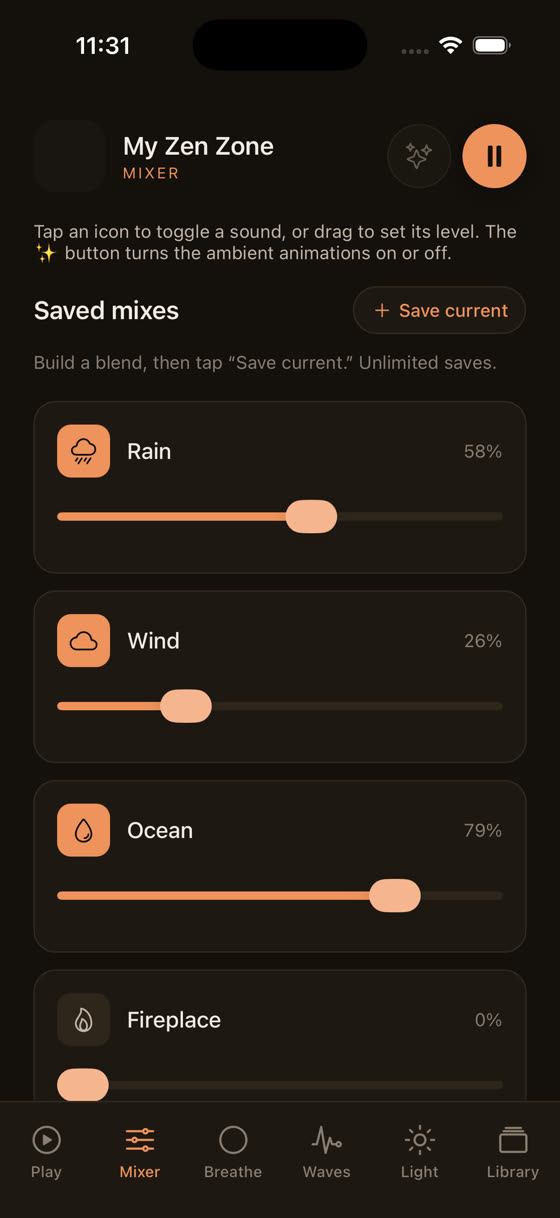
Watching the levels move live is a clearer way to understand this than reading about it.
Turn the rain down and the low drone up if it's the hum of traffic that's the problem. Add a touch of distant thunder if you sleep in a detached house where the main disturbance is your own thoughts rather than outside noise. It takes fifteen seconds to set and then it's yours, not a preset someone else decided suited everyone.
Loudness, Layering, and the 2am Wake-up
A common mistake is setting everything too loud at bedtime because the room feels noisy at 11pm, then waking at 2am when the house has gone quiet and the sound now feels intrusive. Layering solves this better than a single loud track does, because you can keep the masking layer (say, the low drone) fairly steady while lowering everything else, rather than choosing between "too loud" and "off." If you wake in the small hours, a quick adjustment down, rather than reaching to turn the whole thing off, tends to be less disruptive than silence suddenly arriving. A sleep timer that fades out over the last twenty minutes, instead of cutting off sharply, does the same job automatically.
Free vs Paid: What You're Actually Trading
A genuinely free app usually means one of three things: ads that can appear mid-track, a small handful of loops with no ability to combine them, or no offline downloads, which matters the moment your signal drops or you want to leave your phone on airplane mode overnight. None of these are dishonest, but they're worth knowing before you commit to a routine built around an app that might change under you. My Zen Zone's library runs to hundreds of original tracks, all composed and recorded by one musician rather than pulled from a stock library, with new music added every two weeks. A subscription unlocks the full mixer, offline downloads, and the whole catalogue in a browser as well as on iPhone and Android, which is useful if you fall asleep with a laptop open more often than a phone.
Tonight's Actual Routine
If you want something concrete to try tonight rather than tomorrow: dim the lights about thirty minutes before you intend to sleep rather than the moment you get into bed, since the drop in light matters more than the timing of it. The light screen gives you something to look at while you do this, which is oddly more effective than sitting in the dark scrolling.
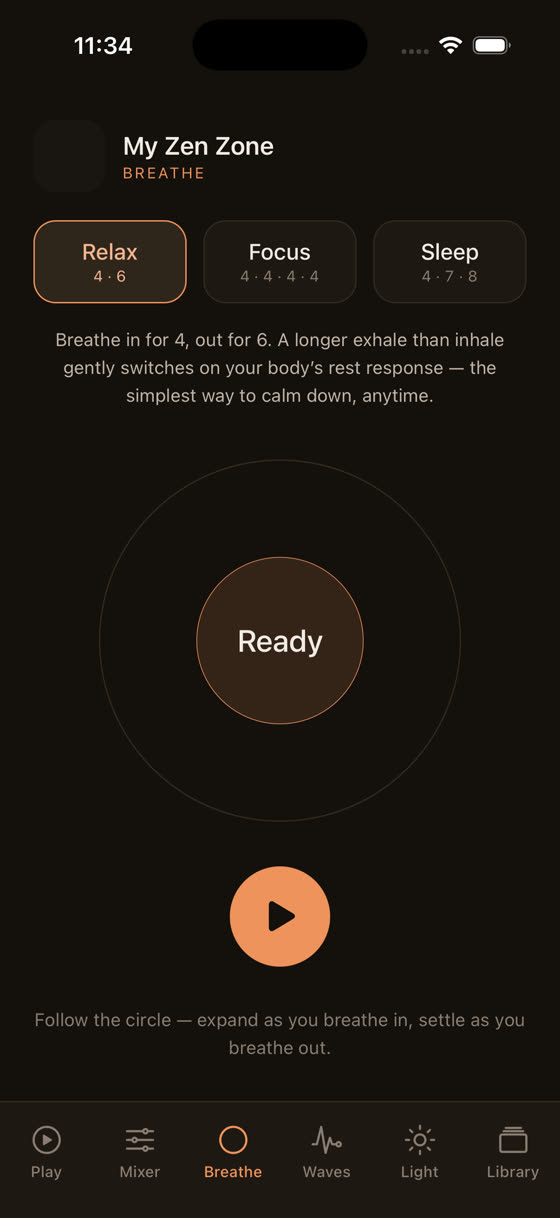
Set your sound layers before you're actually tired, not after, so you're not fiddling with sliders while half asleep. If your mind is still busy rather than your room being noisy, a short breathing pattern before the sound layer, four seconds in, six seconds out, tends to slow things down faster than music alone.
Then set a sleep timer for somewhere between 45 and 90 minutes rather than leaving audio running all night; most people don't need masking sound once they're in deep sleep, only during the drift-off period and light early-morning stages.
Where the Evidence Actually Stands
It's worth being straightforward here: there isn't strong, settled research proving that white noise, pink noise, or any specific frequency profile improves sleep for most people. Some studies find modest benefits for masking disruptive sound in noisy environments, hospitals in particular; others find no meaningful effect, or that responses vary too much person to person to generalise. This isn't a reason to dismiss it, background sound is cheap to try and low-risk, but it's a reason to be sceptical of any app or article that promises guaranteed results. What tends to help more reliably, on the anecdotal but consistent side, is a routine you actually stick with, and something that adapts to your specific room rather than a track that assumes everyone's bedroom sounds the same. For more on how tempo and composition affect wind-down specifically, see our piece on the best music for sleep, and if it's a racing mind rather than an noisy room keeping you up, music for focus and study covers a related but different problem. You can see the full range of what's available at myzenzone.app or go straight to the app if you'd rather try the mixer than keep reading about it.
Common questions
Is white noise actually bad for you if you use it every night?
There's no evidence it's harmful for most adults at reasonable volume. The main caution is keeping levels moderate, roughly the loudness of a quiet shower, since sustained loud volume near your ears overnight isn't ideal regardless of the sound. If you rely on it and can't sleep without it in unfamiliar rooms, that's worth noticing, but it isn't dangerous.
Does brown noise work better than white noise for sleep?
Some people find brown noise's deeper, rumblier tone less harsh than white noise's static-like hiss, and easier to sit with for hours. But there's no solid research showing one reliably outperforms the other. It genuinely comes down to personal preference, which is why being able to blend and adjust rather than pick one fixed track matters more than the label.
Can I use a white noise app without wifi or a phone signal?
Yes, if the app supports offline downloads, which is worth checking before you rely on it. Streaming-only free apps will drop out or stall if your connection is patchy overnight. Downloading your mixer setup in advance means it plays the same whether you're on a plane, in a signal dead zone, or just have your phone on airplane mode to avoid notifications.
Should I turn white noise off once I'm asleep?
You don't need to manually, but a fading sleep timer set for 45 to 90 minutes is a reasonable default. Most people need the masking sound during the drift-off period and lighter early sleep stages more than during deep sleep, and a gradual fade is less disruptive than the sound cutting off sharply mid-night.