The short answer
No, not in the way most people picture it. An Apple Watch does not have a feature that records the ambient sound of your bedroom overnight, the way a dictaphone would. What it does is track movement, heart rate, and (on newer models) wrist temperature while you sleep, and it uses that data to estimate when you were awake, in light sleep, REM, or deep sleep. There is no microphone-based audio log sitting in your Health app the next morning.
The confusion is understandable, because two very different ideas get mashed together under the phrase "sleep sounds." One is recording sound, as in capturing snoring or talking. The other is playing sound, as in background audio to help you drift off. Apple Watch does neither of those directly, though it touches both in small ways worth separating out properly.
What the watch is actually measuring
The core sleep tracking on Apple Watch runs on the accelerometer and the heart rate sensor. The accelerometer picks up the tiny shifts in wrist position that happen constantly through the night, more during light sleep, almost none during deep sleep, a distinct pattern during REM. Heart rate variability adds another layer, since your resting heart rate dips in deep sleep and becomes more irregular in REM. Series 8 and later also track wrist temperature, which Apple uses to flag deviations rather than to show you a number.
None of this involves the microphone. It's motion and physiology, not audio. That's actually a sensible design choice, because a microphone running all night would drain the battery fast and raise obvious privacy questions about always-on audio capture next to your bed.
The one place sound does come in: the Noise app
There is a built-in app called Noise that uses the watch's microphone, but it measures decibel levels in your environment, not sleep specifically. It will tap you if ambient sound crosses a threshold that could affect hearing over time. It is not recording audio files, not logging snoring, and not running automatically overnight unless you've set it up that way. People sometimes assume this is a "sleep sound recorder" because it's the only audio-related feature on the device. It isn't built for that job.
Why third-party sleep recording apps are a different story
Phone apps like those used for snoring detection do exist, and some can technically run on a watch too, but they work by recording actual audio clips triggered by volume spikes, then letting you review them in the morning. These are third-party tools, not something Apple ships natively, and the practical issues are real: watch microphones are small and designed for voice calls at close range, not capturing sound across a room. Battery life on a watch running continuous audio detection overnight is poor. And most people who want this information are better served running the equivalent app on a phone left on the nightstand, where the mic placement and battery capacity are both better suited to an eight-hour job.
What most articles on this topic get wrong
A lot of pieces answering this exact question blur "sleep tracking" and "sleep sound recording" together as if they're the same feature with two names. They aren't. Sleep tracking is motion and heart data interpreted into stages. Sound recording is a literal audio file. Conflating them leads people to expect a morning playback of their own snoring, check the Health app, and find nothing, because that was never what the watch was doing in the first place.
The other thing that gets skipped is the reverse question, which is actually more useful for most people: not "can my watch record sound" but "can my watch play sound to help me fall asleep." The honest answer there is also limited. A watch speaker is tiny, tinny, and not built for an evening of layered ambient audio. A phone, or a browser session on a laptop, does that job properly.
What actually helps you fall asleep, practically
If the real goal is better sleep rather than data about sleep, the more useful setup is a phone (or tablet) running actual sleep audio, with the watch doing what it's good at in the background, tracking stages passively while you're not thinking about it at all. This is where composed sound, not raw ambient recording, earns its place. A steady low drone around 60-70 bpm, roughly a resting heart rate, gives your nervous system something external to match pace with, which is a different mechanism from simply masking noise.
In My Zen Zone the sleep sounds aren't a single looped file either. You get a mixer with separate levels for things like rain, a low drone, and distant thunder, so you can build your own bed of sound rather than accept someone else's fixed mix.
That's worth seeing in motion, because the difference between a flat preset and three layers moved to your own taste is immediate once you hear it. We cover the reasoning behind tempo and layering in more depth in our guide to music for sleep, including why most commercial "sleep sound" tracks are tuned for the average listener rather than for you specifically.
A better bedtime setup, step by step
Here's what I'd actually do, as someone who records this material for a living rather than someone selling a gadget feature:
- Leave the watch on your wrist for passive sleep stage tracking. That part works reasonably well and needs no setup beyond wearing it.
- Put your phone on the nightstand, not under your pillow, running an actual sleep sound mix rather than relying on watch playback.
- Use a sleep timer so the audio fades out instead of playing at full volume for eight hours straight, which some nights is what you want and some nights isn't.
- If background noise is a recurring issue, like a snoring partner or street sound, raise the nature sound layer rather than the whole mix, so you're masking the problem, not drowning the music.
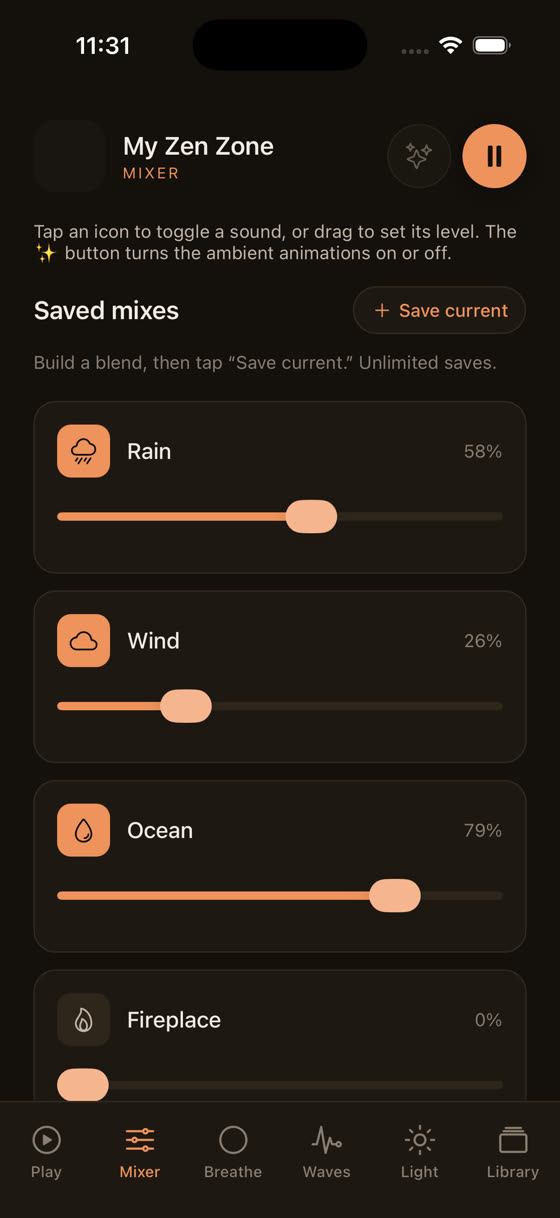
That's the screen this whole setup leans on, three sounds, three sliders, one result that's actually yours. Offline downloads matter here too. If your watch and phone are both in airplane mode or Do Not Disturb overnight, which many people do deliberately, a downloaded track keeps playing without needing a live connection.
Where this fits with the rest of the library
Sleep is one corner of what gets made. The same studio that records the sleep layers also builds slower, steadier material for settling the mind before bed, which is a different need from pure sound-masking. New tracks go up every two weeks, so the sleep section isn't a static dozen loops you'll have memorised by week three. If you're weighing up whether this is worth the subscription versus a free white noise app, the honest pitch is the mixer and the guided layering, not a bigger pile of mp3s. You can see the whole shape of the library at myzenzone.app, or go straight to the app if you'd rather just try it tonight.
The bottom line on the watch itself
Apple Watch is a reasonable passive sleep tracker and a poor audio recorder or speaker. That's not a flaw, it's just what the hardware was built for. If you came here wanting proof of snoring or noise in your room, you'll need a phone-based app with a real microphone and real battery capacity. If you came here wanting better sleep itself, the watch was never going to be the tool that delivered that. The sound you fall asleep to matters more than the device measuring what happened after.
Common questions
Does Apple Watch sleep tracking use the microphone at all?
No. Sleep stage tracking on Apple Watch relies on the accelerometer, heart rate sensor, and on newer models wrist temperature. The microphone isn't part of the sleep tracking pipeline at all, it's a separate system used only by the Noise app for measuring ambient decibel levels.
Can I play sleep sounds directly from my Apple Watch speaker overnight?
You can technically play audio from a watch speaker, but it's small, quiet, and not designed for hours of continuous playback. A phone or browser session gives better sound quality and far better battery life for an eight-hour session, which is why most people run sleep audio from their phone instead.
Will my Apple Watch tell me if I snored?
Not natively. Apple's built-in sleep tracking reports stages and duration, not snoring or sound events. Detecting snoring requires a third-party app that records audio clips, and these work better run from a phone with a proper microphone and more battery headroom than a watch.
Does wearing the watch to bed affect sleep quality?
There's no solid evidence either way specifically about wearing a watch. Some people find any wrist-worn device mildly distracting, others don't notice it. If it bothers you, charging it during the first part of the evening and wearing it only for the back half of the night is a reasonable compromise.