Yes, for most people rain sounds can help you study, but not because rain is magic. It works by covering up the unpredictable noises around you, the ones that actually break your concentration, with something steady and predictable. If your flatmate's TV or the street outside is what keeps pulling your eyes off the page, rain will likely help. If the problem is that your brain is tired or the material is too hard, rain won't fix that.
What rain sounds are actually doing to your brain
Rain is what's called broadband noise. It covers a wide range of frequencies at once rather than sitting on one note, which is why it doesn't grab your attention the way a ringtone or a snippet of lyrics does. Your auditory system is built to flag sudden changes: a door slam, a voice saying your name, a phone buzzing against a desk. A steady rainfall has almost none of those sudden changes, so after the first minute or two your brain mostly stops tracking it. That's the masking effect, and it's the same principle behind white noise machines in nurseries and the hum of an aircraft cabin.
Rain specifically sits close to what audio engineers call pink noise, which has more energy in the lower frequencies than pure white noise and tends to sound softer and less hissy to most ears. Some people find pink noise easier to sit with for an hour than white noise, which can feel thin and bright after a while. This is partly why rain, waves, and wind recordings are popular study backgrounds rather than a flat static hiss.
The research is real but thinner than the headlines suggest
You'll see plenty of claims online that background noise "boosts productivity by X per cent." Be sceptical of specific numbers like that. The honest picture is that a handful of small studies have looked at background noise and task performance, with mixed results depending on the task, the noise level, and the person. Some work on moderate ambient noise suggests it can aid creative, open-ended thinking, while very quiet or very loud conditions tend to suit narrow, detail-heavy tasks better. Nobody has produced a reliable rule that says rain sounds will raise your exam score by a fixed amount, and anyone telling you that is overselling the evidence.
What the research agrees on more consistently is simpler: unpredictable noise is more disruptive than steady noise, and most people's attention recovers faster in a masked environment than an unmasked noisy one. That's a modest claim, but it's the one worth building your study habits around.
Where most advice on this topic gets it wrong
Most articles treat "rain sounds" as one single intervention that either works or doesn't. In practice it depends heavily on three things: how loud it is relative to the noise you're masking, whether it's looped in a way that creates a jarring repeat every ninety seconds, and whether you're layering it with anything else. A rain track that loops badly, with an audible seam every two minutes, will train your brain to notice exactly the kind of pattern it's supposed to ignore. That's the difference between a track made for background listening and a generic ten-minute loop pulled from a stock library.
The other thing people miss is that one sound rarely fits every session. Light rain on leaves suits reading. A deeper rain-on-roof sound with distant thunder suits heavier, repetitive work like data entry or revision flashcards. Being able to adjust that on the fly matters more than picking the "best" rain sound once and sticking with it.
When rain sounds won't help, and might even hurt
If you're doing work that depends on verbal memory, like learning vocabulary or editing your own writing, any sound with speech-like qualities competes for the same mental resources language does. Rain itself has no words in it, so it's fine here, but a rain track mixed with a radio station playing underneath, which happens more often than you'd think with free YouTube loops, will hurt you. Some people with ADHD also report that steady background noise is distracting rather than calming, because their attention is drawn toward novelty rather than soothed by its absence. If fifteen minutes of rain makes you more fidgety, not less, trust that and try something with more rhythmic structure instead, which is covered in more depth in our piece on music for focus and study.
Rain versus white noise versus brown noise versus instrumental music
Each has a slightly different use case. White noise is flattest across frequencies and masks the widest range of sounds, which suits very noisy environments like open-plan offices or shared houses. Brown noise drops off more steeply at higher frequencies and sounds deeper and rumblier, which some people find less fatiguing over a three-hour study block. Rain sits between the two, with enough texture to feel natural rather than mechanical, which is probably why it's one of the most searched sounds for studying specifically rather than sleep. Instrumental music, by contrast, isn't masking noise at all, it's giving your brain something mildly engaging to ride alongside while the analytical part of your mind works on the actual task. Neither approach is objectively better. It depends on the task and the person, which is why a fixed fifteen-minute rain video on YouTube is a weaker tool than something you can actually shape.
How to actually set this up for a study session
The detail that gets skipped in most advice is volume relative to your room, not volume in isolation. Rain needs to sit just above your actual ambient noise floor, not blast over it. Too quiet and it doesn't mask anything; too loud and it becomes its own distraction. The other improvement almost nobody mentions is layering two or three nature sounds at different levels rather than relying on one. A base layer of rain with a touch of distant thunder underneath masks a wider range of real-world frequencies than rain alone, because it's covering both the mid and low end of what might leak in from outside.
This is where having a proper mixer rather than a single play button changes the outcome. In the My Zen Zone app you can bring in rain, wind, and a low drone separately and set each one's level by ear until your specific room goes quiet in your head. That's a different experience to pressing play on a ten-minute rain loop and hoping it's enough.
Building this into an actual study routine
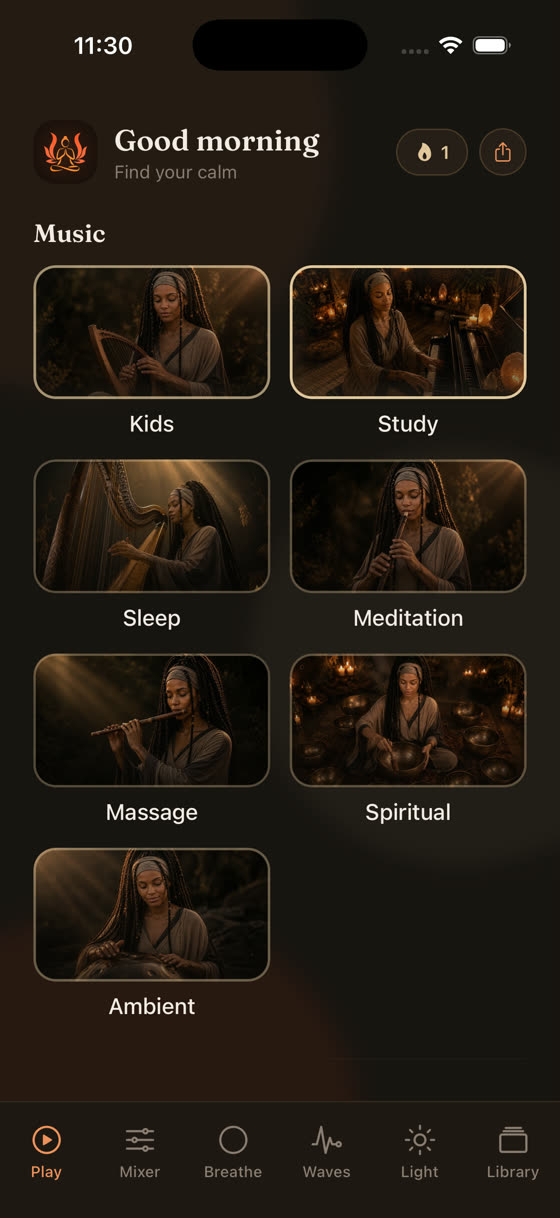
A session that works reliably in practice looks like this: start the mixer a minute or two before you sit down, not after you've already opened your laptop and lost ten minutes to your phone. Use a 25 to 45 minute block, since that's roughly how long sustained attention tends to hold before it drifts regardless of the sound in the background. Take a short break with the sound off, not on, so your ears get a genuine reset and the next block of rain still reads as novel masking rather than wallpaper. If you study at the same desk every evening, having a library that changes means the sound doesn't go stale the way one bookmarked YouTube video eventually does, and because new tracks are added roughly every two weeks, there's always a slightly different rain or storm recording to drop in when the old one stops doing its job.
If your real problem is winding down after a long study session rather than getting into one, that's a different mechanism entirely, covered properly in best music for sleep. You can try the mixer and the rest of the library at myzenzone.app or go straight to download it and test it against your own desk, your own room, tonight.
Common questions
How loud should rain sounds be for studying?
Loud enough to sit just above the ambient noise in your room, not louder. If you can still clearly make out a conversation two rooms away, it's probably too quiet to mask it. If the rain itself is the thing you notice most, it's too loud. Aim for it to disappear into the background within a minute or two.
Is rain better than white noise for concentration?
Neither is universally better. White noise masks a wider range of frequencies, which suits very noisy environments, while rain feels more natural and is less fatiguing for some people over long sessions. Try both for a week each and notice which one you stop hearing faster, since that's the real sign it's working.
Can rain sounds help with ADHD and studying?
For some people yes, because steady masking noise reduces the pull of sudden outside sounds. For others it adds unwanted stimulation and becomes its own distraction. There's no reliable way to predict which you are without trying it, so test it over a few sessions rather than assuming either way.
Should I use rain sounds or instrumental music while studying?
Use rain or similar masking sound when the goal is blocking outside noise, and instrumental music when the room is already quiet and you want something mildly engaging to sustain attention. For verbal or language-heavy work, avoid anything with lyrics or speech-like qualities either way.
Do rain sounds work for everyone equally?
No. Response to background noise varies a lot between individuals and even between tasks for the same person. The evidence supports it as a reasonable, low-risk thing to try, not as a guaranteed fix. If it's not helping after a few honest attempts, it's not the right tool for your particular distraction.