Yes, a good music and noise app can help you fall asleep, but not because it plays you something pretty. It works by giving your ear a steady, predictable signal to hold onto instead of the sharp, random sounds that keep pulling your attention back to the room. If you're lying there at 2am with your phone in your hand, the short version is: pick something low and constant, set a timer so it doesn't play all night, and stop hunting for the "perfect" track. Almost anything steady beats silence and beats scrolling.
Why noise helps more than most people expect
Your brain doesn't switch off at bedtime, it keeps monitoring the environment for anything that might matter. A car door, a pipe knocking, a partner shifting in bed. Each of those is a small, sharp change in sound level, and a sharp change is exactly what a half-asleep brain is built to notice. Steady background noise, whether it's rain, a fan hum, or a slow drone of synth pads, raises the floor so those small spikes don't stand out as much. This is called auditory masking. It's the same reason people sleep fine next to a running air conditioner but wake at the click of a door thirty feet away.
There's a second effect that gets less attention: habituation. A sound your brain expects and can predict gets filtered out faster than one that surprises it. This is why the same sound played every night tends to work better over time, not worse. If you've been switching tracks every few nights looking for a better one, you may actually be undoing the thing that was starting to work.
What most sleep apps get wrong
Plenty of apps hand you a single looped file: rain, ocean, one steady drone, pick one and go. That's fine as a starting point but it treats every night and every bedroom as identical, which they aren't. A thin-walled flat needs more low-frequency cover than a detached house. A partner's breathing needs something different to mask than street traffic. A fixed single loop can't adjust to any of that, so you end up either turning it up too loud or giving up and taking your headphones off at 1am.
The other common problem is length. A track that's four minutes long and loops abruptly is a small but real interruption every time it restarts, which matters more than it sounds like it should when you're right on the edge of sleep. Longer, seamless pieces, or ambient loops built specifically not to have an audible seam, avoid that problem entirely.
Build your own noise instead of picking one
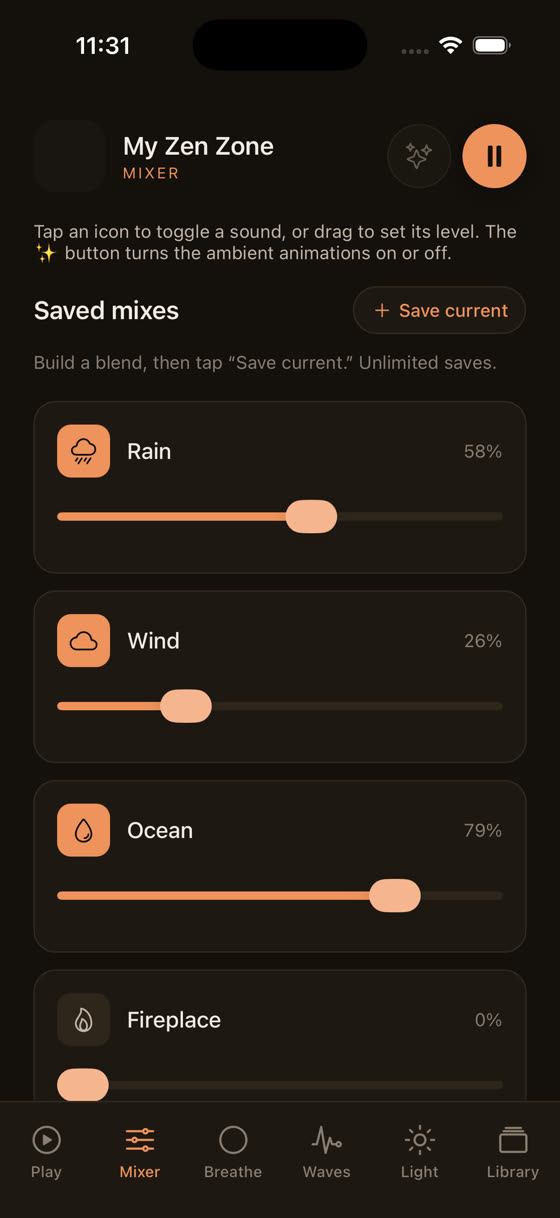
The more useful approach is layering more than one sound and setting your own balance for each, rather than accepting whatever level the app decided for you. Rain alone can feel thin. Rain under a low drone with a touch of distant thunder can feel like a room. This is the actual advantage of a proper mixer over a single play button: you're not choosing a track, you're building an environment.
That's what a layered mixer looks like in practice: three or four sounds, each on its own slider, so you can push the rain down and bring a warm low pad up until the mix stops sounding like a sound effect and starts sounding like a room you could fall asleep in.
What actually makes music sleep-friendly
Not all calm-sounding music is equal for this. Tempo matters more than genre. Music sitting around 60 to 70 beats per minute, roughly a resting heart rate, doesn't pull your attention the way a melody with clear phrasing and changes does. A piece with an obvious chord progression, a hook, or a build and release, the things that make music good to listen to on purpose, are exactly the things that keep a light sleeper's brain half-engaged. Sleep music generally avoids all of that on purpose: long sustained tones, minimal harmonic movement, no percussion with a sharp attack, nothing that resolves.
This is a different job to focus music, which usually wants a bit more rhythmic structure to hold attention without words, or meditation music, which often needs space for a voice to sit inside. If you want the difference explained properly, this piece on the best music for sleep goes into what separates a sleep track from something that just sounds relaxing on a coffee shop playlist, and there's a companion piece on music for focus and study if you're trying to use the same app for daytime concentration as well.
The wind-down matters as much as the track
An app that only gives you play buttons is only doing half the job. The twenty minutes before you try to sleep matters as much as what plays once you're lying down. Slowing your breathing on purpose, even for two or three minutes, brings your heart rate down before the music has to do any work at all.
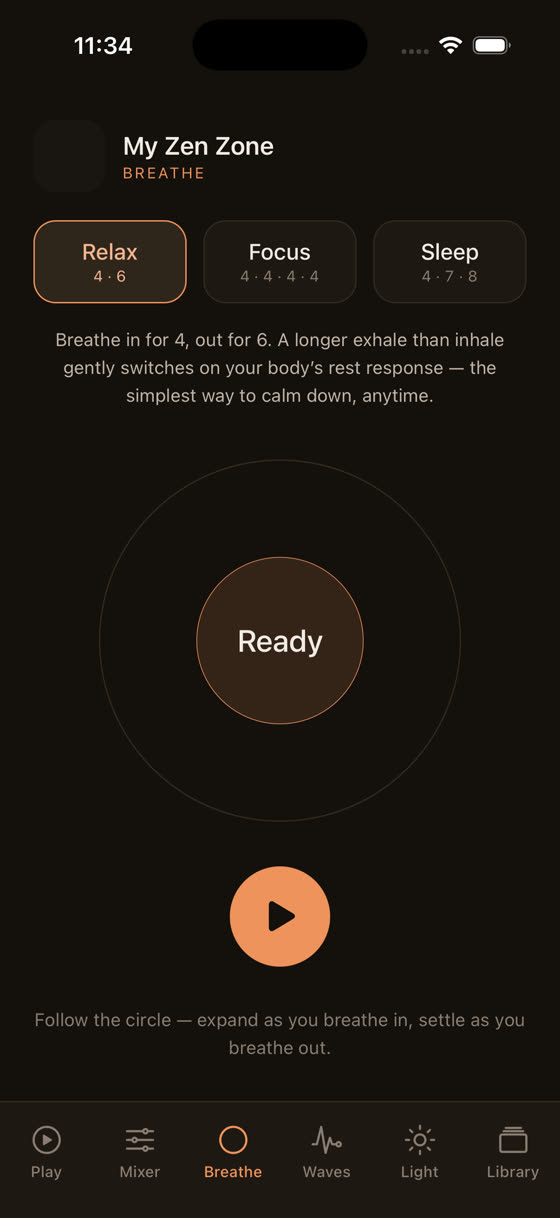
A simple 4-6 pattern, breathe in for four, out for six, done a dozen times with a visual to follow rather than counting in your head, does more in three minutes than most people expect. Pair that with dimming your screen and easing the light in the room rather than going from bright phone screen to total darkness in one step.
Set a timer, don't let it play all night
This is the detail most people skip. Sound playing all night, even soft sound, means your ear keeps working all night, and there's a reasonable argument that this interferes with the deeper stages of sleep later on rather than helping them. A sleep timer that fades the audio out after 30, 45 or 60 minutes, once you're likely to be properly under, is a better setup than looping something for eight hours straight. If your app doesn't have a timer with a fade, that's worth checking before you commit to it.
What to actually do tonight
Pick one steady base sound, not music with a melody, and layer in a second element until it stops sounding like a loop and starts sounding like a room. Set a timer for 40 to 60 minutes rather than leaving it running. Do a few minutes of slow breathing first if your mind is racing rather than just your body being tired. Keep the same combination for a week rather than switching nightly, since habituation needs repetition to do its job. None of this is a guarantee, sleep is affected by far more than sound, but it's the version of "try a sleep app" that's actually built on how hearing and attention work rather than just hoping soft sounds are automatically soothing.
Where My Zen Zone fits into this
Every track in the library is composed and recorded by one musician working specifically to these rules: slow tempos, no sharp transients, long seamless loops, nothing designed to grab attention. The library runs into the hundreds of tracks and grows every two weeks, so the "switch it up occasionally" approach doesn't mean starting from nothing.
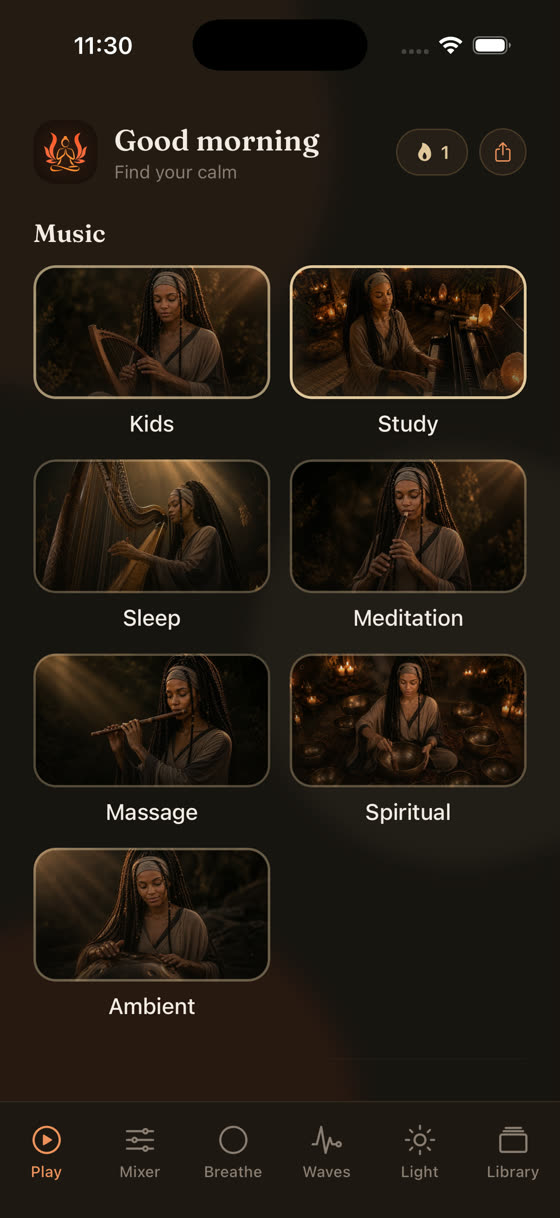
Sleep, Focus, Calm and Meditation each sit as their own space rather than one long undifferentiated playlist, which matters if you're using the same app at 7am and 11pm for very different reasons. It's on iPhone and Android, works offline once tracks are downloaded so a spotty connection doesn't cut out mid-sleep, and a subscription opens the same library in a browser too. If tonight is the night you actually want to try building your own mix instead of pressing play on someone else's, this is where to start.
Common questions
Is white noise or pink noise better for sleep?
Pink noise has more energy in lower frequencies and sounds softer, closer to rainfall or wind, while white noise is flatter and can feel harsher over hours. Neither is proven definitively better; most people find pink noise easier to tolerate all night, but it's genuinely personal. Try both for a few nights each rather than assuming.
Should I use headphones or a speaker for sleep sounds?
A speaker across the room is usually better than headphones, which can be uncomfortable side-sleeping and occasionally cause ear irritation over a full night. A speaker also lets the sound fill the room rather than sitting directly in your ear canal, which does a better job of masking sounds coming from elsewhere in the house.
How loud should sleep noise be?
Quiet enough that you'd need to concentrate to make out details in it, roughly the level of a quiet conversation in the next room. If it's loud enough to notice as "a sound playing" rather than just part of the room, it's too loud and may itself become the thing keeping you awake.
Will music or noise stop me reaching deep sleep?
There isn't strong evidence either way, and it likely depends on volume, sound type and the individual. A timer that fades sound out after 30 to 60 minutes is a reasonable middle ground, giving you the settling-in help without sound continuing through the whole night uninterrupted.
Can the same app help with sleep and daytime focus?
Yes, but the music should be different for each. Sleep material avoids melody and rhythm on purpose; focus material usually needs a bit more structure to hold attention without becoming distracting. An app organised into separate categories for each purpose, rather than one mixed playlist, makes this much easier to get right.