Yes. Search "sleep" on Spotify and you'll get hundreds of playlists, curated mixes, and individual tracks tagged for rest. The music exists. The problem is what happens around it once you've fallen asleep, which is the part almost nobody checks before they rely on it.
What Spotify's sleep playlists actually are
Most of them are licensed compilations, pulled together by editorial teams or algorithms matching tempo and instrumentation to a mood tag. Some are genuinely well made. A lot are stitched from tracks by dozens of different artists, recorded in different studios, mastered to different loudness levels, with no relationship to each other beyond a shared genre label. One track fades out at 55 bpm and gentle piano; the next comes in at 80 bpm with a string swell. Your nervous system doesn't read metadata. It reads the sudden change in energy, and on a light sleep cycle that's often enough to nudge you toward waking.
This matters more than people assume. Sleep music works by keeping the body in a low-arousal state long enough for you to drop into deeper sleep stages. A single jarring transition three tracks into a two-hour playlist can undo twenty minutes of settling. Playlist curation for mood is not the same discipline as composing a continuous piece meant to be listened to, half-conscious, for two hours straight.
The autoplay problem
Spotify's autoplay is built to keep you engaged, which is exactly the wrong design goal for someone trying to disengage. Reach the end of a sleep playlist at 3am and Spotify will often queue up something "similar" based on your listening history, which might mean a podcast, a pop song, or an ad if you're on the free tier. People message us regularly saying they woke up to a comedy podcast at full volume because a playlist ended and autoplay picked something unexpected. You can turn autoplay off, but it's off by default in a way that means most people don't know it's on until it bites them.
Ads, even at night
Free-tier Spotify plays ads between tracks regardless of the hour. A 30-second ad at normal speaking volume, dropped into a quiet ambient mix at 1am, is about as effective a way to wake someone up as a smoke alarm. Premium removes this, but it means the sleep-music experiment now has a subscription cost attached whether or not the music itself was ever designed for sleep in the first place.
What actually makes music work for sleep
Tempo matters more than genre. Most effective sleep music sits around 60 to 70 bpm, close to a resting heart rate, with no sudden dynamic swings and no strong beat to entrain to. Structure matters almost as much as tempo: a track that loops or evolves slowly over 20 to 40 minutes beats a 3-minute pop-adjacent instrumental repeated on shuffle, because shuffle itself reintroduces the jarring-transition problem. We go into more of the mechanics, including why some instruments settle the body faster than others, in our guide to music for sleep.
None of this is about Spotify being a bad company or the music being bad music. It's a mismatch between a platform built for music discovery and engagement, and a use case that needs the opposite: predictability, continuity, and silence when the listening is meant to stop.
What a purpose-built app does differently
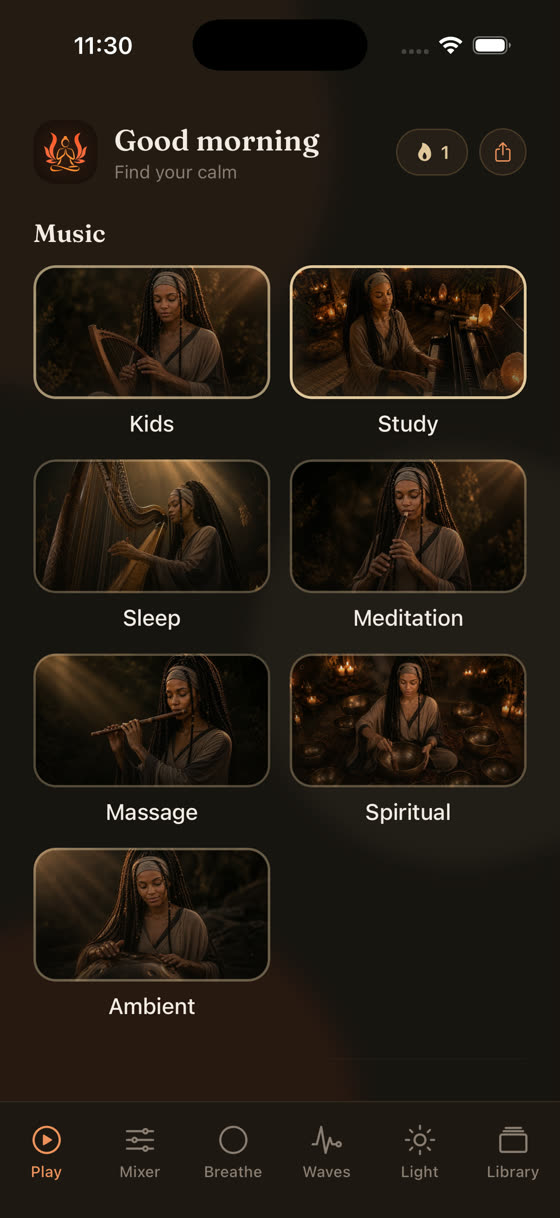
My Zen Zone exists because of that mismatch. Every track in the library is composed and recorded specifically for sleep, focus, meditation or rest, by one musician working to those constraints, not adapted from a commercial release after the fact. There's no shuffle-into-something-else risk because there's no advertising catalogue behind it pushing engagement metrics.
The sleep timer stops playback outright rather than queueing something new. Offline downloads mean the track keeps playing even if your phone drops to airplane mode or the wifi cuts out at 2am, which happens more than people expect in older buildings or on holiday.
The mixer is the part regular playlists can't replicate at all. Instead of one fixed track, you layer rain, a distant thunderstorm, and a low drone yourself, each on its own level, and save the balance that actually works for you.
That's a genuinely different way of listening. A playlist gives you someone else's mix. A mixer gives you your own, and you can rebuild it in ten seconds if a sound that worked last month starts to grate.
Guided sessions without stopping the music
Most sleep and meditation apps play a voice track instead of music: the narration stops, then the music starts, back and forth. Ours layers them. A guided wind-down session plays as its own track with separate Voice, Music and nature levels, so you can turn the narration down to a whisper under the music rather than choosing one or the other.
For focus work during the day, the same logic applies with different material entirely, covered in our piece on music for focus and study if that's the problem you're solving right now rather than sleep specifically.
Where Spotify is genuinely fine
To be fair to Spotify: if you're an active subscriber already, ad-free, autoplay turned off manually, and you've found one or two playlists that consistently work for you, there's no strong reason to abandon that setup. Familiarity itself has a calming effect, and forcing a change for its own sake isn't useful advice. The honest case for switching is narrower than most articles make it sound: it's for people who've noticed the ad interruptions, the jarring transitions, or the autoplay surprises, and want those specific problems solved rather than a vague upgrade.
It's also worth being honest that there isn't strong clinical research proving any app or playlist improves sleep outcomes in a measurable way. What exists is a reasonable, physiologically plausible mechanism, tempo and consistency lowering arousal, plus a lot of anecdotal reporting. We'd rather say that plainly than imply a guarantee.
What to actually change tonight
If you're sticking with Spotify: turn off autoplay in settings, and choose one long continuous mix rather than a shuffled playlist, so you're not relying on track-to-track transitions holding together at 2am.
If you want to try something built for this specifically, the library at My Zen Zone adds new tracks every two weeks, so it doesn't go stale the way a fixed playlist does after the twentieth listen. Start with the mixer at a low overall volume, use the sleep timer instead of hoping the album ends quietly, and give it three or four nights before judging whether it's working, since the first night with any new sound is rarely representative. You can see the whole thing for free before committing to anything at the download page.
The light screen, for the ten minutes before you even hit play
A detail people underrate: what happens before the music starts matters almost as much as the music itself. Bright phone light at full brightness while scrolling to find a track undoes some of the calming work before a single note plays.
The light screen is built for that gap, a warm, low, screen-friendly dimming step between putting the phone down and closing your eyes, so the transition into the music is actually a transition rather than a hard cut from a lit screen to darkness.
Common questions
Is Spotify sleep music free to use?
Yes, on the free tier, but you'll get ads between tracks at any hour, including overnight, and autoplay can queue up something unrelated once your playlist ends. Premium removes ads and gives more control, but neither tier was built specifically for continuous overnight listening.
Why do I wake up during a Spotify sleep playlist?
Usually a transition: one track ending abruptly, a louder or faster track starting, an ad on the free tier, or autoplay switching to unrelated content. None of these are faults exactly, they're side effects of a platform built for discovery rather than uninterrupted rest.
What tempo is best for sleep music?
Roughly 60 to 70 bpm, close to a resting heart rate, without strong percussion or dynamic swings. This isn't a hard rule, some people settle fine to slower ambient drones with no discernible beat at all, but it's a useful starting range if you're choosing between tracks.
Can I download sleep music to use without wifi?
On Spotify Premium, yes, for playlists you've saved offline. In My Zen Zone, offline downloads are included and work across the whole library, so a track keeps playing even if your connection drops or you switch to airplane mode overnight.
Does background noise like rain help more than music?
For some people, yes, particularly if outside noise (traffic, a partner, a snoring pet) is the real problem rather than an unquiet mind. Blended sound, a low drone under rain, often works better than either alone, which is the idea behind a mixer rather than a single fixed track.