Short answer: there's no solid evidence that a track labeled "alpha waves" tunes your brain into a specific frequency and makes you absorb information faster. But calm, structured instrumental music can still help you study, often for reasons that have nothing to do with brainwaves at all. The label is mostly marketing sitting on top of something more ordinary and still useful.
What "alpha wave music" actually claims
Alpha waves are a real, well-documented pattern of electrical activity in the brain, roughly 8 to 12 Hz, that shows up on an EEG when someone is relaxed, awake, and not processing much visual input, classically when you close your eyes and let your mind go quiet. Researchers have measured this since the 1920s. It's genuine neuroscience.
What's sold as "alpha wave study music" is usually one of two things. Either it's a track with a binaural beat embedded, two slightly different tones played separately into each ear so your brain perceives a third, phantom frequency equal to the difference between them, set to land in the 8-12 Hz range. Or, more often, it's just ambient instrumental music with no embedded beat at all, labeled "alpha waves" because the phrase tests well in a thumbnail. The second kind is far more common than most listeners realize.
What the research on entrainment actually shows
Brainwave entrainment, the idea that external rhythmic stimulation can pull your brain's electrical activity toward a matching frequency, is a real and measurable phenomenon called the frequency-following response. Studies using EEG have shown that binaural beats and rhythmic auditory or light stimulation can shift measured brain activity somewhat toward the target frequency. That part isn't in dispute.
What's much thinner is the next step: does that shift translate into something you'd actually notice, like faster recall, better comprehension, or longer sustained attention. The studies here are small, often inconsistent, and rarely replicated at scale. Some find modest reductions in self-reported anxiety with alpha-range binaural beats. Few find a clear, repeatable improvement in study performance. If an article tells you flatly that alpha wave music boosts memory encoding, it's overstating what the data supports.
Where most study-music articles go wrong
The common mistake is treating "it's labeled alpha waves" and "it will help you study" as the same claim. They're not. Plenty of music helps people study without containing any embedded binaural tone whatsoever, and plenty of tracks with a genuine 10 Hz beat underneath do nothing measurable for the listener because they're also layered with distracting melody, shifting volume, or lyrics that compete for the same attention you're trying to protect.
The thing that actually predicts whether background music helps you concentrate is much more mundane: tempo, structure, and familiarity. A steady, repetitive piece around 50-70 bpm, close to a resting heart rate, with no vocals and no abrupt dynamic swings, tends to fade into the background rather than pulling your attention toward it. That's the mechanism doing the real work in most "alpha wave" playlists, whether or not there's an actual beat frequency involved.
So does it help, or not
It can help, just maybe not for the reason the label suggests. Consistent instrumental sound masks sudden noises, like a door slamming or a conversation two desks over, that otherwise hijack attention. It gives your brain a stable, low-information backdrop instead of silence, which some people find harder to sustain focus against than they expect. And if you use the same track or genre every time you sit down to work, it becomes a cue, a signal to your brain that it's time to settle in, the same way a specific chair or a particular desk lamp can become a cue.
None of that requires an embedded 10 Hz tone. It requires consistency and the absence of things that pull attention away from the task. We cover this in more depth, including specific tempo ranges and genre choices, in our guide to music for focus and study.
Who it probably won't help
If you're doing work that depends heavily on verbal processing, reading dense text, writing an essay, translating, almost any music with lyrics will compete with the language centers you're using, alpha-labeled or not. Some people also find that any music at all, however calm, pulls a sliver of attention away from genuinely difficult problem-solving. If you notice your comprehension drops with music on, that's worth trusting over what a label promises. There's no universal answer here, only what your own attention does under test conditions.
Brainwave tones, if you want to actually try them
If you're curious about binaural-style tones rather than just atmospheric instrumental music, it's worth trying them properly: over headphones, since the effect depends on each ear hearing a distinct frequency, and for a sustained block rather than a few minutes.
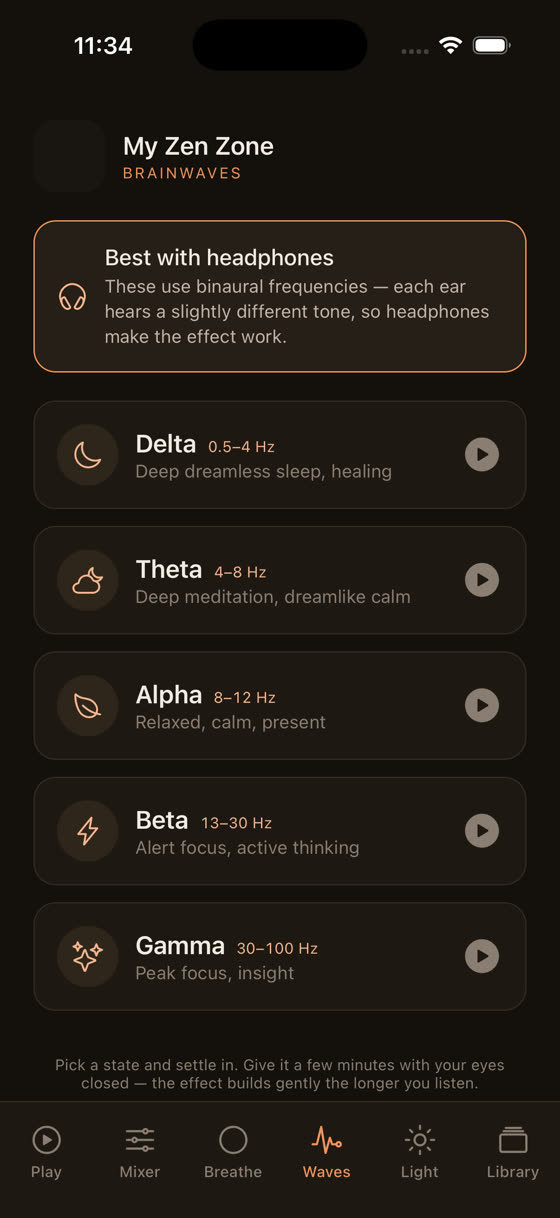
My Zen Zone includes a dedicated brainwave tones screen alongside the instrumental library, so you can compare a genuine tone-based track against a plain ambient one and judge for yourself whether it changes anything for your own concentration. We'd rather you test it than take a claim on faith.
Building a study session that actually works
Instead of chasing a specific frequency, build the session around what's actually controllable: a track with steady tempo and no lyrics, a fixed volume rather than one that swells and fades, and a block of time with a clear end point so your brain isn't guessing how long it needs to sustain focus. A kitchen timer or Pomodoro app works, but a sleep-and-focus app with a built-in timer that fades the music out rather than cutting it dead is gentler on attention than a sudden silence.
Layering matters too. A thin bed of rain or a low fan hum underneath the instrumental track can mask the specific, attention-grabbing noises around you, a kettle, traffic, a housemate, better than either sound alone.
That's the part most study-music apps skip entirely, they give you one fixed mix and that's it. My Zen Zone's mixer lets you set the instrumental track, a nature layer, and even a brainwave tone each at its own level, so you can find the balance that actually disappears into the background for your ear rather than one preset volume that works for nobody in particular.
What to try tonight or before your next study session
Pick one instrumental track, no vocals, tempo on the slower side, and use it for a full week of study sessions rather than switching tracks every day. Consistency is doing more of the work than any specific frequency claim. Set a timer so the session has a defined edge. If you want to test the alpha-wave claim directly, try a genuine binaural track over headphones for a few sessions and a plain ambient track for a few others, and compare how you actually feel afterward rather than how the label makes you feel beforehand.
The library inside My Zen Zone is composed and recorded in-house, with new tracks added every fortnight, so if one piece stops working as a cue, because you've simply heard it too many times, there's always something fresh rather than the same four looping playlists every app seems to recycle. You can browse the whole thing at myzenzone.app or start with the free download at /get.
The honest bottom line
Alpha wave music is a real scientific term borrowed for a commercial label that usually promises more precision than the research can back up. The underlying habit, calm, consistent, lyric-free sound while you work, is genuinely useful for a lot of people, just not for the reason the packaging implies. Treat the frequency claim with some skepticism, and judge the music on whether it actually lets you concentrate, which is the only test that was ever going to matter.
Common questions
Do I need headphones for alpha wave music to work?
Yes, if it's a genuine binaural beat track. The effect depends on each ear receiving a slightly different frequency, which speakers can't deliver cleanly since both ears hear the same mixed sound. Plain ambient instrumental music without an embedded beat works the same through speakers or headphones either way.
Is alpha wave music the same as white noise for studying?
No. White or pink noise masks sudden sounds with a flat, textureless hiss and has no melodic structure. Alpha wave tracks are usually melodic or tonal pieces, sometimes with an embedded binaural tone. Both can help concentration by covering distracting noise, but they work through different listening experiences.
Can alpha wave music help with anxiety before an exam?
Some small studies suggest alpha-range binaural beats may modestly ease self-reported anxiety, though the evidence isn't strong or consistent enough to call it reliable. A slow, steady, lyric-free track is a reasonable low-risk thing to try before a stressful exam, just don't expect a guaranteed calming effect.
Why do some study playlists feel distracting instead of helpful?
Usually because of sudden volume changes, melodic hooks that grab attention, or lyrics competing with the language-processing part of your brain. A track that keeps surprising your ear works against focus rather than for it. Steady tempo, consistent volume, and no vocals matter far more than any frequency claim on the label.
How long should I listen to alpha wave music before studying?
There's no established minimum. If you're testing a binaural track specifically, give it at least 20-30 minutes within a real study session so you can judge its effect on sustained attention rather than just the first few minutes, which is too short to tell anything meaningful about focus or recall.