Short answer: apps like Calm can take the edge off anxiety in the moment, for a lot of people, some of the time. They are not a treatment for an anxiety disorder, and no reputable app should claim to be one. What they can do is give your nervous system a different signal to respond to when it's stuck in an alert state, and that's a real, useful, limited thing.
What "working" actually means here
Anxiety is partly a body state. Faster breathing, a racing heart, muscles braced for something that isn't happening. Slow music, guided breathing and steady background sound work on that body state directly, not on the thoughts causing it. A track built around 60 bpm, roughly a resting heart rate, gives your body something calmer to entrain to than the 90-100 bpm hum of stress. It's a nudge, not a switch. If you're mid-panic, four minutes of ambient piano isn't going to argue you out of it. But used before the spiral gets going, or in the ten minutes after a hard meeting, it can shift things measurably.
This is the same mechanism behind most of what's used for sleep music too: the goal isn't distraction, it's giving an overactive system a slower rhythm to match.
What the evidence actually shows
Be wary of anything that quotes a specific percentage improvement from using a wellness app. The honest picture is messier. Studies on meditation and relaxation apps generally show modest, short-term reductions in reported stress and anxiety symptoms for some users, especially with consistent use over weeks rather than a single session. They don't show these apps outperforming therapy, medication, or exercise, and they're not designed to. Most of the research is on adherence and self-report, which is useful but limited. If a blog post tells you an app "cures" anxiety, that post is wrong. If it tells you an app has zero effect, that's probably wrong too. The realistic middle is: it can help you manage a symptom in the moment, and it's not a substitute for treating the cause.
Where it helps most, and where it doesn't
Apps like this do best with situational anxiety: the pre-flight jitters, the racing mind at 1am, the tight chest before a presentation. Anxiety that's tied to a specific moment responds well to a body-based interruption. They do less for generalised anxiety disorder, panic disorder, or anxiety tangled up with depression, where the causes are more structural and the tools that help are usually clinical: therapy, sometimes medication, sometimes both. If your anxiety is constant rather than situational, or it's stopping you from working or sleeping most nights, an app is a supplement to real support, not a replacement for it.
The mistake most guides make
Most articles on this topic treat "calming content" as one undifferentiated blob, as if any ambient track or any guided meditation does the same job. It doesn't. A guided script that talks you through naming your worries is doing cognitive work. A drone at 40Hz is doing something closer to masking. A breathing pattern is doing something physiological. Lumping them together is why so much advice on this feels vague. The more useful question isn't "do calming apps work" but "which specific tool fits this specific moment": racing thoughts before sleep want something different from a tight chest before a meeting.
What to actually try tonight
If tonight's anxiety is the lying-awake kind, skip anything with lyrics or a story, since your brain will follow the narrative instead of settling. Go for instrumental, unchanging, low-register sound, and pair it with a breathing pattern rather than trying to breathe "normally." A 4-6 pattern, four counts in, six counts out, taps into the vagus nerve response that actually slows heart rate, and it gives your mind a single simple job instead of nothing to do.
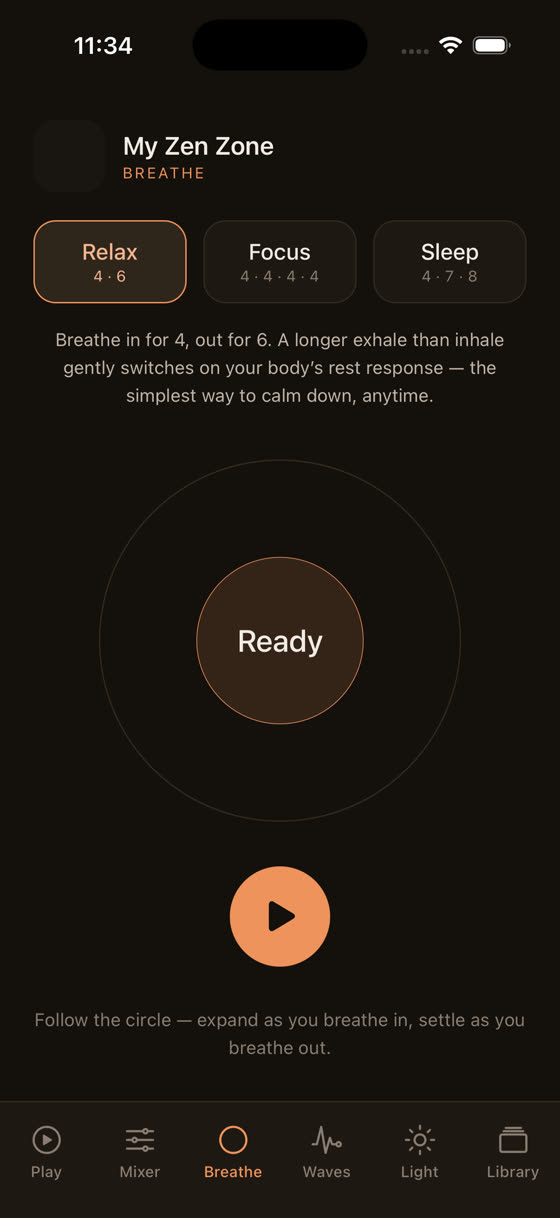
If the anxiety is more of a background hum through the day, layering matters more than any single track. Rain plus a low drone plus something with almost no melody, mixed low enough that you forget it's there, tends to outlast a single song that eventually ends and leaves silence behind. This is where a fixed playlist falls short: it wasn't built for your ears or your evening.
Why a mixer changes the outcome
Most apps hand you one file and expect it to fit everyone's version of anxious. It rarely does. What actually helps is control: turning rain down, a low pad up, cutting a melody that's too busy for a racing mind. That's the whole idea behind the sound mixer in My Zen Zone, three or more elements each on their own slider, so you're not settling for whatever balance someone else chose.
Watch how the levels move in real time and it's obvious why this matters more than picking "the right track." Someone anxious about sleep might want the water sound higher and the tone almost silent. Someone anxious about a work deadline might want the reverse. A fixed track can't do that. A mixer can.
Guided sessions without losing the music
Guided meditations are one of the more evidence-backed tools here, but most apps stop the music dead the moment a voice starts talking, which can feel jarring for someone already on edge. My Zen Zone treats a guided session as layers instead: Voice, Music and nature sound each with their own level, so the music keeps breathing underneath the words rather than disappearing.
You can bring the voice down and let the music carry more, or the other way round, depending on whether you want to be talked through something or just held by sound while your mind settles on its own. It's a small design choice that makes a noticeable difference to how anxious a session feels.
Building it into a routine, not a rescue
The apps that seem to help most are used ahead of the spike, not just during it. Ten minutes with slow music before bed, most nights, does more over a month than reaching for an app once during a 2am panic. Because My Zen Zone adds new tracks every two weeks, the same wind-down slot doesn't turn stale after the first fortnight, which matters more than it sounds for something you're meant to do repeatedly. Pair that with a sleep timer so the sound fades instead of cutting out, and offline downloads for the nights your signal drops, and the routine becomes something you can actually keep, not something you have to remember to set up each time. You can look through the full library, including what's arriving next, at myzenzone.app, or start with the app itself at the download page.
When to look past any app
If anxiety is affecting sleep most nights, work most days, or relationships most weeks, that's worth taking to a GP or therapist, not managing solely through sound. Apps are a reasonable first layer, cheap and private and always available at 3am when nothing else is. They're a poor last resort. Use one to take the edge off tonight. If tonight keeps repeating for months, that's information worth acting on, not just soundtracking.
Common questions
Can music alone stop a panic attack?
Not reliably. Music and slow breathing can support your body's shift out of a panic response, but the attack itself often needs to run its course. Pairing a breathing pattern like 4-6 with low, unchanging sound tends to help more than music alone, because it gives your body a rhythm to follow rather than just background noise.
Is guided meditation better than music for anxiety?
Neither is universally better. Guided sessions do cognitive work, walking you through naming or reframing worry, while instrumental music works more on the body's arousal level. Many people find combining them, a quiet voice layered over slow music rather than instead of it, covers both angles without either feeling like too much.
How long before a relaxation app makes a difference?
Some people notice a shift within one session, mostly a lowered heart rate and slower breathing. Meaningful change in overall anxiety tends to show up over weeks of regular use, not one sitting, similar to any habit that affects the nervous system. Consistency matters more than picking the perfect track.
Should I use anxiety apps instead of therapy?
No. Treat them as a supplement, not a substitute. They're good for situational anxiety and wind-down routines, but they don't address the underlying causes a therapist works with. If anxiety is frequent or severe, use an app alongside professional support, not in place of it.