The short answer
No. My Zen Zone has no ads anywhere in the app, not on the free tier, not between tracks, not as a banner sitting under the mixer. The library is funded by subscriptions, full stop. If you've ever been three minutes into falling asleep and had a mattress advert cut in at full volume, you already understand why that matters more here than in almost any other kind of app.
Why an ad breaking into white noise is worse than it sounds
Most apps treat an ad interruption as a minor annoyance. In a sleep or focus context it's a physiological event. Rain or brown noise works partly because it's steady: no sudden peaks, no surprises, nothing for your nervous system to flag as worth waking up for. A pre-roll or mid-stream ad does the opposite. It's usually louder than the audio around it, because ad networks normalise volume differently than music does, and it often has a jingle or a voice, which your brain processes very differently to broadstream noise even at low volume.
If you're using sound to get to sleep, that spike can pull you back up out of the lighter stages before you've settled into anything deeper. If you're using it to hold focus during work, the ad doesn't just interrupt the audio, it interrupts your attention, and getting back to the same depth of concentration can take several minutes. A five-second ad can cost you a lot more than five seconds.
How free white noise apps usually pay for themselves
It's worth knowing the business model, because it explains almost everything about how an app behaves. A free white noise app with no subscription and no ads is rare, because someone has to pay for hosting, development and the sound library itself. Usually one of three things is happening: there's a free tier with ads and a paid tier without them, there's a one-time purchase that unlocks everything, or the app is selling your usage data in ways that aren't obvious from the App Store listing. None of these are automatically bad, but they're worth knowing before you fall asleep with a stranger's product open on your phone every night.
What to actually check before you trust a 'free' sleep app
- Whether the free tier is genuinely ad-free, or just ad-light with occasional interruptions the reviews don't mention.
- Whether ads can autoplay video with sound even when your phone is on silent, which some ad SDKs do by default.
- Whether offline downloads exist at all, because an app that needs a live connection to play sound will also need a live connection to serve you ads.
- Whether the sound loops cleanly or has an audible seam every 30 to 60 seconds, which is a separate problem but tends to travel with cheaper, ad-funded libraries.
None of this is paranoia. It's just the same due diligence you'd apply to any subscription, except most people don't think to apply it to something as low-stakes-seeming as a noise app.
How My Zen Zone is actually built
The whole library, hundreds of tracks across sleep, focus, meditation, calm and music, is composed and recorded by one musician working in-house, not licensed in bulk from a stock catalogue. New tracks go in roughly every two weeks, and the subscription is what pays for that ongoing work rather than a rotating ad slot. There's no free tier with interruptions bolted in. You either have the subscription and the whole thing opens up, on iPhone, Android and in a browser, or you're on the trial and haven't paid yet. There's no third state where you're the product.
What that buys you practically is a mixer where you can layer three or four elements and set a separate level for each, rain a bit louder than distant thunder, a low drone underneath both.
Because nothing in that chain is ad-funded, nothing needs to interrupt it to justify itself. The same logic applies to guided sessions. Most apps that offer a guided meditation or a wind-down script stop the music entirely and play the voice instead, which is really just a different kind of interruption. Here the voice sits as its own layer over the music and nature sound, with its own volume control, so a session plays over the track rather than instead of it.
Offline downloads and why that detail actually matters
An ad-funded app almost always needs a live connection, because ads are served in real time and the network is how the app gets paid. That's one reason ad-supported white noise apps tend to be worse for actual sleep use: you leave your phone on wifi or data all night, notifications can slip through, and if your connection drops mid-stream you get a stutter or a dropout at 3am. Downloads sidestep all of that. Pull a track down in advance, put the phone in airplane mode, and there's genuinely nothing left that can interrupt the sound, no ad server to ping, no buffering, no stray notification riding in on the same connection.
Setting up tonight so nothing interrupts you
If you're testing this out for the first time, the useful habit is to build the session once and let it run, rather than checking your phone partway through. Pick a category on the home screen first, sleep, focus, meditation or calm each function as their own space with their own tracks, rather than one long undifferentiated playlist.
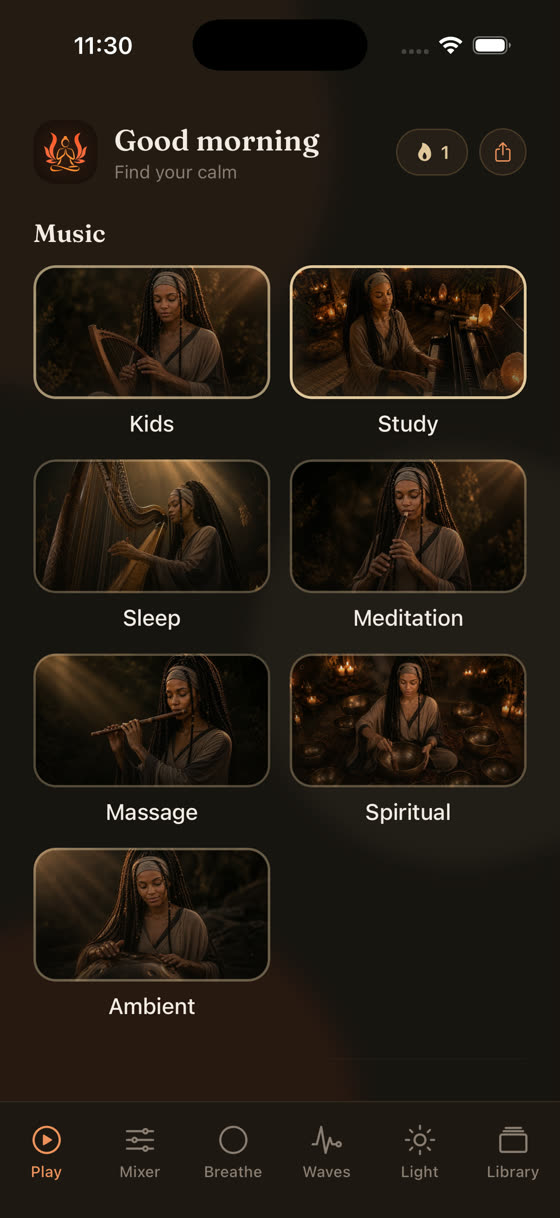
From there, set a sleep timer so the audio fades out instead of playing all night, download the track if you're going to put the phone in airplane mode, and if you want something visual to slow down to before you close your eyes, there's a dedicated light screen designed for exactly that wind-down window.
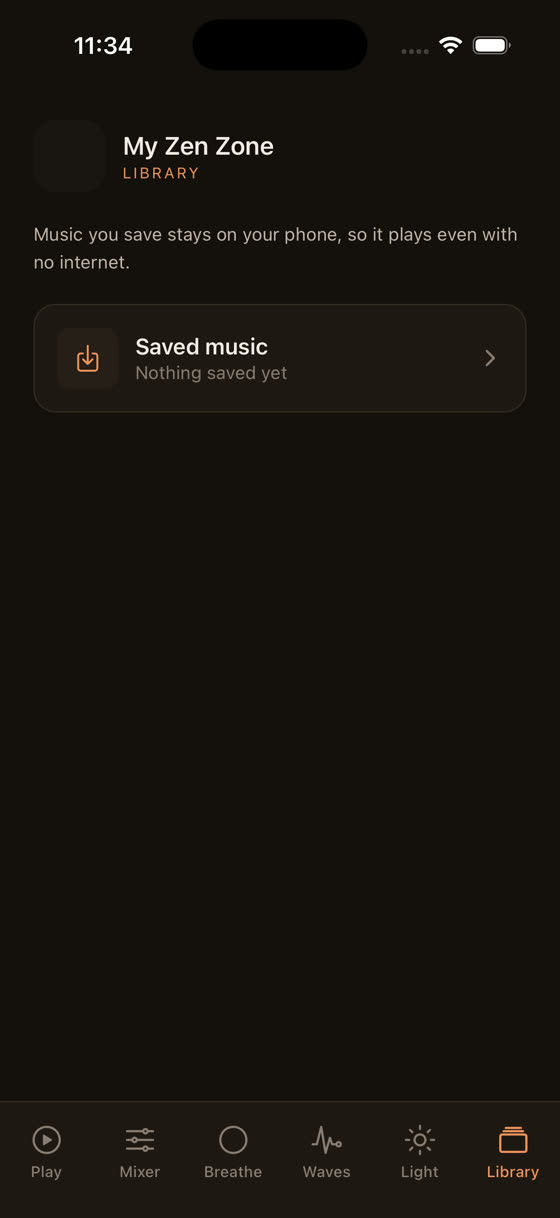
None of that setup is complicated, but it's worth doing once properly rather than fumbling with volume mid-sleep because an ad just came in over the top of your rain sound.
Where the evidence is solid and where it isn't
It's worth being straightforward here: there isn't strong clinical research specifically on ad interruptions during sleep audio, because it's a narrow and fairly new thing to study. What we do know, from general sleep research, is that unpredictable noise and sudden volume changes are more disruptive to sleep onset and to lighter sleep stages than steady, low-level sound, and that much better established point is the one actually doing the work here. If you want the fuller picture on what does and doesn't help at bedtime, our piece on the best music for sleep goes into tempo and structure in more depth, and if focus rather than sleep is the goal, music for focus and study covers why ad-free steadiness matters just as much during work as at night.
The bottom line
If an app needs ads to survive, someone will hear them eventually, usually at the worst possible moment. My Zen Zone was built the other way round: the subscription funds the composer, the composer keeps the library growing, and nothing gets inserted to pay for anything else. You can see the whole thing, mixer included, at myzenzone.app, or go straight to the download and try a track tonight without wondering what's going to interrupt it.
Common questions
Is there a free version of My Zen Zone with ads?
No. There's a free trial so you can hear the library before committing, but there is no permanent ad-supported free tier. Once the trial ends you either subscribe or the app stops playing. There's no middle version where ads appear instead of payment.
Do other white noise apps have ads even on paid plans?
Some do, usually disguised as 'sponsored sounds' or occasional promo banners even after purchase. It varies a lot between apps, so it's worth checking recent reviews specifically for the word 'ads' before subscribing anywhere, since App Store listings themselves rarely disclose this clearly.
Can ads in other apps actually wake you up?
There's no dedicated study on this exact scenario, but general sleep research shows sudden, unpredictable volume changes are more likely to disrupt lighter sleep stages than steady background sound. An ad breaking into white noise fits that pattern, even if nobody's specifically measured this exact case yet.
Does downloading tracks for offline use cost extra?
No, offline downloads are included as part of the subscription, not an add-on. The idea is you can queue up what you need, put your phone in airplane mode overnight, and remove any dependency on a live connection, which is also what keeps ad-style interruptions out of the picture entirely.
Why does new music get added every two weeks instead of all at once?
Because it's one musician composing and recording everything in-house rather than a licensed back-catalogue being dumped in bulk. A steady fortnightly pace keeps quality consistent and gives regular users something new to return to, rather than a huge library upfront that never grows again.