The Short Answer
Spotify does have usable guided meditation, it's just filed in three different places: podcasts (Jason Stephenson, Michael Sealey, Sleep With Me), meditation teachers who've uploaded full courses as audio series, and playlists tagged "guided meditation" that are often just ambient music with no voice at all. The honest truth is quality on Spotify is wildly inconsistent because anyone can publish a podcast episode with zero editing standard. Free tier users get an ad dropped mid-session, which is genuinely disruptive if you're trying to fall asleep. Premium removes that, but it doesn't fix the bigger issue: Spotify was built to shuffle songs, not to hold a 20-minute arc of breath, pause, and voice.
What "Best" Actually Means Here
Most "best of" lists rank guided meditation by subscriber count or chart position, which tells you almost nothing about whether the track will actually work for you at 11pm. What matters is pacing: how many words per minute the narrator uses, how long the pauses run between instructions, and whether the music underneath sits low enough that you can still hear the voice without straining. A good sleep-focused session slows its speech rate as it goes, the way a lullaby slows a child's breathing. A lot of what's popular on Spotify is popular because the first 30 seconds hook well, not because the full arc holds together.
Why the Mix Matters More Than the Script
Here's what most articles on this topic get wrong: they focus entirely on who's talking and ignore what's happening underneath. A guided meditation is really three layers stacked on top of each other, voice, music, and often a nature bed like rain or waves. On Spotify those layers are baked together into one fixed file. You get whatever balance the creator chose, and if the music is a touch too loud, or the rain too hissy against your headphones, there's nothing you can do about it short of skipping the track entirely.
This is the one thing worth seeing rather than reading about. A session where you can raise the voice, drop the music, and bring in a bed of rain independently, in real time, changes how usable the whole thing is depending on your mood that night.
Where the Format Breaks Down
Spotify's guided meditation content also runs into structural problems that have nothing to do with quality. Autoplay kicks in the second your track ends and can drop you into something jarring, upbeat, or just wrong for the moment, right when you were finally settling. There's no per-layer volume control, so a voice that's slightly too forward for your taste stays that way for the whole 20 minutes. And because most of this content lives inside podcast feeds, there's no consistent way to download a session for offline use the way you'd expect from an app built specifically for sleep or focus.
What To Actually Do Tonight
If you're using Spotify for meditation regardless, a few adjustments help more than switching tracks. Use headphones rather than a phone speaker, the stereo separation between voice and background sound matters more than people expect. Dim the room before you press play rather than during, since fumbling with a lamp mid-session undoes some of the settling. And do 60 seconds of slow breathing before the track even starts, in for four counts, out for six, which brings your heart rate down toward a resting 60-70 bpm before the voice ever begins guiding you.
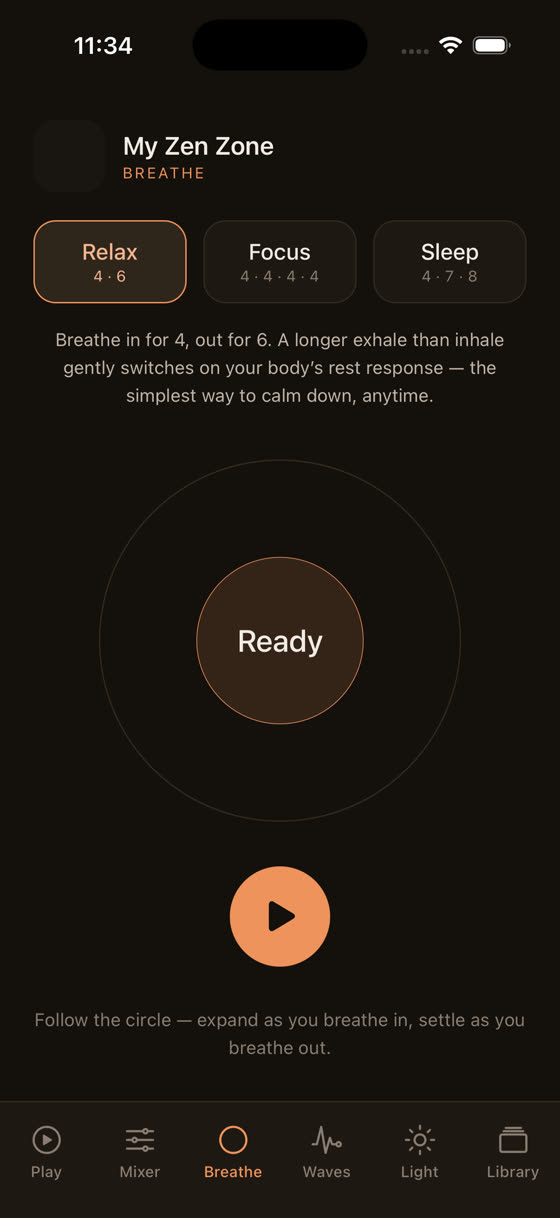
That breath pattern, four in and six out, is worth doing on its own even without any audio at all. It's the same 4-6 relax rhythm we built into our own breathing screen, because slowing the exhale past the inhale is one of the more reliable ways to nudge the nervous system down a gear, not a guarantee, just a consistent, low-effort lever.
A Different Way to Handle the Voice
We built My Zen Zone specifically because of the problem above: most apps, Spotify included, treat a guided session as one fixed audio file. Ours doesn't. Every guided session plays with the voice as a separate layer over the music and any nature sound you've added, so you can bring the narration forward if you're new to this, or fade it right down and let the music carry once you know the script by heart.
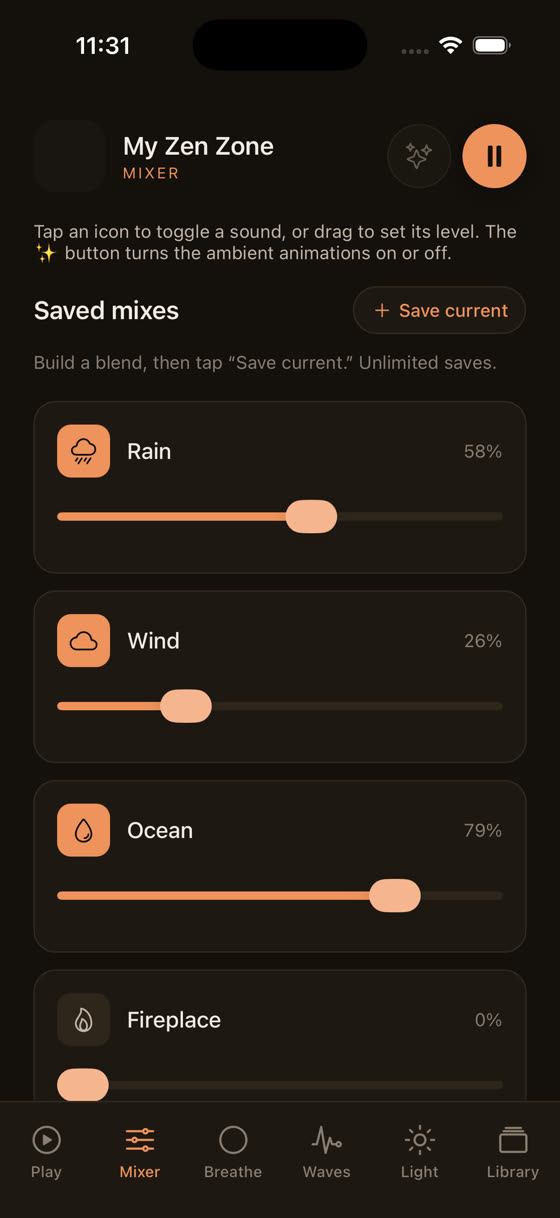
That same mixer is what lets three different nature sounds sit at three different levels under a single track, rain louder than wind, a touch of distant thunder, whatever combination actually settles your particular ear. It's a small thing until you've tried adjusting a fixed Spotify file and realised you can't.
If You're Choosing Between the Two
Spotify still wins on raw discovery. If you want to sample dozens of voices and styles for free before deciding what you respond to, it's a reasonable place to start, and there's no harm treating it that way. But if guided meditation is becoming a nightly habit rather than a one-off experiment, the fixed-file format starts to show its limits fast: no offline downloads for most content, ads breaking the free tier, no sleep timer that fades rather than cuts off mid-breath.
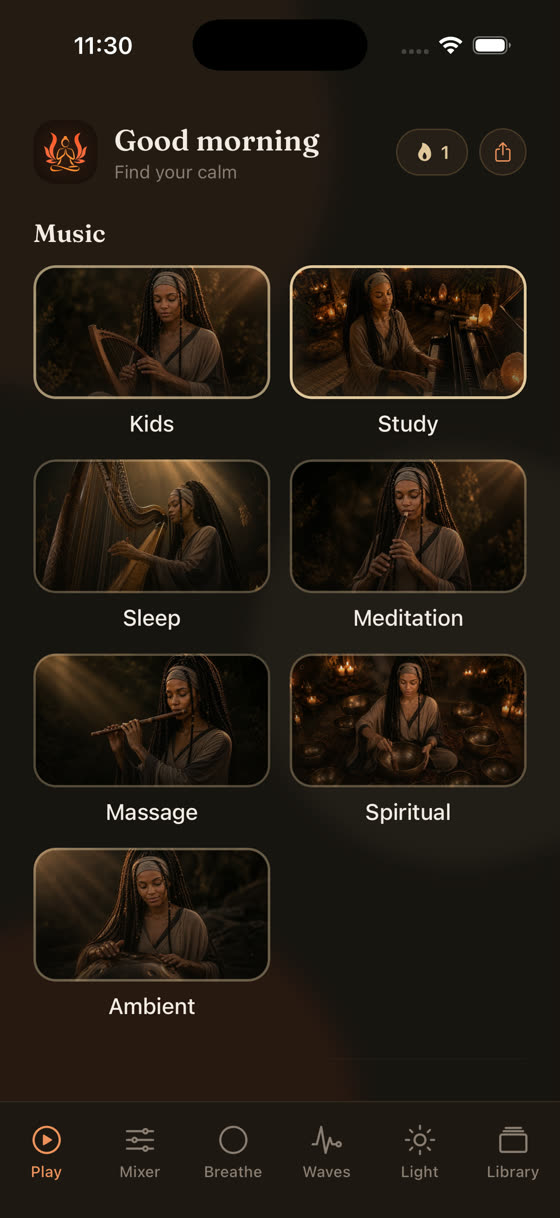
A dedicated library solves the second half of that problem. Every track in ours is composed and recorded in-house by one musician, the catalogue runs to hundreds of pieces already and grows every two weeks, so the sessions you rely on for sleep don't feel identical to the ones you use to focus during the day. If you want to see how the whole library is organised by what you're actually trying to do, rather than by genre, the app lays sleep, focus, meditation, calm and music out as separate spaces rather than one long scrollable feed.
For more on the actual mechanics of sound and sleep, our piece on best music for sleep goes into tempo and instrumentation in more depth, and if focus rather than rest is the goal, music for focus and study covers what changes when you're trying to concentrate rather than switch off. You can also see the whole approach at myzenzone.app before deciding whether it's worth moving away from a fixed playlist altogether.
Common questions
Is Spotify Premium worth it just for guided meditation?
Only if you also use it for music generally. Premium removes ads, which matters a lot for sleep, but it doesn't add offline structure for podcast-based meditation content or give you any control over the voice-to-music balance. If meditation is your main use case, a dedicated app will do more for the same subscription cost.
Why does the guided meditation on Spotify sound rushed or too fast?
Most of it wasn't scripted for sleep specifically, it was recorded once and uploaded as-is. Pacing that works for a daytime stress-relief session is often too quick for winding down at night. Look for creators who explicitly slow down as the track progresses, or use a tool that lets you fade the voice down once you know the pattern.
Can I download guided meditations from Spotify for offline use?
Only with Premium, and only for content Spotify has flagged as downloadable, which excludes a lot of independently uploaded podcast episodes. If offline reliability matters, for flights, patchy signal, or just avoiding ads breaking the mood, check that before committing to a particular creator's feed.
What's actually proven to work in guided meditation, versus just marketing?
Evidence here is genuinely thin and we won't pretend otherwise. Slower speech pacing and longer pauses are widely reported as more settling by users, and slow paced breathing has decent general support for calming the nervous system short-term. Beyond that, most of what makes one session work better than another for you personally is preference, not proven mechanism.