No, they are not the same thing, even though they can sound almost identical from the outside. A calm voice, a slow pace, a quiet room, maybe some soft music underneath. Guided meditation keeps you aware and present, gently directing your attention to your breath or body. Hypnosis narrows that attention down to a single channel and uses it to plant a specific suggestion. Both can relax you. Only one of them is designed to change something about how you think or act afterward.
That distinction matters more than it sounds like it should, because the labels get used loosely, especially in apps and on YouTube. A track called "sleep hypnosis" is very often just guided relaxation wearing a more dramatic name. Knowing the difference helps you pick the right thing for tonight, rather than the thing with the most persuasive title.
What guided meditation actually does
Guided meditation is attention training with a narrator. You are asked to notice your breath, scan down through your body, or hold a single word or image in mind, and when your attention wanders, as it always does, you are invited to notice that too and come back. Nothing is hidden from you. You stay aware of the room, your own thoughts, the voice talking, the music underneath. The aim is present-moment awareness, not a change of state.
A body scan script usually moves slowly, maybe one body part every ten to fifteen seconds, paced to a breath that's settling into something close to four seconds in and six seconds out. That 4-6 pattern is the one most people find easiest to sustain without feeling short of breath, and it's worth seeing it rather than just reading about it.
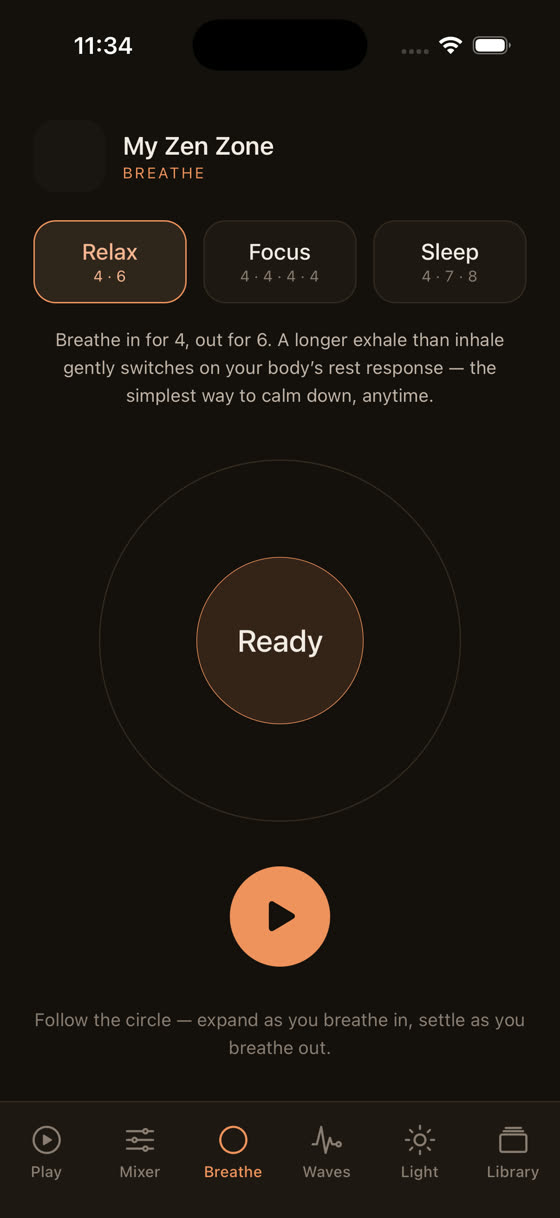
What hypnosis actually does
Hypnosis has a different structure: an induction to narrow focus, a deepening phase, a suggestion, and a re-alerting at the end. The suggestion is the whole point. It might be about reducing a craving, easing a specific fear, or managing pain, and it's phrased directly, often repeated several times in slightly different words. Clinical hypnosis is used by trained practitioners for things like smoking cessation, needle phobia, or pain management, and it works through suggestibility, a state where your critical, questioning faculty relaxes a little and a specific idea can land more easily.
Contrary to the common image, you are not unconscious during hypnosis. You can hear everything, you could get up and leave, and you remember most of it afterward. It's closer to deep absorption, the kind you get lost in a good book, than to sleep.
Where the two blur together
Here's where most confusion starts. The vocal pace in both is similar, often somewhere around 50 to 60 words per minute, much slower than normal speech. The music underneath both tends to sit below 70 beats per minute, close to a resting heart rate. And the vocabulary overlaps heavily: "heavy," "sinking," "letting go," "drifting." A hypnosis script and a meditation script can sound almost the same for the first two minutes.
The difference shows up in what comes after that. Meditation keeps circling back to open, non-directive language, noticing, allowing, observing. Hypnosis moves toward a specific outcome: you will find it easier to, you no longer need to, you will sleep deeply and wake refreshed. If a track is making a direct claim about what will happen to you, that's hypnosis-style suggestion, whatever the app calls it.
What most articles on this get wrong
Two things, usually. First, they describe hypnosis as a sleep-like unconscious state, which isn't accurate and makes it sound either mystical or sinister. Second, they treat meditation as having no lasting effect at all, just relaxation in the moment, which undersells what regular attention practice actually trains over time. The honest position sits between those: evidence for sustained, meaningful change from either is genuinely thin outside clinical settings with trained practitioners, and it's worth being plain about that rather than promising outcomes neither format can reliably deliver on its own.
Does it matter which one you use tonight?
For falling asleep, yes, a little. A hypnosis-style track loaded with direct suggestions gives your mind something to evaluate, even passively, right when you want it to stop evaluating things. A simple guided meditation or an unguided ambient track with no voice at all tends to work better for that specific job, because there's nothing to agree or disagree with. If you're trying to address something specific, a smoking habit, a fear of flying, you're better off with a trained hypnotherapist than a generic app track, however well produced.
For general evening wind-down, you don't need either in the clinical sense. You need something slow enough to pull your attention away from the day. That's covered in more detail in our guide to music for sleep if you want the fuller picture on tempo and structure.
How we build guided sessions differently
Most apps hit play on a guided track and the music either stops or ducks underneath the voice automatically, which means you get whatever balance someone else chose. We built it the other way round. Every guided session here plays as a separate layer over the music, with its own level, so you can bring the voice forward when you want direction and fade it back when you'd rather just sit in the sound.
That same layering logic runs through the rest of the library. Rain, a slow piano pattern, a low drone, each one gets its own fader rather than being baked into a single fixed mix.
It's a small thing until you're trying to sleep with a partner who wants silence, or working with background noise you can't control, and suddenly having three independent levels instead of one volume knob matters quite a lot.
A quick way to tell what you're actually listening to
Three questions, if you're ever unsure about a track: Does it ask you to notice something, or tell you something will happen? Does the language stay open, or does it narrow toward a specific claim? Does it keep returning your attention to the present, or walk you toward an idea about the future? Open, noticing, present usually means meditation. Direct, specific, future-focused usually means hypnosis, regardless of what the title says.
None of this is a reason to avoid either format. It's just useful to know which tool you're actually holding before you decide it isn't working.
What to try tonight
If sleep is the goal, skip anything with heavy suggestion language and try a plain guided body scan, or no voice at all, paired with something slow and low in the mix. Set a sleep timer so it fades out rather than looping all night, and if you want a wind-down visual to look at while your eyes are still open, the light screen is built for exactly that.
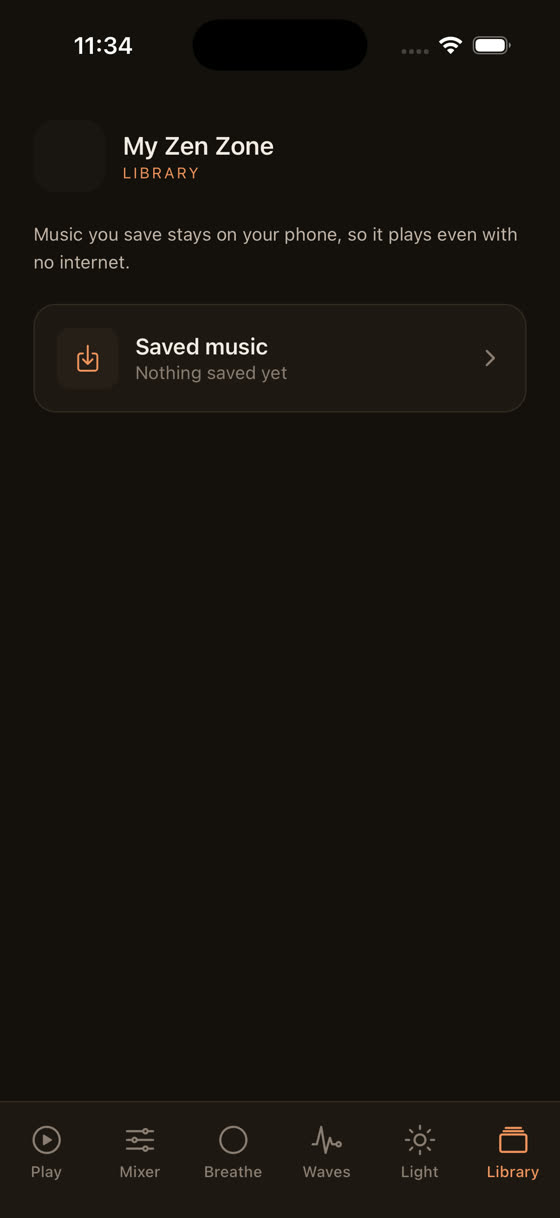
The library adds new material every two weeks, all of it composed and recorded by one person rather than licensed in bulk, so if tonight's track doesn't suit you, there's almost always something new worth trying. You can see the full range, categories for sleep, focus, meditation, calm and music, laid out separately at myzenzone.app, or go straight to the download if you'd rather just open it and start.
Common questions
Can guided meditation accidentally turn into hypnosis if I'm tired enough?
Not in any meaningful sense. Tiredness can make you more suggestible generally, but a meditation script without directive suggestion language won't function as hypnosis just because you're drowsy. What changes is simply how quickly you fall asleep during it, which for a sleep track is usually the point anyway.
Is self-hypnosis different from the hypnosis apps sell?
Not really, the mechanism is the same, you're just the one running the script from memory rather than following a recording. App-based "hypnosis" is self-hypnosis with a narrator doing the induction and suggestion for you. Clinical hypnotherapy differs mainly in that a trained practitioner tailors the suggestions to your specific situation.
Why do some sleep tracks use hypnosis language even though they're really just relaxation?
Mostly marketing. "Hypnosis" sounds more powerful and specific than "relaxation," so it sells better as a title, even when the script is just slow, open, meditative language with a dramatic label on top. Checking whether the track makes direct claims about outcomes is the quickest way to see past the title.
Does guided meditation stop working if I use the same track every night?
Some people do find familiar scripts lose their pull once the novelty wears off, since part of the effect relies on attention rather than memorised routine. Rotating between a few different sessions, or trying new ones as they're added, tends to keep it more effective than relying on a single track indefinitely.