Sleep sounds on Alexa are free. If you own an Echo device, or have the Alexa app on your phone, you can say "Alexa, play sleep sounds" or "Alexa, play rain sounds" and it will start a loop at no extra cost. There's no subscription required for the core feature, and no one-time fee. That's the honest, complete answer to the question most people are typing.
But "free" is doing a lot of work in that sentence, and it's worth understanding what you're actually getting before you build a bedtime routine around it.
What "free" actually includes
Amazon built a small set of ambient loops directly into Alexa: rain, ocean waves, white noise, a crackling fire, a few others depending on your region. These come from Amazon's own content, not from a third party, so there's no in-app purchase screen and no upsell. You ask, it plays, you say "Alexa, stop" when you're ready. That's the entire transaction.
There are also third-party Alexa skills with names like "Sleep and Relaxation Sounds" or similar. Most of these are free to enable too, monetised through Amazon's skill ecosystem rather than a direct charge to you. A handful offer expanded sound packs as in-skill purchases, usually a few dollars for a themed pack of ten or twenty extra loops. None of this is expensive. The actual money question isn't really about price. It's about what you get for free versus what you'd get from something built specifically for sleep.
Where the free version runs into trouble
A looped sample is exactly that: a loop. Most Alexa sleep sounds are somewhere between thirty seconds and two minutes of audio, repeated on a seam. Your brain is reasonably good at detecting repetition, even at low attention, and that seam becomes a small jolt every couple of minutes across a long night. It's not loud enough to fully wake you, but it's enough to nudge you out of deep sleep more often than you'd like.
There's also the single-channel problem. Alexa plays one sound at a time. You can have rain, or you can have ocean, but you can't blend a low layer of rain under a thread of soft piano at a lower level, because the skill wasn't built with a mixer in mind. If you've ever wanted just a touch of white noise under something musical, Alexa simply can't do that for you.
And then there's the hardware itself. Most people run Alexa through an Echo speaker in the bedroom, which means the device's microphone is listening all night, notifications can interrupt playback, and the audio quality depends entirely on the speaker you bought, often a small, bass-light driver that wasn't designed for extended ambient listening.
The skills marketplace and what "premium" usually means
When people search for pricing, they're often half-remembering a skill that asked for an in-skill purchase. These are typically one-off packs: twenty extra nature loops for $2.99, or a "premium" tier that removes a short audio prompt at the start of playback. None of it is subscription-based in the way a dedicated app is, and none of it adds real composition, mixing, or guided content. You're paying a small amount for more of the same kind of thing, not a different kind of thing.
Why composed music behaves differently than a looped sample
This is the part most articles comparing Alexa sounds skip entirely. A loop is a recording of a moment, repeated. Composed sleep music is structured across a full arc, often twenty to forty minutes, written at a tempo around 60 to 70 bpm, close to a resting heart rate, with phrases that resolve rather than cut off and restart. There's a difference between hearing rain fall in a four-second sample on repeat and hearing a piece built to slowly release tension over half an hour, with the lower register thickening as it goes and the melody thinning out toward the end. One is background noise. The other is designed to carry you somewhere.
None of this is a knock on rain sounds themselves, which plenty of people sleep well with. It's a question of whether a thirty-second loop or a composed, evolving piece does more of the quieting work for you. If you want the longer version of that argument, we've written about it directly in best music for sleep.
What a dedicated sleep app does that Alexa can't
This is where My Zen Zone works differently, and it's worth being specific rather than just saying "we're better." Every track in the library is composed and recorded by one musician, not licensed stock loops, so the tempo, structure and instrumentation are deliberate rather than incidental. The library runs to hundreds of tracks already, with new ones added every two weeks, so you're not relying on the same four loops for years.
The mixer is the clearest practical difference. Instead of choosing one sound at a time, you can bring in three nature layers and set each one's level independently, a touch of rain, a little wind, a thread of low drone underneath, all balanced to your own ear.
Watch how each layer moves on its own slider there, rain dropping back as a low tone rises. That kind of live, independent control over three separate sounds simply isn't something Alexa's built-in skill, or most competing apps, let you do.
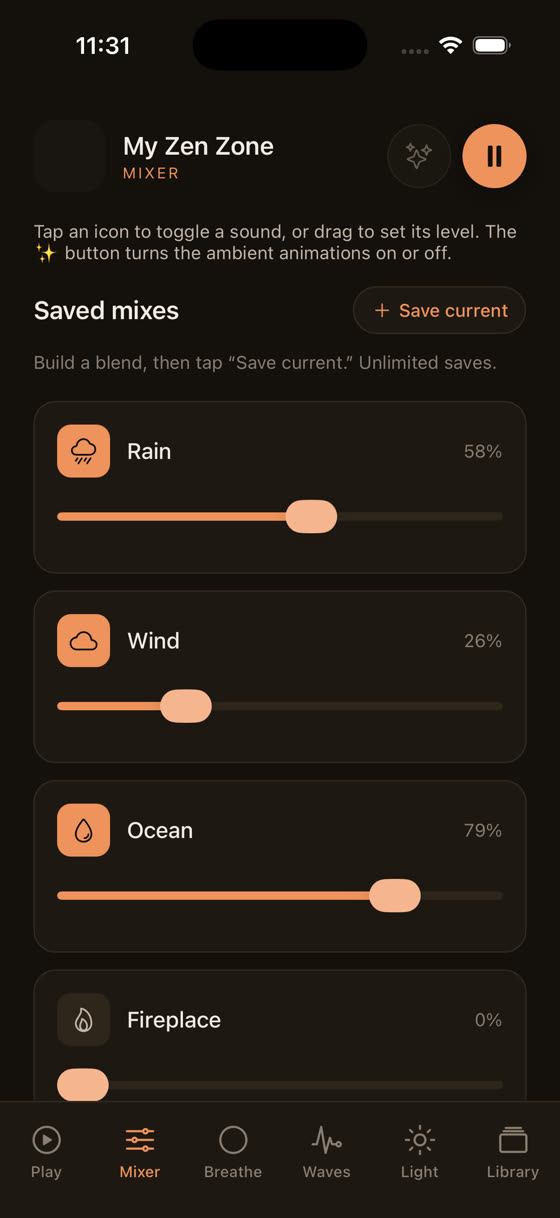
There's a sleep timer so the music fades out rather than cutting off mid-phrase, offline downloads so a hotel wifi dropout at 2am doesn't matter, and the whole library opens in a browser too if a subscription is active, not just on the phone.
Guided sessions without losing the music
If part of what draws you to Alexa's sleep content is a guided wind-down voice, it's worth knowing most apps pause the music entirely to play a session, then resume it afterward, which creates its own jolt. Here, a guided session plays as a separate layer over the music rather than instead of it, so you can turn the voice down as you drift and leave the music running underneath.
That clip shows a guided session with Voice, Music and nature each on their own level, adjustable mid-session rather than fixed at the start. It's a small design choice that changes how natural the whole thing feels by the time you're actually falling asleep.
A practical setup for tonight
If you already have an Echo in the bedroom, there's no reason to abandon it outright. Use it for the odd night you want pure white noise and nothing else. But if you're waking at the loop seams, or wishing you could blend two sounds instead of one, that's the signal to try something built for the job rather than bolted onto a voice assistant as an afterthought.
The light screen above is there for the ten minutes before you actually want to sleep, dimming gradually while the music does the same. You can see the whole shape of a wind-down routine, not just a single looped sound, from the home screen, and if focus or study is more your current problem than sleep, the same mixing approach is covered in music for focus and study. Either way, it's worth trying for yourself rather than taking our word for it, and you can start from here.
Common questions
Do I need an Echo device to use Alexa's sleep sounds?
You need either an Echo speaker or the Alexa app open on a phone or tablet with voice commands enabled. The sounds play through whichever Alexa-enabled device you're speaking to. Without an Echo, most people use the app version, though speaker placement and quality will shape how the sound actually feels in the room.
Can I set a sleep timer on Alexa's sleep sounds?
Yes, you can say something like "Alexa, stop playing in 30 minutes" and it will set a timer for that sound. It's a basic on/off cutoff rather than a gradual fade, so the sound stops abruptly rather than tapering down, which is worth knowing if sudden silence tends to wake you.
Are Alexa sleep sounds better than a white noise machine?
They're roughly comparable: both play a looped sample on repeat. A dedicated white noise machine sometimes has smoother, longer loops and no smart speaker notifications interrupting playback, but neither offers composed, evolving music or the ability to layer multiple sounds at independent volumes.
Is My Zen Zone free to try?
You can explore the app before subscribing, and a subscription unlocks the full library across phone, tablet and browser, plus offline downloads. New tracks are added every two weeks, so the library you start with keeps growing rather than staying fixed.