You can download meditation music for free through a handful of legitimate routes: free tiers of meditation apps, royalty-free libraries like the YouTube Audio Library, and Creative Commons sites such as Free Music Archive. None of them are quite as free as they look once you account for ads, low file quality, or licences that stop you using the track anywhere public. The faster path, if you actually want something you'll use tonight, is to skip the hunting and use an app's offline download instead of chasing individual files.
Why "free" rarely stays free
Search "free meditation music download" and you'll land on three kinds of sites. There are ad-supported streaming pages where the music stops every four minutes for a mattress advert. There are YouTube rips, often re-uploaded without the original artist's permission, compressed down to a bitrate that turns a clean pad sound into something faintly underwater. And there are stock libraries that are genuinely free but built for video backgrounds, not for lying in bed with your eyes shut, so the loops are eight seconds long and you can hear the seam.
None of this is a moral failing on the listener's part. It's just that music which costs nothing to distribute usually recovers that cost somewhere else: your attention, your data, or the listening experience itself. Worth knowing before you spend an hour downloading four different zip files at 11pm.
What meditation music actually needs to do
Good meditation music is not just "slow music". It tends to sit around 50-65 bpm, close to a resting heart rate, with long sustained tones rather than a strong beat, because a beat gives your mind something to track and tracking is the opposite of settling. It also needs to loop or extend without an audible seam, since a jarring restart every three minutes will pull you straight back out of a session. If you're pairing it with a guided voice, the music has to sit under the words in volume rather than competing with them, which most free loops were never mixed to do.
This is also why a single 20-minute file often isn't enough. A proper wind-down might run 45 minutes; a free single track will end, and then either silence or a jarring next-track kicks in through your headphones at 1am. That gap is where a lot of people give up on the whole idea.
The legitimate free routes, and their real limits
If you want to stay strictly free and do your own downloading, three sources are worth knowing:
- YouTube Audio Library — genuinely free, no copyright issues, but built for creators making videos, so most tracks are short and instrumentally sparse.
- Free Music Archive — Creative Commons tracks from independent musicians, often with an attribution requirement if you ever share or repost.
- Free tiers of meditation and sleep apps — usually a small rotating selection, sometimes downloadable for offline use, sometimes streaming only.
All three are real options. None of them give you a library that's actually built around sleep, focus and calm as separate needs, with music composed specifically for those states rather than repurposed from somewhere else.
How My Zen Zone's free access actually works
Every track in the app is composed and recorded by one musician, not licensed in bulk from a stock catalogue, and the library runs to hundreds of tracks now with new ones added every two weeks. You can explore the free tier before deciding whether a subscription is worth it, and if you do subscribe, tracks download for offline listening so a flight, a dead wifi router, or a rural signal blackspot doesn't end your wind-down halfway through.
The home screen splits everything into its own world instead of one long undifferentiated list, so sleep, focus, meditation and calm music don't blur into each other the way they do on a general playlist.
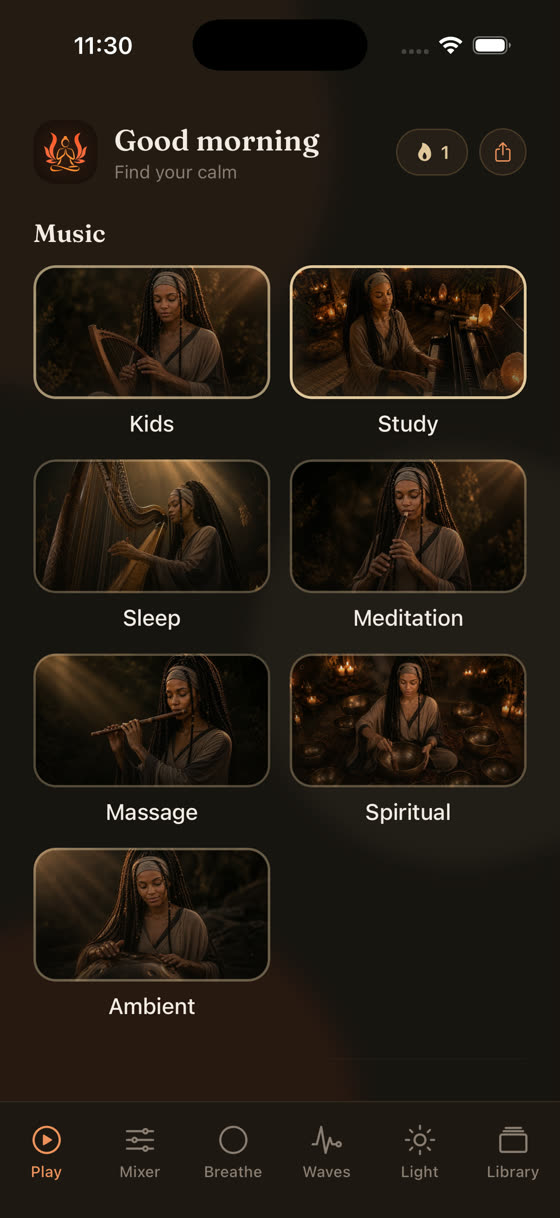
That separation matters more than it sounds. Focus music at 90 bpm dropped into a sleep playlist will keep you half-alert. A meditation track built around a single drone, used for studying, gives your brain nothing to hold onto and you'll drift within ten minutes.
The mixer: the part free downloads can't give you
A downloaded MP3 is fixed. What you hear is what you get, forever, at whatever balance the original mix chose. The mixer in My Zen Zone works differently: you take three nature sounds or layers and set each one's level yourself, rain a little louder, the drone lower, a distant thunder almost gone.
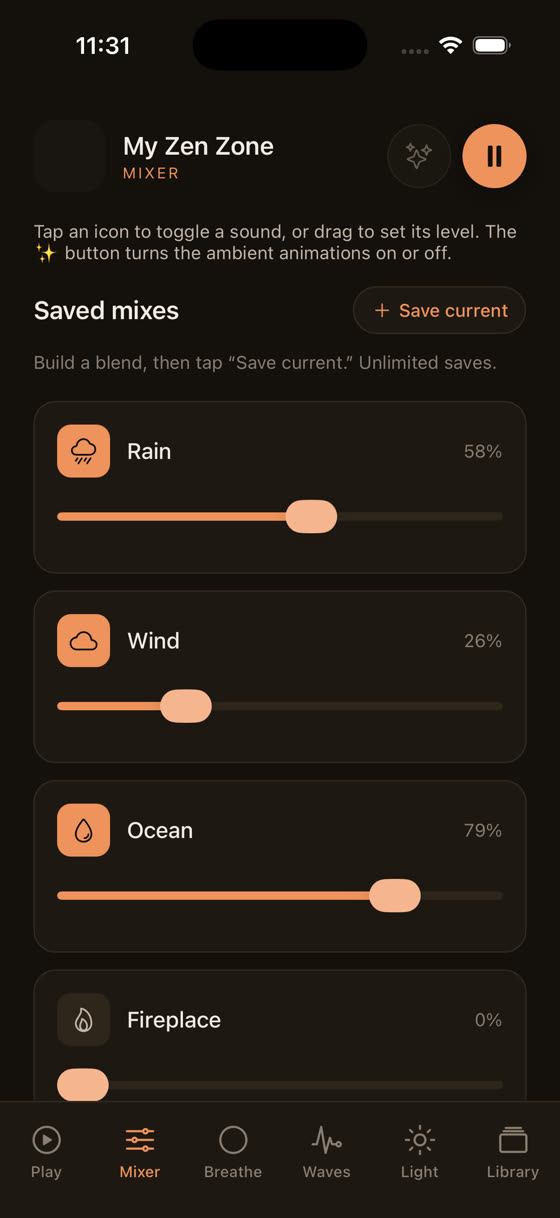
Watching the levels move live is a better explanation than any description of it.
This is the single feature free downloads structurally cannot offer, because a finished file is one fixed mix. A live mixer means the same three sounds can be a study backdrop at 70% rain and 20% drone one afternoon, and a heavier, darker sleep mix at midnight.
Guided sessions that play over the music, not instead of it
Most free guided meditations are a single audio file: voice and music baked together at whatever ratio the recording engineer chose, usually too much voice and not enough music. If the narrator's pace doesn't suit you, or you find the music too quiet, there's no fix. You either put up with it or find another file.
My Zen Zone treats voice, music and nature sound as three separate layers you can raise or lower independently while the session plays.
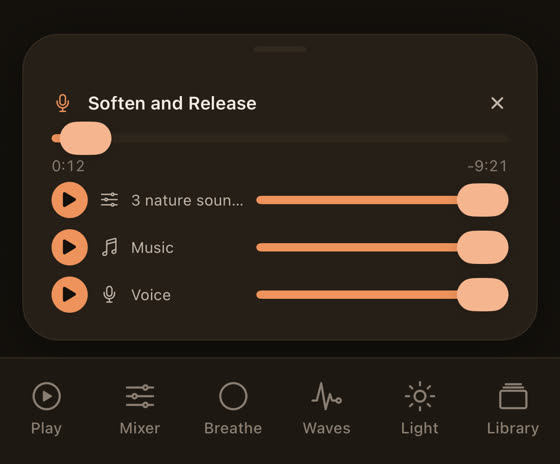
That's a genuinely different way of listening to a guided session, and it's worth seeing rather than just reading about, because most people assume all guided meditation works the same way until they hear one where the music doesn't disappear the moment the voice starts.
What to actually do tonight
If you want a free meditation track right now and nothing else, the YouTube Audio Library will get you a usable, loop-friendly ambient bed in under five minutes. Fine for a one-off.
If you're trying to build an actual practice, five minutes a night rather than a hunt each time, it's worth setting fifteen minutes aside once to explore a free tier properly: find one meditation track and one sleep track that suit you, download them for offline use, and use the same two for a week before judging whether it's working. Consistency in what you listen to matters more than most people expect, in the same way a familiar bed matters more than a new one.
Pair a slow track with the right listening habits for sleep rather than treating the music as the whole solution, and if you also study or work to background sound, the same logic about tempo and mixing applies almost in reverse, which is worth reading about separately in how tempo affects concentration.
A short note on the musicians behind the free tracks
It's easy to forget that "free" music was made by someone. Creative Commons and royalty-free libraries exist because musicians choose to release work that way, often unpaid, and attribution requirements exist to protect that. If you download and reuse a free track anywhere public, check the licence terms rather than assuming free means unrestricted. It's a small courtesy that costs nothing and keeps those libraries viable for the next person searching the same thing you just did.
If what you actually want is music built specifically for meditation from the start, composed with the drone lengths, tempos and loop points that setting requires, it's worth trying the full library at myzenzone.app or starting from the app itself and seeing what a fortnightly-updated, purpose-built catalogue feels like next to a folder of downloaded files.
Common questions
Is it legal to download meditation music for free?
Yes, as long as it comes from a source licensed for free use, such as the YouTube Audio Library, Creative Commons sites, or an app's own free tier. Ripping audio from copyrighted videos or paid streaming services is not legal, even if the file itself is easy to find.
Can I use free meditation music in a YouTube video or class I teach?
Only if the licence allows commercial or public use. Royalty-free doesn't always mean free of restrictions; some tracks require attribution, and some are for personal listening only. Check the specific licence attached to the track before using it anywhere public.
Why does free meditation music often sound worse than paid tracks?
Usually compression and looping. Free tracks are often exported at lower bitrates to save file size, and short loops built for background video use an audible seam when they repeat, which is more noticeable when you're lying still with your eyes closed than when you're half-watching a screen.
Does downloaded music work without an internet connection?
Only if you actually download the file rather than stream it. In My Zen Zone, tracks and guided sessions download for offline use with a subscription, so a flight or a dead connection at bedtime doesn't interrupt the session partway through.
What's a reasonable amount of meditation music to keep on my phone?
Two or three go-to tracks you know well tend to work better than a huge downloaded folder. Familiarity helps you settle faster, and constantly switching tracks to find the "right" one usually keeps the analytical part of your brain awake longer than the music itself would.