You can't fall asleep on willpower alone, and you can't fall asleep just because the clock says you should. The fix isn't to try harder. It's to lower your body's arousal level deliberately, using the same tools that naturally build up tiredness over a long day: slower rhythms, dimmer light, slower breathing, and getting out of a bed that isn't working for you. Do those four things in the right order and sleepiness usually follows within twenty to forty minutes, even on nights when you felt wired at 10pm.
The reason this happens so often isn't a mystery, but it's also not what most advice assumes.
Tired and sleepy are not the same thing
Tiredness is physical fatigue, the heavy-limbed feeling after a long day on your feet. Sleepiness is a separate signal, driven mostly by two systems: your sleep pressure (a chemical called adenosine that builds up the longer you've been awake) and your circadian rhythm (your internal clock, which decides when melatonin rises). You can be exhausted and not sleepy at all, which is why a hard physical day doesn't guarantee an easy night. And you can be relatively well-rested yet feel drowsy right on schedule, which is why your body clock matters more than how your day went.
When someone says "I'm not tired at bedtime," what's usually true is that their arousal is still high. Nervous system still in daytime mode, mind still processing, body not getting the cues that would normally lower heart rate and core temperature. You're not short on sleep pressure. You're carrying too much activation on top of it.
Where most sleep advice goes wrong
Counting sheep, "just relax," clearing your mind, lying still and waiting: these all ask you to do nothing, which is hard precisely when your mind is active. Doing nothing in a quiet, silent, dark room is often the worst environment for a busy brain, because there's nothing else competing for its attention, so it fills the space with whatever you were thinking about at 6pm.
The better approach gives the brain something mild and repetitive to attend to instead, something slow enough that it pulls arousal down rather than up. That's the actual mechanism behind slow music, paced breathing and dim light. They're not relaxing because they're pleasant. They're relaxing because they're monotonous and slow, and your nervous system tends to synchronise toward a steady external rhythm.
Use the 20-minute rule, honestly
If you've been in bed for roughly 20 minutes and you're alert, not drowsy, get up. Staying and trying harder trains your brain to associate the bed with frustration, which makes the next night worse too. Go to another room, keep the lights low, and do something calm and slightly boring, reading something unexciting, or listening to slow instrumental music, until you feel genuinely drowsy. Then go back. This is one of the few pieces of sleep advice with decent evidence behind it, originally from cognitive behavioural therapy for insomnia, though it works for anyone whose arousal is simply too high, not just people with a diagnosed sleep disorder.
Borrow a slower tempo than your own
Music composed for sleep usually sits around 50 to 65 beats per minute, close to or below a resting heart rate. There's some evidence that steady external rhythms in that range can nudge heart rate and breathing to slow down to match, an effect called entrainment. It isn't dramatic and it isn't guaranteed, but it's a real, low-effort lever, and it's one reason a track built specifically for winding down works differently to a song you just happen to like.
What matters is the absence of surprise. No key changes, no drum fills, no swelling chorus. Just a slow, repeating, predictable bed of sound your attention can rest on instead of chewing over the day.
This is also where layering several soft sounds, rather than picking one, tends to work better than silence. A single rain sound can get monotonous enough to become noticeable again after ten minutes; three sounds blended at low, uneven levels disappear into the background instead.
In the app the mixer lets you build that yourself, rain at a low level, a distant drone underneath, a slow piano line barely audible on top, each on its own slider. You're not picking one fixed loop, you're building a texture that doesn't draw attention to itself, which is exactly the point. You can read more about how tempo and layering affect sleep specifically in our piece on the best music for sleep.
Breathe slower than you think you need to
A longer exhale than inhale activates the parasympathetic nervous system, the "rest and digest" side, more than a longer inhale does. A simple pattern many people find useful is four seconds in, six seconds out, repeated for a few minutes. It's not complicated and it doesn't require belief in anything, it's just mechanical: longer exhales slow heart rate.
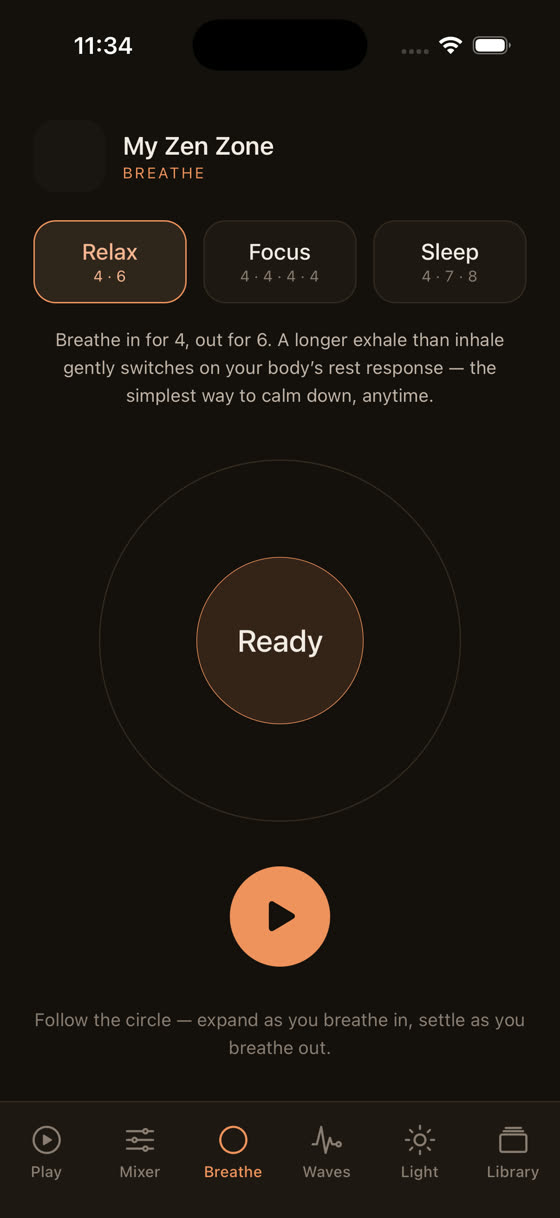
Having something to follow on screen, rather than counting in your head, removes one more small cognitive task, which matters when the whole goal is quieting a busy mind rather than giving it something new to track.
Deal with light before you deal with anything else
Bright light in the hour before bed, especially blue-heavy light from phones and overhead bulbs, suppresses melatonin and delays the point at which you'd start feeling sleepy regardless of how tired your body actually is. This is probably the single most common reason someone lies in bed wide awake despite a long day: the light exposure right before bed told their brain it was still afternoon.
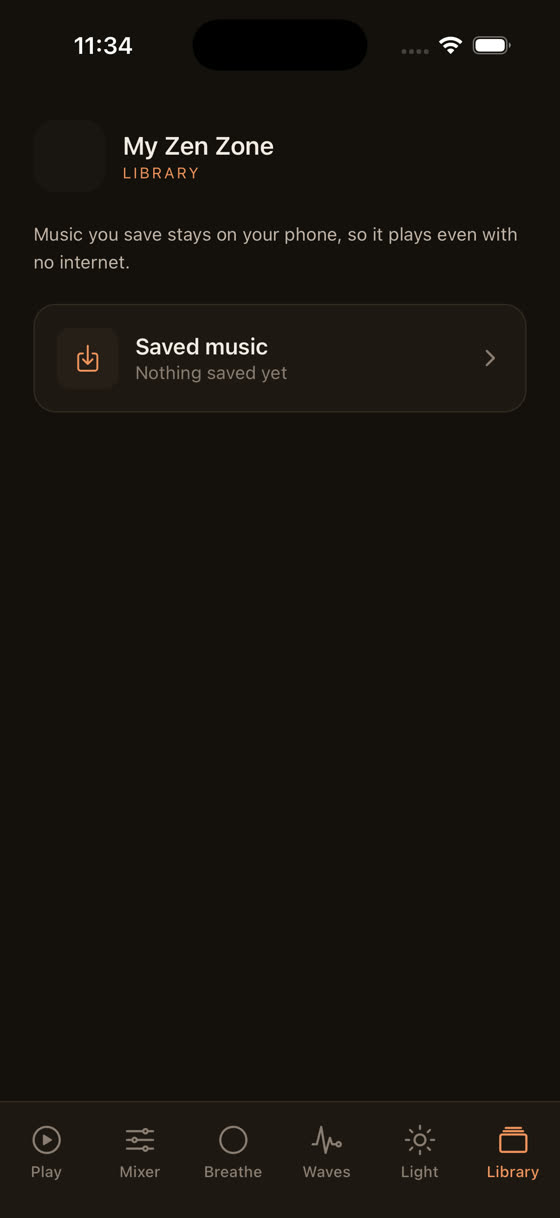
Dimming screens, switching to warm light, or just using a dedicated wind-down screen for the last twenty minutes before bed does more for actual sleepiness than almost anything else on this list, and it costs nothing.
Try brainwave tones if music alone isn't cutting it
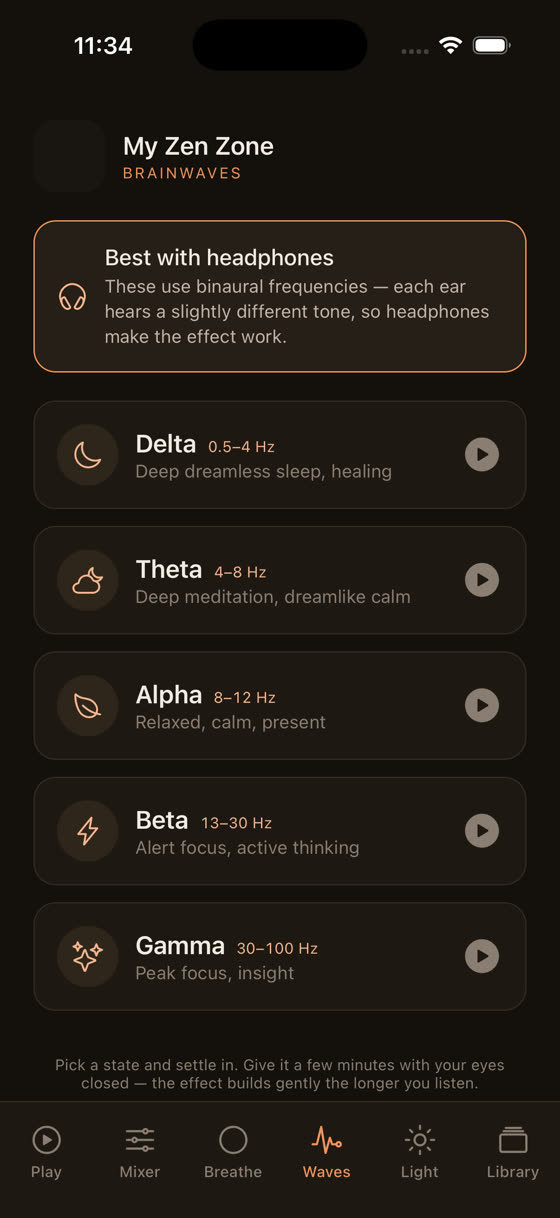
Some people find a binaural or isochronic tone sitting underneath music helps when their mind is especially wired, a slow background pulse in the theta range associated with drowsy, pre-sleep states. The evidence here is thin and mixed, so treat it as worth trying rather than guaranteed, but it's a reasonable low-risk option on a night when standard slow music isn't enough on its own.
Build a routine that doesn't depend on feeling tired
The deeper fix, beyond any single night, is to stop waiting for tiredness to arrive before you start winding down. Pick a consistent time, even if it feels early, and start the same sequence: dim the lights, open something slow, breathe for a few minutes, lie down. Doing this at a consistent time trains your circadian rhythm to expect sleep around then, so sleepiness starts arriving on schedule rather than only after exhaustion forces it.
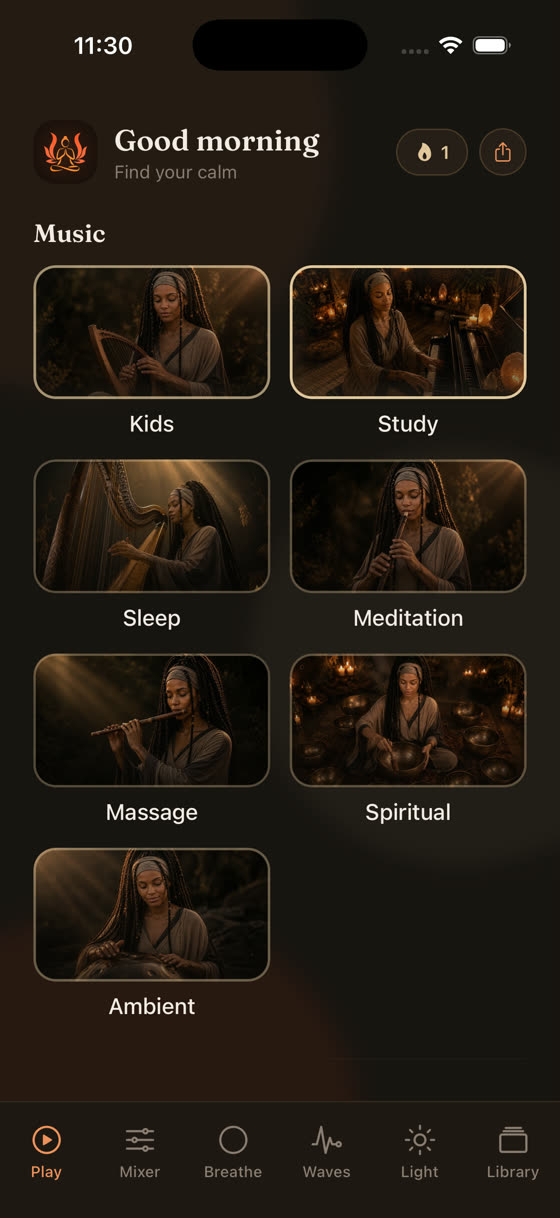
This is also why a library that's actually large matters more than it first seems. A single looped sleep track gets familiar fast, and familiar things stop holding attention, which defeats the purpose. New material added every two weeks keeps the wind-down routine from going stale, so the habit survives longer than most people's patience with a single app does. You can see the full range, sleep, focus, meditation and calm, at myzenzone.app, or go straight to the download if you want to try tonight's routine rather than read about it.
Common questions
Why do I feel wide awake even after a long, tiring day?
Physical fatigue and sleepiness are driven by different systems. A busy day builds sleep pressure, but if your nervous system is still in daytime mode when you get into bed, high arousal can override that pressure. You can be exhausted and still feel alert; the fix is lowering arousal directly, not waiting for more fatigue.
Is it bad to stay up if I'm not sleepy?
Lying awake frustrated is worse than getting up. If you're alert after about 20 minutes in bed, get up, keep lights low, and do something calm until you feel drowsy. Staying put and forcing it tends to teach your brain to associate the bed with wakefulness, which makes future nights harder, not easier.
Do sleep sounds actually work or is it placebo?
There's reasonable evidence that slow, steady external rhythms can nudge heart rate and breathing down through entrainment, and that masking sudden noises with steady background sound reduces awakenings. It's a modest, real effect rather than a guaranteed one, which is why combining it with dim light and paced breathing works better than any single tool alone.
Should I nap during the day if I struggle to feel sleepy at night?
Long or late naps reduce the sleep pressure you need at bedtime, which can make the "not tired" problem worse. If you nap, keep it under 30 minutes and before mid-afternoon. If nights are consistently hard, it's often more effective to protect daytime alertness and let sleep pressure build naturally instead.