Most advice about focusing in class skips the boring truth: attention is not a switch you flip, it's a resource that drains on a schedule. You can improve it in the next hour by changing three things — where you sit, what you did in the ten minutes before the bell, and what your body is running on. Everything else is secondary.
Why your attention actually drops mid-class
The brain works in cycles of roughly 90 to 120 minutes called ultradian rhythms, and within those cycles, sustained attention on one input — a teacher's voice, a slide deck — tends to dip after about 15 to 20 minutes. This isn't a discipline failure. It's the same reason a 50-minute lecture feels fine at minute five and impossible at minute thirty-five. Most people fight this by trying to concentrate harder, which doesn't work, instead of building in small resets: a note taken by hand, a question jotted down, a two-second glance away from the screen. Those micro-breaks are what let the next stretch of attention actually land.
Cognitive load matters too. If you walk into class already tired, hungry, or mid-argument with someone in your head, you've got less working memory left for the actual material. Focus in class is downstream of what happened in the two hours before it, not just what happens during it.
The ten minutes before class matter more than the class itself
Arriving with thirty seconds to spare, phone still buzzing in your pocket, is the single most common reason a class feels unfocused from the start. Your brain needs a runway. Try showing up five to ten minutes early, put the phone in a bag rather than a pocket, and skim yesterday's notes or the reading once. This isn't about being keen — it's priming: giving your brain a rough map of what's coming so it can slot new information into place rather than scrambling to build the map live.
If you study or review beforehand, background sound can do real work here. A steady instrumental track without lyrics, somewhere in the 60-90 bpm range, keeps the nervous system from spiking while you read. Words in the music compete for the same language centres you need for reading and note-taking, which is why lyrics tend to hurt more than help for this kind of task. We cover this in more detail in our piece on music for focus and study, but the short version: instrumental, steady, not too loud.
What to actually do during the class
Handwriting notes, even messy ones, forces a small amount of summarising as you go, which keeps you more engaged than typing verbatim. Sit where you can see the teacher's face and the board without turning your head — side seats and back rows cost you more attention than people admit, simply from the physical effort of tracking what's happening. If the class allows it, ask one question per session, even a small one. Formulating a question is one of the few things that reliably pulls wandering attention back into the room.
Multitasking is the other lie worth naming. Switching between the lecture and a phone screen doesn't split your attention evenly — each switch costs a few seconds of re-orientation, and those seconds add up to whole minutes of the class you never actually processed. If a habit is hard to break mid-class, the more realistic fix is upstream: build the pre-class routine strong enough that you're not reaching for the phone out of boredom at minute ten.
Using sound between classes, not during them
Headphones in class are rarely allowed and rarely a good idea anyway — you need to hear the teacher. But the gaps around class are where sound earns its keep: a free period before a hard subject, a commute, or a revision block right after. This is where most study apps hand you one fixed playlist and hope it fits. It usually doesn't, because a lecture hall isn't a library and a bus isn't your bedroom.
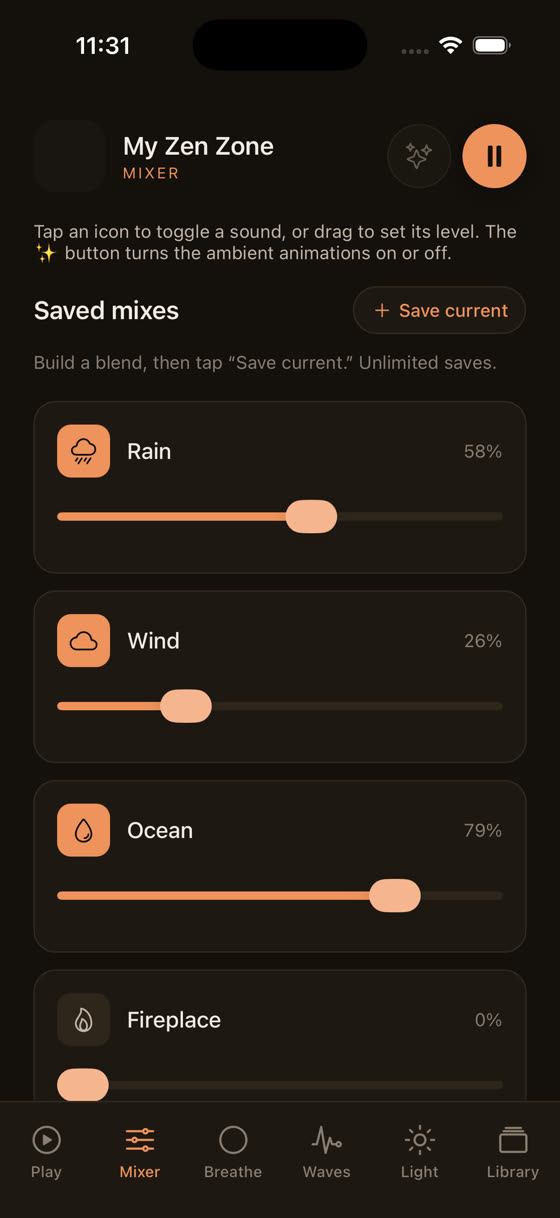
What actually helps is control over the layers of sound rather than one track picked for you. Rain at a low level under a soft piano line, or nothing but a steady brainwave tone if lyrics or melody pull your attention away entirely.
That's the mixer: three sounds, each with its own level, so you can turn the rain down and the tone up until it disappears into the background instead of becoming something else to listen to.
The phone habit nobody wants to hear about
The research on notifications is not subtle: even a phone sitting face-down on the desk, silent, measurably pulls at attention just by being visible. The fix isn't willpower, it's distance. Leave it in a bag, in a locker, in another room if you're studying at home before class. If you use your phone for the actual study session — for notes, for background sound — put it in aeroplane mode with downloaded audio rather than a live stream, so a notification can't surface mid-task. Offline downloads solve this quietly: the sound keeps playing, nothing pings, and the temptation to check anything disappears because there's nothing to check.
Sleep is doing more of this work than people think
A single short night of sleep before a big class or exam period shows up the next day as slower reaction time and a harder time holding information in working memory — not dramatically, but enough to feel like the material is