The short answer
You focus better when reading by removing the things competing for your attention before you open the book, not by trying harder once you're already in it. That means your phone in another room, a single task in front of you, and if you use background sound, something with no lyrics and no surprises in it. Willpower is the last line of defence, not the first.
Most advice on this topic skips straight to tips — timers, highlighters, note-taking systems — without explaining why focus collapses in the first place. Understand that and the tips make more sense.
Why your attention keeps sliding off the page
Reading is unusual among mental tasks because it's entirely self-paced. Nobody is setting the tempo for you the way a lecture or a podcast does. Your brain has to generate its own momentum, and the moment that momentum dips, anything louder or more interesting is ready to take over. A notification. A half-formed worry about tomorrow. The temptation to check what time it is.
There's also the issue of subvocalization — the quiet inner voice that reads along with your eyes. When you're tired or distracted, that inner voice starts running two tracks at once: part of it reading the sentence, part of it drafting a reply to a text you haven't answered yet. You can feel this happening. You reach the bottom of a page and realise you absorbed almost nothing. That's not a comprehension problem. It's an attention-allocation problem, and it's exactly why reading suffers more from distraction than tasks with a built-in rhythm, like walking or running.
Fix the room before you fix the soundtrack
This is the part most articles underplay. The single biggest lever isn't music, it's your environment, and specifically your phone. Not on silent — in another room. The pull of a phone sitting face-down next to you is measurable even when it never buzzes; you know it's there, and some part of your attention is reserved for it. Reading with your phone within reach is like trying to have a quiet conversation with someone who keeps glancing at the door.
Light matters too, more than people expect. Reading under a single warm lamp rather than overhead light narrows your visual field to the page and cuts down on peripheral movement that pulls your eyes away. If you wind down with reading before bed, a dim, warm light also signals to your body that the day is closing, which is a separate but related reason we built a dedicated light screen into the app for exactly that transition.
Does music actually help you focus when reading
Be honest about this one: the evidence is thin and mixed, not because nothing works but because people vary enormously. Some readers concentrate better in total silence. Others find silence itself distracting, because every small sound in a quiet room — a fridge humming, a floorboard — becomes its own interruption, and a steady layer of sound masks those spikes rather than adding to the noise.
What the research does suggest fairly consistently is that lyrics hurt reading comprehension specifically, because your language-processing system is already occupied with the words on the page. A voice singing competes directly for the same mental resource. Instrumental music doesn't carry that cost the same way, which is why it's the safer default if you're going to use music while reading at all.
What kind of music helps, and what ruins it
If background music works for you, the details matter more than people assume. Look for something slow and steady, roughly 50 to 70 beats per minute, which sits close to a resting heart rate and doesn't pull your pace up or down. Piano, strings, and ambient textures tend to work better than anything with a strong beat, because a beat invites your foot to tap and your attention to follow it.
Structure matters as much as tempo. A track with a big swell halfway through, or a sudden key change, will yank your attention away from the page exactly when it happens — which defeats the point. This is part of why we compose tracks for our focus library to stay deliberately even: no big crescendos, no drop, nothing designed to be noticed. Good focus music is music you forget is playing.
Build a reading session instead of hoping for one
Treat reading as a block with edges rather than something you drift into. Twenty-five to forty minutes is a reasonable length — long enough to get past the slow first few pages where your mind is still settling, short enough that you're not relying on willpower to get through it. Set a timer and tell yourself you only need to protect that one block, not the whole evening.
Start the same way every time if you can. Same chair, same light, same two minutes of quiet before you open the book. Rituals do a surprising amount of work here, because they signal to your brain that a specific kind of attention is about to be asked of it, the same way a pre-sleep routine signals the body to wind down rather than stay alert.
Layer the right background sound, not just any sound
Generic ambient playlists tend to get this wrong because they're fixed: one rain sound, one volume, take it or leave it. What actually helps is control — being able to dial in exactly the amount of masking you want without it becoming its own distraction.
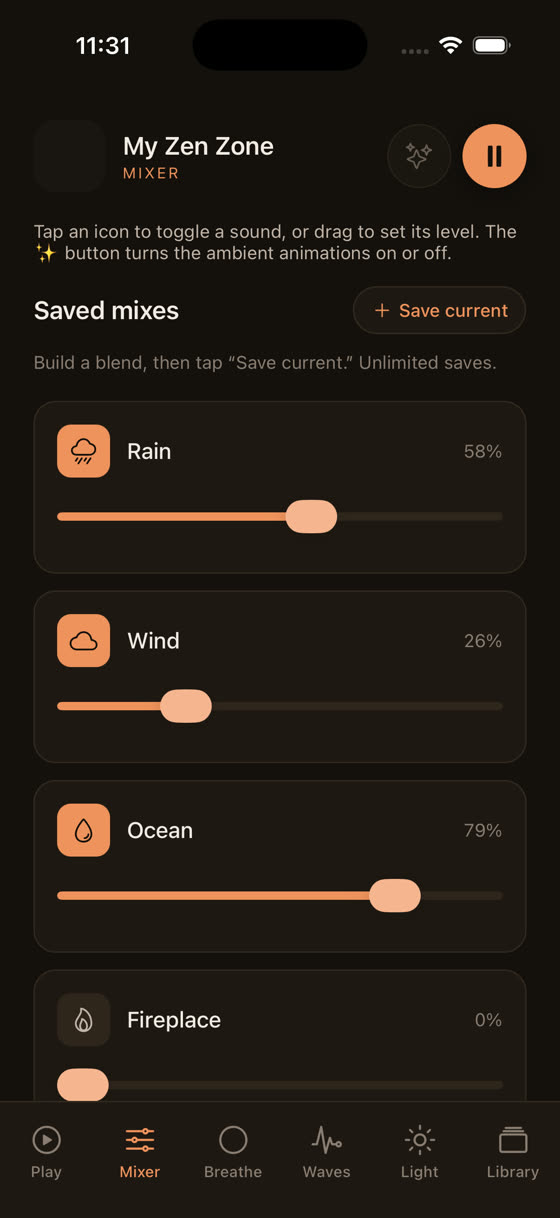
In the app, the mixer lets you blend something like a quiet piano piece at low volume with a thread of rain or distant white noise underneath it, each on its own slider. Some readers want almost no music and mostly rain. Others want the opposite. There's no single right balance, which is exactly why a fixed playlist is the wrong tool for this job and a mixer isn't.
When music won't fix it, and what will
If you've tried the right kind of background sound and you're still losing the thread every few paragraphs, the honest answer is that no soundtrack fixes a fundamentally wrong environment or a genuinely overloaded mind. If you're reading dense material at 11pm after a full day, the problem is tiredness, not acoustics, and more sound won't solve it. In that case it's worth separating your reading time from your wind-down time rather than asking one session to do both jobs — save the slower, heavier-eyed reading for daylight, and let evening reading be lighter.
It's also worth checking whether the material itself is the issue. Dense, unfamiliar text genuinely demands more from working memory, and no amount of environmental tuning changes that. Sometimes the right move is reading in shorter bursts with real breaks, not fighting through fatigue with a longer session.
Where this fits with the rest of your day
Reading focus doesn't exist in isolation from sleep and stress the rest of the day. Someone who's wired from screens all evening will struggle to settle into a book regardless of the music playing, and someone sleep-deprived will drift off mid-paragraph no matter how good the lighting is. If evenings are the problem, it's worth looking at what happens an hour before you pick up the book, not just during it — our piece on music for sleep covers the broader wind-down side of that if reading is part of your bedtime routine rather than a standalone session.
New instrumental tracks go into the library every two weeks, built specifically with these tempos and structures in mind rather than borrowed from a generic playlist, and you can download them for offline reading sessions where your signal or data isn't reliable. If you want to try building a proper reading block tonight, the library's Focus category is a reasonable place to start — you can see the full range at myzenzone.app/get.
Common questions
Is silence better than music for reading focus?
For some people, yes. If your reading environment is already quiet and you don't get distracted by small background noises, silence is fine and adds nothing to change. Music or ambient sound tends to help most when your space has unpredictable noise that a steady background layer can mask.
Why does music with lyrics hurt my concentration when reading but not when exercising?
Reading and lyrics both use your brain's language-processing system at the same time, so they compete directly. Exercise doesn't rely on that same system, which is why lyrics feel fine on a run but pull your attention away from a page within a paragraph or two.
How loud should background music be while reading?
Quiet enough that you could have a normal conversation over it without raising your voice. If you notice the music, it's too loud or too eventful. The goal is a steady layer you stop consciously hearing within a few minutes, not something you're actively listening to.
Does classical music specifically help you read faster or remember more?
There's no solid evidence that any one genre improves reading speed or memory on its own. What tends to help is slow tempo and a lack of lyrics or sudden changes, qualities classical pieces often have, but plenty of modern instrumental and ambient music shares those same traits.
Can I use the same focus music for studying and for casual reading?
Yes, though dense study material may benefit from an even steadier, more minimal track since your working memory is already under more load. For lighter reading, you have more room to use something with a bit more melodic movement without it pulling your attention away.