The short answer
Open the Mindfulness app on your Apple Watch, tap either Reflect or Breathe, set a duration, and start. When the session ends, it writes automatically to the Health app under Mindful Minutes. No extra step, no syncing button. If you meditated through a different app instead of Apple's own, it only shows up in Health if that app has been given permission to write to the Mindfulness category in HealthKit.
That permission detail is where almost everyone gets stuck. The rest of this is about why, and what to do about it.
What's actually happening behind the Mindful Minutes number
HealthKit treats mindfulness the same way it treats steps or sleep: as a data category that any authorised app can write to. Apple's own Mindfulness app is pre-authorised, which is why it logs without asking. A third-party meditation app has to request write access to that same category, and you have to grant it, usually during first setup or buried in Settings > Privacy & Security > Health > [App Name]. If you tapped through setup too fast and said no, the app can run a perfectly good session and Health will never know it happened.
You can check who's actually allowed to write mindfulness data at any time. Open the Health app, go to Browse > Mindfulness, then Data Sources & Access. It lists every app with permission, in the order they last wrote data. If an app you use regularly isn't on that list, that's your answer.
Where people lose minutes without noticing
A few patterns come up constantly:
- Closing the Watch app, or raising the wrist to check a message, before the on-screen timer actually finishes. A session cut short sometimes logs a partial time, sometimes nothing at all, depending on watchOS version.
- Starting a meditation through the Workout app instead of Mindfulness. It gets logged as exercise, which is a different category entirely and won't show up as mindful minutes however calm you felt.
- Leaving the Watch on the nightstand while meditating with the phone in hand. If the session is only running on the phone and the phone app has no HealthKit permission, there is nothing for the Watch to log.
- Denying the permission prompt once, months ago, and forgetting it ever happened. This is the most common one by far.
Can you backfill a session you forgot to log?
Not reliably, as far as we're aware. Unlike categories such as weight or water intake, mindful minutes aren't something you can type in manually after the fact through the Health app's own interface. If a session didn't get captured in the moment, by either Apple's app or a third-party one with permission, it's gone. The honest fix isn't a workaround, it's starting the Watch's own Mindfulness timer at the same moment you begin whatever you're actually doing, even if that's listening to a guided session on your phone.
Running your own practice alongside the Watch's tracker
This is the setup that actually works day to day: let the Watch handle the logging, and let your meditation app handle the meditating. Start the Mindfulness app on your wrist for the minute count, then play the real session, the one with a voice guiding you and music underneath, through your phone.
Most meditation apps play a single pre-mixed track, voice and music baked together at one fixed volume. Ours doesn't work that way. A guided session in My Zen Zone is built as separate layers, voice, music, and an optional nature sound, each with its own level you can raise or lower while it plays.
That matters more than it sounds. If the narrator's voice is too loud against the music, or you want the music barely audible and the voice up front, you adjust it mid-session rather than living with whatever the app's engineer decided. It also means the music under the voice is never generic stock audio. It's recorded by the same person who builds the rest of the library, so the tone matches the room you're trying to create, not whatever was cheapest to license.
Why minutes logged isn't the same as a real practice
A number in Health tells you how long you sat there. It says nothing about whether your breathing actually slowed, whether your mind settled, or whether you were just watching the countdown. Worth saying plainly: there's limited independent evidence for exactly how many minutes of mindfulness produce any specific measurable benefit, so treat the streak as a habit tracker, not a dosage chart.
What does seem to help, anecdotally and in how most guided practices are built, is pacing your breath deliberately rather than letting the mind wander at whatever rate it wants. A 4-6 pattern, four seconds in, six seconds out, nudges the exhale longer than the inhale, which tends to feel calmer within a few cycles.
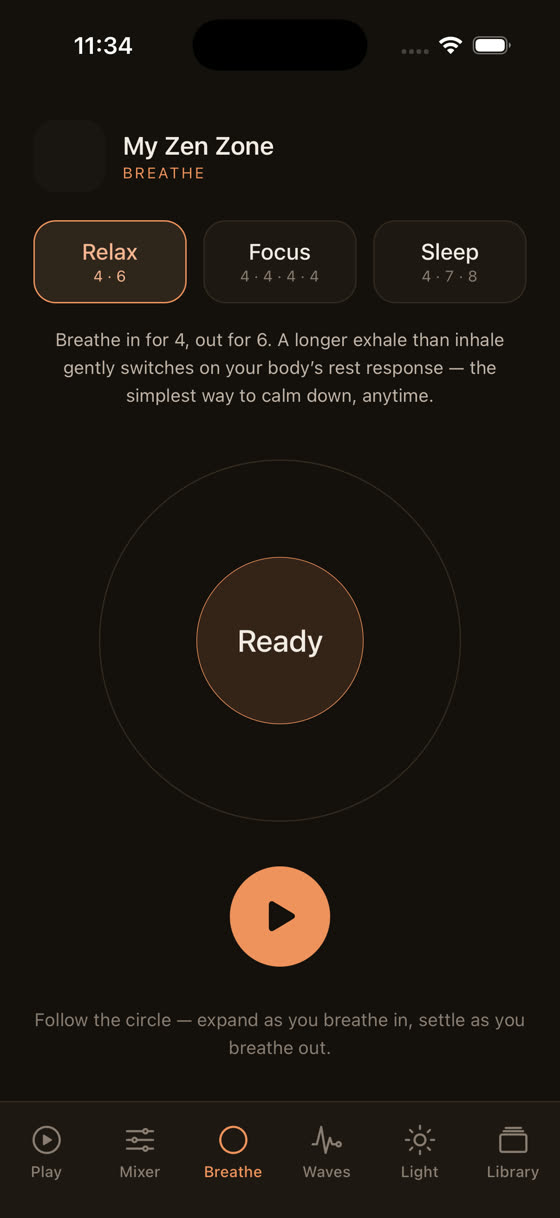
That's the same shape behind the breathing screen in the app, there to use whether or not a guided voice is playing over it. It's a useful anchor on a day when fifteen minutes feels impossible and ninety seconds of slower breathing is the realistic ceiling.
Make the environment part of the session, not an afterthought
The room you meditate in is doing more work than most people credit. A radiator ticking, traffic outside, a housemate's television through the wall, all of it pulls attention away from the breath far more than an active thought does, because it's unpredictable. Masking it with something steady and low helps more than silence does for a lot of people.
The mixer lets you layer rain, a low drone, and the guided voice at three independent levels, so the room noise gets covered without the nature sound itself becoming the new distraction. It's the same mixing logic used for sleep tracks, where getting the balance of layers right matters just as much; there's more on that approach in our piece on the best music for sleep, and the same principle shows up again in how we think about music for focus and study, where the goal is steady background texture rather than anything that pulls attention toward itself.
A simple routine for tonight
Open the Watch's Mindfulness app and start a timer for whatever length feels honest, five minutes is a completely legitimate number. At the same moment, start a guided session or an unguided music track on your phone. Adjust the voice and music levels once, in the first thirty seconds, then leave it alone. Let both run to the end rather than checking the time halfway through. The Watch logs the minutes; you get the actual experience from whatever's playing. Two separate jobs, done by two separate tools, each doing the one thing it's built for.
If you don't already have the app, it's available at myzenzone.app/get, with new tracks added roughly every two weeks so the library doesn't start feeling familiar after a month. You can also browse the full catalogue from a browser at myzenzone.app if you'd rather see what's there before putting it on your phone.
Common questions
Why isn't my meditation app showing up in the Health app at all?
Almost always a permissions issue. Open the Health app, go to Browse > Mindfulness > Data Sources & Access, and check whether that app is listed with write access. If it isn't, go to Settings > Privacy & Security > Health, find the app, and turn Mindfulness on. New sessions will log from that point, not retroactively.
Does using the Workout app for meditation count as mindful minutes?
No. The Workout app logs to the exercise/activity categories, not Mindfulness, even for a slow, seated session. If you want the minutes to count as mindfulness specifically, use the dedicated Mindfulness app on the Watch, or a third-party app with Mindfulness write access, not the Workout app.
Can I log a meditation session I did without wearing my Watch?
Not reliably. Mindful minutes aren't something you can type in after the fact through Health's own interface the way you can with weight or water intake. If the Watch or an authorised app wasn't running at the time, there's generally no way to add it later.
Does My Zen Zone automatically log minutes to Apple Health?
The app is built for the guided sessions and music themselves, layered and mixed by you, rather than for duplicating the Watch's own Mindfulness tracker. If logging minutes matters to you, run the Watch's Mindfulness app at the same time you play a session in ours; both will do their job without any manual syncing.
What's a realistic amount of time to start with?
There's no firm evidence pointing to an ideal number, so start smaller than feels impressive. Five minutes done consistently beats twenty minutes attempted twice and abandoned. Once sitting still for five minutes feels unremarkable, extending the session tends to happen on its own rather than needing to be forced.