The Short Answer, and Why It Works
The fastest way to relax your nervous system is to slow your exhale and slow the sound around you at the same time. Breathe out for six seconds, four or five times in a row, with something nearby moving at around 60 beats a minute or slower, and most people feel their shoulders drop within two minutes. That is not a trick or a hack. It is two separate inputs, breath and sound, both reporting back to the same system and both saying the same thing: nothing here requires you to be ready for danger.
Here is the mechanism, in plain terms. Your autonomic nervous system runs on two main settings, sympathetic (alert, ready, fight or flight) and parasympathetic (rest, digest, recover). The vagus nerve is the main wiring between your brain and your organs for the parasympathetic side, and it is unusually sensitive to the length of your exhale and to low, steady, predictable sound. A long exhale slows your heart rate on that breath. A tempo near resting heart rate gives your body an external rhythm slower than its own alarm state to match. Neither is a cure. Both are leverage.
What "Calming the Nervous System" Actually Means
It is worth being precise here because the phrase gets used loosely. You are not switching anything off completely; the sympathetic and parasympathetic systems are always both a little active, and the goal is a shift in balance, not a binary flip. Heart rate variability, the small natural variation in time between heartbeats, is often used as a rough proxy for this balance, and it tends to improve with slow breathing and calm environments. The research on breathing and heart rate variability is reasonably solid. The research on music specifically changing nervous system state is thinner and more mixed than most wellness articles admit, partly because music is so personal. A cello at 60 bpm might calm one listener and irritate another who associates strings with a funeral. So treat everything below as a set of tools worth testing on yourself, not a guarantee.
Breath Is the Fastest Lever You Have
If you only do one thing from this article, do this: inhale for four seconds, exhale for six. That asymmetry, a longer exhale than inhale, is the part that matters most. It mimics what your body does naturally when you are genuinely safe and winding down, so doing it on purpose borrows that same signal. Four minutes is usually enough to notice a change; it is not a long commitment.
Box breathing (four in, four hold, four out, four hold) gets more attention online, but for pure down-regulation a longer exhale pattern tends to work faster because the hold phases do not add much extra parasympathetic signal. We built a breathing screen around a 4-6 pattern for exactly this reason, with a visual that expands and contracts so you are not counting in your head while also trying to relax.
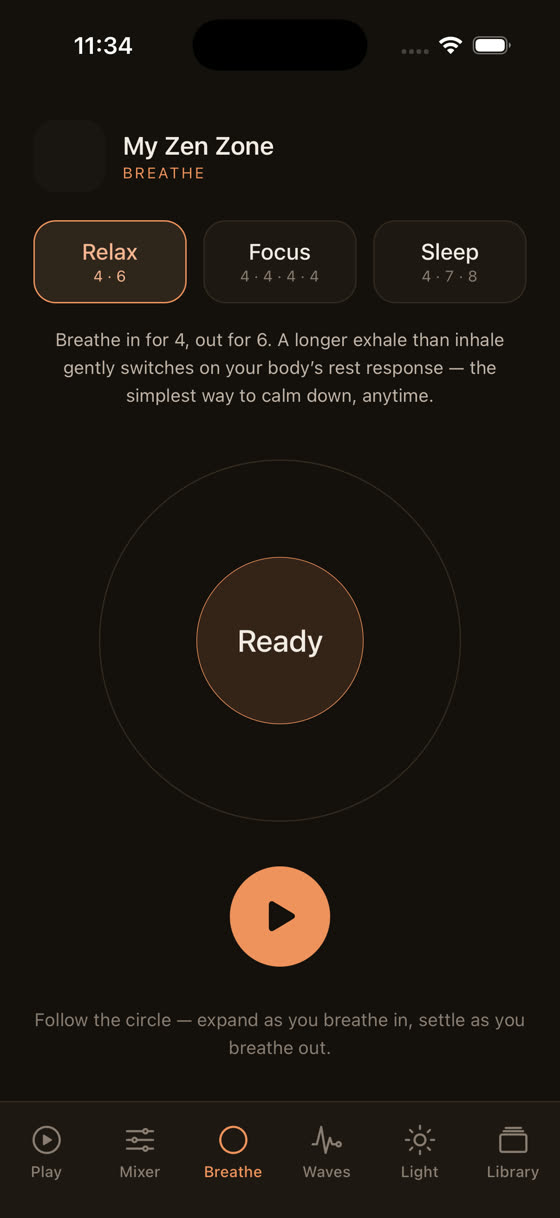
Use it before a stressful call, before sleep, or honestly anywhere you've got sixty seconds and a racing mind.
Why Tempo and Instrumentation Matter More Than Genre
"Calming music" is not a genre, it is a set of measurable properties. Tempo around 60-70 bpm, roughly a resting heart rate. No sharp transients, so no sudden cymbal hits or plosive vocal sounds that spike attention. Predictable structure, so your brain isn't bracing for a key change or a drop. A lot of music marketed as relaxing fails on one of these even when it sounds gentle on the surface, because a soft piano piece can still have erratic timing that keeps you subtly alert.
Layering matters too. A single instrument can feel thin or repetitive over twenty minutes, but three elements at different levels, a slow pad, a recurring rain sound, something with almost no melody, is harder for your brain to predict and tune out at the same time. That's the actual argument for mixing your own sound rather than hitting play on a fixed track.
Watch what happens when you push the rain up and pull a low drone down: the whole emotional register of the room shifts without the tempo changing at all. That's the mixer, three nature sounds each at their own level, built because nobody's idea of calm is identical, and a track that's perfect for one person at 50% volume might need the opposite balance for you. If you want the deeper version of this argument, including specific examples of what to layer for sleep versus focus, we've written more on it in best music for sleep.
The Mistake Most Advice on This Topic Makes
Most articles tell you to "put on calming music" or "sit in silence" as if those are universal fixes. They are not, and treating them that way wastes people's time. Silence is genuinely uncomfortable for some people, especially anyone whose mind gets louder without external input, a common experience for people with anxiety or tinnitus. For them, a low constant sound, not music exactly, more like a tone or a steady wash of rain, works better than nothing. Conversely, some people find instrumental music distracting precisely because their brain tries to follow the melody, and a plain brown-noise or binaural layer does more for them than a composed piece ever will.
The other mistake is treating relaxation as a single event rather than a skill you build. One good breathing session before bed is nice. Ten minutes of slow sound and slow breath most evenings, even on the nights you don't feel wound up, is what actually moves your baseline over weeks. That's a less exciting sentence to write, but it's the honest one.
Building a Routine Instead of a One-Off Fix
A nervous system that's been running hot all day doesn't downshift the moment you decide to relax at 10pm. It needs a runway. That usually means dimming actual light in the room, not just your screen, cutting off anything with a fast or unpredictable rhythm (news, most podcasts, anything competitive), and giving yourself fifteen to twenty minutes of something slow before you expect to feel different.
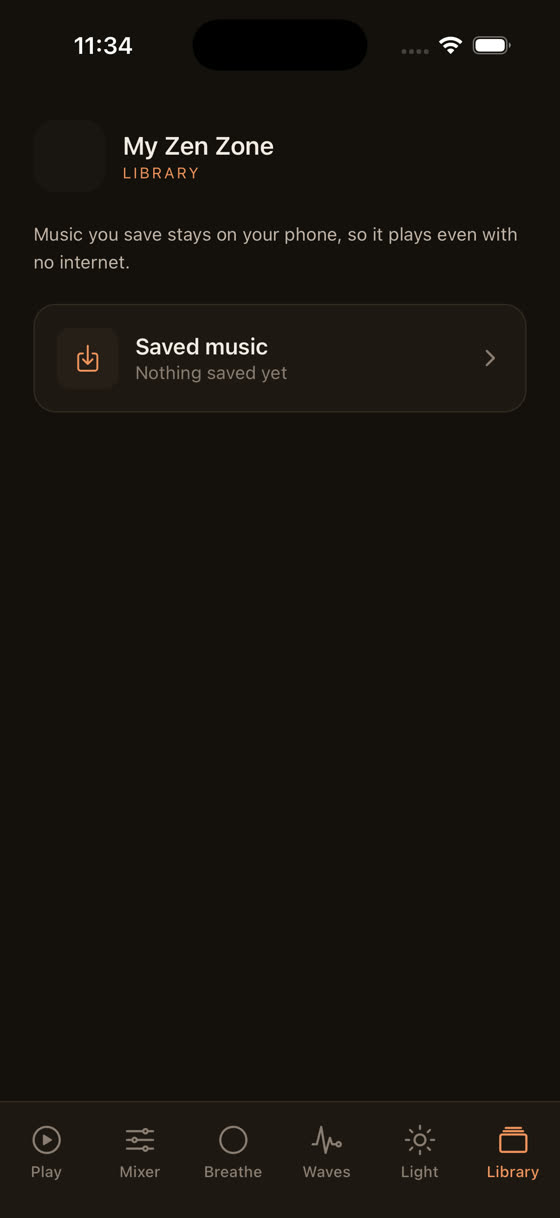
We added a light screen for exactly this transition window, something to look at that shifts gradually rather than a bright phone screen fighting against the thing you're trying to do. Pair that with a sleep timer so the music or sound fades out on its own rather than running all night or cutting off abruptly and startling you awake. Small mechanical details like a timer sound unglamorous, but they're the difference between a routine you actually keep and one you abandon after three nights.
Tools Worth Trying Tonight
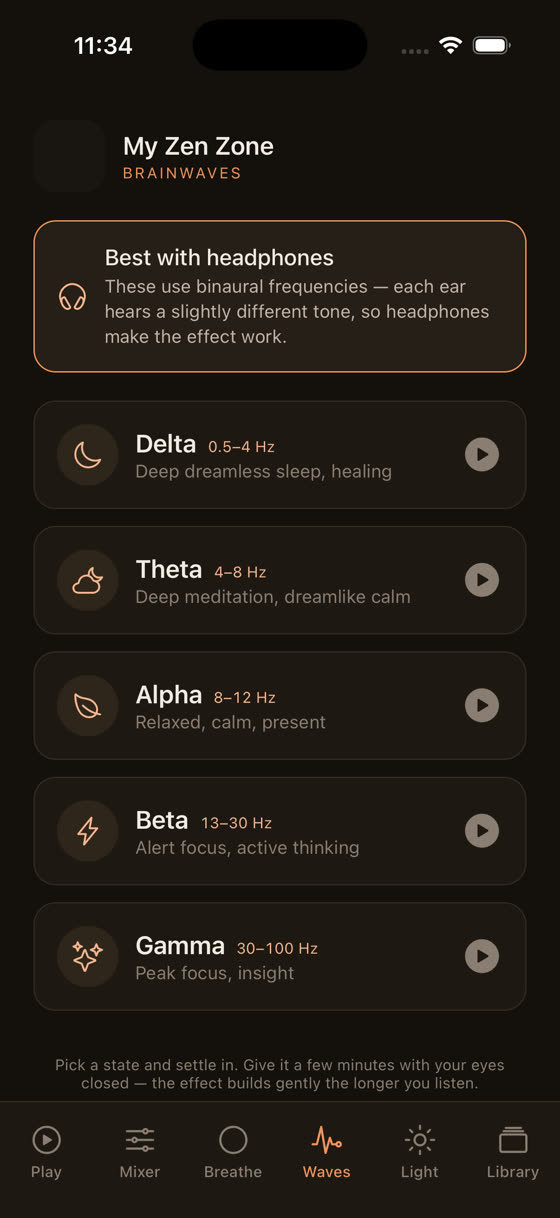
Beyond breath and tempo, there are a couple of specific tools worth naming because they're less well known. Brainwave tones, low pulsing frequencies designed around states like deep relaxation, are one; the evidence for them is early and mixed, but plenty of people find them a useful low background layer rather than a centrepiece.
Guided sessions are the other. Most apps play a voice instead of music, which means you lose the sound environment the moment someone starts talking. We built ours so the voice is its own layer, sitting over the music and nature sound rather than replacing them, with independent levels for each.
That's a guided session playing over the music, not instead of it; you can bring the voice down to a whisper under the rain, or bring it forward and fade the music out, depending on what your evening actually needs. The whole library, hundreds of tracks from one composer working in-house, grows every two weeks, so this isn't a fixed playlist you'll exhaust in a month. You can start from the app or browse the full range at myzenzone.app on a laptop if that's where your evening winds down.
When This Isn't Enough
Breath and sound are genuinely useful for everyday stress, a racing mind before sleep, the jitteriness after a hard meeting. They are not a treatment for clinical anxiety, panic disorder, or trauma responses, and nothing in this article should be read as medical advice. If calming techniques aren't touching the intensity of what you're feeling, or if it's happening most days, that's worth taking to a doctor or therapist rather than solving with an app. Music and breathing are good daily maintenance. They are not a substitute for the help some nervous systems genuinely need.
Common questions
How long does it take to relax your nervous system?
A single long-exhale breathing session can shift how you feel within two to four minutes. But your baseline, how quickly you get wound up in the first place, tends to change over weeks of regular practice, not a single session. Treat quick relief and long-term change as two different goals with two different timelines.
Does music actually lower cortisol or heart rate?
Slow, predictable music is linked to small reductions in heart rate and perceived stress in several studies, but the research is mixed and effects vary a lot between people. It's a reasonable, low-risk tool worth trying, not a guaranteed physiological fix backed by strong consistent evidence.
What's the difference between calming music and white noise for this?
Calming music gives your brain a slow, predictable rhythm to loosely follow. White or brown noise gives it a flat, textureless signal with nothing to track. Some people relax more with the former, some with the latter, especially if melody tends to pull their attention rather than soothe it. Worth testing both.
Can I use these techniques during the day, not just at night?
Yes, and you probably should. A four-minute long-exhale breath before a difficult meeting or a tense conversation works the same way it does at bedtime. Keep it brief during the day; you want calm and alert, not calm and drowsy, so skip the heavier sleep-focused sounds until evening.
Is it bad to fall asleep with music or nature sounds playing?
Not inherently, but let the sound stop rather than loop all night. A sleep timer that fades out after 20 to 45 minutes gives you the wind-down benefit without a constant stimulus running for eight hours, which can interfere with deeper sleep stages for some people.