Most relax apps are free to download but not free to actually use for more than a week or two. You get a handful of tracks or sessions, a badge that says \"free trial,\" and then a paywall right when you've started to rely on it. That's true on iPhone, on Android, and on Apple Watch and Wear OS versions too, where the watch app is usually just a remote control for whatever you've already paid for on the phone.
So the honest answer is: free to try, not free to keep. The more useful question is what you're actually paying for once the trial ends, and whether that thing is worth it to you. That's what this post is really about.
Why \"is it free\" is the wrong first question
Every relaxation app has to pay a musician, a sound engineer, or a licensing fee to someone, every single track you hear. That cost doesn't disappear because the app is free to download. It gets recovered somewhere: ads between your sleep sounds, a locked library after ten tracks, or a subscription that unlocks everything at once. None of these are dishonest. But \"free\" as a headline hides where the cost actually lands.
A better question is: what do I get before I pay, and does that match what I need tonight? If you just want white noise to fall asleep to, a free tier with three ocean tracks on loop might genuinely be enough. If you're trying to build a nightly wind-down habit, or you need something different for focus at 2pm versus sleep at 11pm, a thin free tier will frustrate you inside a fortnight.
What free tiers usually include, and what they quietly leave out
In practice, free relaxation apps tend to offer:
- A small rotating selection, often five to fifteen tracks total
- One or two categories, usually sleep and "relax," with focus and meditation locked
- No offline downloads, so you need a signal or Wi-Fi every time
- No sleep timer, or a basic one that just stops playback with no fade
- Ads inserted between tracks, which is the last thing you want at 11pm
What's missing is usually the thing that makes a relaxation app actually useful long-term: control over the sound itself. Most free tiers give you a finished track and nothing else. You can't turn down the rain and turn up the piano underneath it. You get one version, take it or leave it.
What changes when you subscribe
A paid tier isn't just "more tracks." The better ones change what you can do with the sound, not just how much of it you get. In My Zen Zone, subscribing unlocks the full library across sleep, focus, meditation, and calm, plus a browser version so you can play the same library at your desk, not just on your phone. New music is added every two weeks, composed and recorded by one musician rather than licensed in bulk, so the catalogue actually grows instead of just rotating the same fifty tracks.
It also unlocks the mixer, which is the part that free apps almost never offer because it takes real engineering, not just more content:
Three nature layers, each on its own slider, so you can drop the rain to a whisper and bring up a low drone at 60-70 bpm, roughly a resting heart rate, without the whole track feeling static. That kind of control is the difference between background noise and something built for the fifteen minutes you actually have.
The Apple Watch and Wear OS question specifically
If the "watch app" part of your question is about Apple Watch or Wear OS specifically: yes, most relax apps ship a companion watch app, and yes, it's usually free in the same limited sense as the phone app. It mirrors whatever tier you're on. A free account on your phone means a free, limited watch app too. A subscription unlocks the same full library on the watch, though watch screens are small and battery life matters, so most people use the watch to start a session or set a sleep timer, then let the audio play through the phone or a speaker rather than watch speakers alone.
One thing worth checking before you assume a watch app will solve your problem: whether it needs the phone nearby to stream, or whether it can hold downloaded tracks itself. Cellular watches with their own downloads are still the exception, not the rule, across this category.
What most articles on this topic get wrong
A lot of "is this app free" posts stop at price. They don't mention that the real gap between free and paid tiers in relaxation apps is almost always control, not volume. Ten free tracks with a mixer and offline downloads would beat two hundred free tracks with none of that. But volume is easier to advertise, so that's what gets compared.
The other thing that gets missed: guided sessions in most apps stop the music entirely to play a voice track. You lose the bed of sound you picked specifically because it worked for you, and get silence-then-voice-then-silence instead. That's a design choice, not a technical necessity.
Here, a guided session plays as a layer over the music, not instead of it, with separate levels for voice, music, and nature sound. You can bring the narrator down and the music up once you know the pattern, which matters if you use the same session most nights and don't need it read to you in full every time.
What to actually check before you download anything
Skip the marketing copy and look at four things directly:
- Can you play something offline, on a train or a flight, without a live connection
- Is there a sleep timer with a fade-out, not just a hard stop
- Can you adjust the mix, or only choose between whole finished tracks
- Does the library grow, or is it the same fixed set you'll be sick of in a month
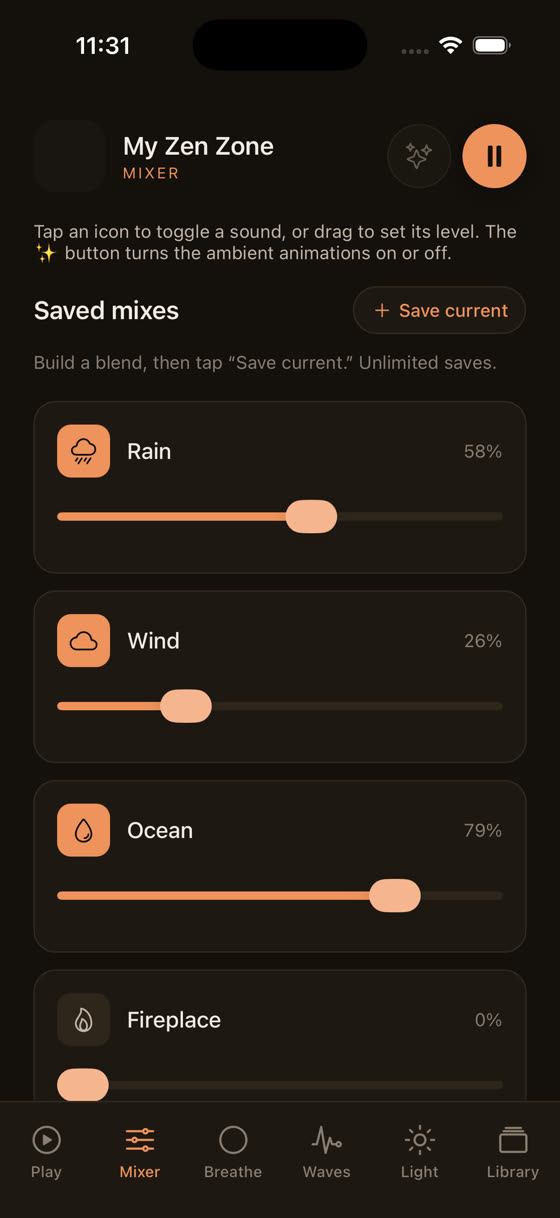
A screen like this, three nature sounds each sitting at a different level, tells you more about whether an app will hold up over months than any pricing page does. If an app can't show you something like it, it's probably a static playlist wearing an app icon.
What we'd actually suggest tonight
Try the free tier of whatever you've downloaded for a few nights and pay attention to when you reach for the skip button. That's the moment that tells you whether the fixed track selection is the problem, not the pricing. If you're skipping because the mix is wrong, not because the track is wrong, that's a sign you need a mixer, not just more content.
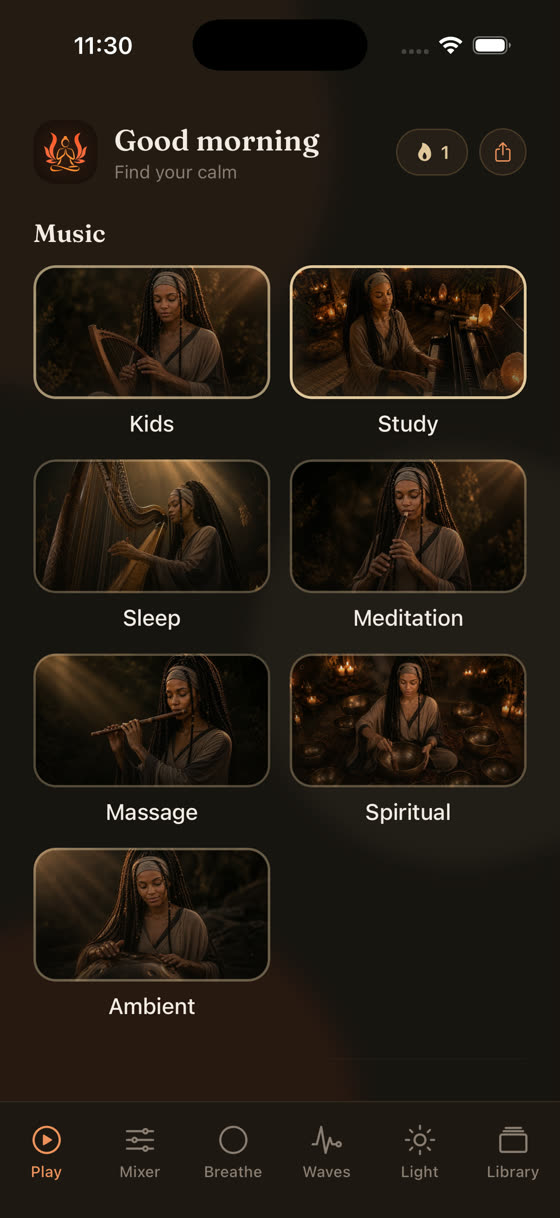
My Zen Zone's home screen splits into sleep, focus, meditation, and calm as separate worlds rather than one long list, which matters if you're the kind of person who wants something different for a 2pm focus block than for falling asleep. You can read more on what actually helps with sleep or music built for focus and studying if you want the detail on either end of that. And if you'd rather just see it than read about it, the app itself is the fastest way to check whether the mixer and the growing library are worth it for you specifically.
The honest bottom line
No serious relax app is free forever, and none should be, because someone made the music you're hearing. What's worth checking isn't the price tag but what the free tier withholds: control over the mix, offline access, a sleep timer that actually fades, and whether the library is alive or frozen. Answer that, and the "is it free" question mostly answers itself.
Common questions
Does My Zen Zone have a free trial before I have to pay?
Yes, you can try the app before subscribing, which gives you a look at the interface, the categories, and how the mixer works before committing. The subscription is what unlocks the full library across sleep, focus, meditation, and calm, plus the browser version and the fortnightly new tracks.
Can I use a relax app on Apple Watch without my phone nearby?
Usually not fully. Most watch apps in this category, including free ones, stream through the paired phone rather than storing tracks independently on the watch itself. A handful of cellular watch setups support standalone downloads, but that's still the exception rather than the norm across relaxation apps generally.
What's the actual difference between a free white noise app and a paid one?
Mostly control, not volume. Free apps usually give you finished tracks you can't adjust. Paid tiers with a real mixer let you set separate levels for each nature sound or layer, so the same base sounds can be mixed differently for a nap versus a full night's sleep.
Is paying for a relaxation app actually worth it, or is free music just as good?
That depends on how often you use it. For occasional background noise, free is often enough. For a nightly habit, a subscription that adds new music every two weeks and lets you mix the sound to your own ear tends to stay useful for longer, rather than becoming repetitive after a few weeks.