Yes, lullaby music can help babies settle, and the reason has less to do with melody than with predictability. A baby's nervous system is still learning what comes next in any given day. A repeated, slow, quiet sound played at the same point in the evening becomes a signal: this is the part where things get calm. That's the mechanism doing the work, not magic in the notes themselves.
Why repetition matters more than the tune
Parents often ask which lullaby is "best," as if there's a secret melody that unlocks sleep. There isn't. What matters far more is consistency. If the same piece of music plays during the same ten or fifteen minutes before bed, night after night, a baby starts associating that sound with the transition into rest. This is basic associative learning, the same principle behind a bath-book-bed routine. The music is one more reliable cue in a sequence the baby comes to expect.
This is also why switching tracks constantly, chasing whatever's trending in a playlist app, tends to work against you. A new melody every night is a new variable every night. If you want the association to build, pick a handful of pieces and let them repeat for weeks, not nights.
What the research actually supports
It's worth being honest here: the evidence on music and infant sleep is thin. There are small studies suggesting that slow, soft music can reduce the time it takes infants to settle and may lower measurable stress indicators during hospital stays, particularly for premature babies in neonatal units. But these studies are small, often short-term, and don't tell us much about long-term sleep habits at home. There is no solid evidence that lullaby music improves sleep quality, duration, or development over time. Anyone promising that is overstating what's known.
What we can say with more confidence is the general principle behind most calming audio, for babies or adults: slow, steady, low-variation sound tends to support a shift out of an alert state. That's the same logic behind our guide on the best music for sleep, written for grown-ups but built on the same physiology.
The tempo question, and why 60-80 bpm keeps coming up
As a composer, this is the part I can speak to directly. Traditional lullabies across very different cultures tend to sit in a narrow tempo range, roughly 60 to 80 beats per minute, close to a relaxed adult heart rate. That's not a coincidence. A tempo in that range doesn't pull attention the way a faster, more rhythmically active piece does. There's some research suggesting infants may entrain their own heart rate or breathing slightly toward an external slow pulse, though this effect is modest and shouldn't be oversold.
What I avoid when writing anything meant to run near a sleeping child: sudden dynamic swings, percussive hits, bright high-frequency instruments like glockenspiel played forward instead of felted, and anything with a strong backbeat. A simple melodic line over a soft drone or a gently arpeggiated low register does more good than an ornate arrangement. Simplicity isn't a limitation here, it's the whole design brief.
What most advice on this topic gets wrong
Most articles treat lullaby music as background noise you switch on and forget. In practice, environment matters as much as the track itself. A tinny phone speaker playing a lullaby loop with a three-second gap and an ad in between does more harm than good, it introduces exactly the unpredictability you're trying to avoid. Volume matters too: lullaby music should sit well below conversational level, more felt than heard.
The other common mistake is using music as the only cue, expecting it to override an overtired, overstimulated baby on its own. Music works as part of a routine, not a substitute for one. Dim lighting, a consistent bedtime, and a quiet last half hour do more collective work than any single playlist.
Building a routine that actually uses the music well
If you're going to use music as a sleep cue, a few practical choices make it more effective. Start the music before the baby is overtired, not after, since by that point you're fighting a harder physiological battle. Keep the volume low and steady rather than adjusting it up and down mid-session. And resist the urge to stop the music the instant the baby's eyes close; an abrupt cutoff can be as disruptive as a loud noise, since it's another break in the pattern the baby has just settled into.
This is where a timer rather than a manual stop helps. Letting a track fade out naturally, or run on a set sleep timer, keeps the ending as gentle as the beginning. It's a small detail, but it's the difference between a routine that reinforces itself and one that gets interrupted at the worst moment.
Layering lullaby music with other sound
Some babies settle better with a single melodic line and nothing else. Others do better with a lullaby sitting quietly under a layer of soft white noise or rain, which can help mask sudden household sounds, a dog barking, a sibling's footsteps, that would otherwise startle a light sleeper awake. The trick is balance: the lullaby shouldn't compete with the noise floor, and the noise floor shouldn't swallow the melody.
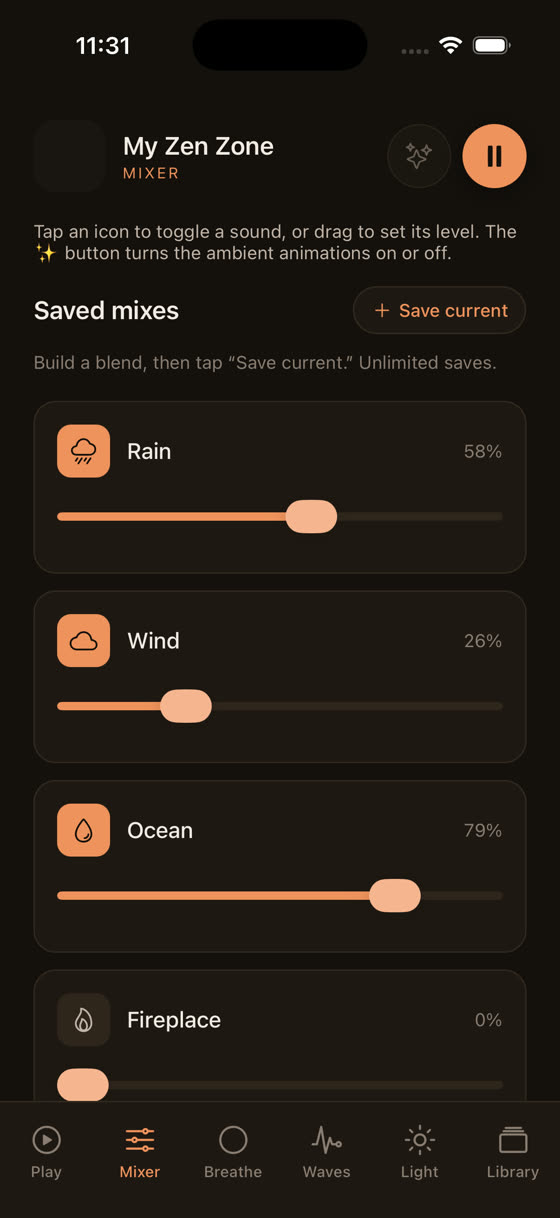
This is the kind of adjustment that's hard to do with a fixed playlist, where every sound is baked into one file at one ratio. In My Zen Zone, each sound sits on its own fader in the mixer, so you can bring a lullaby track in quietly, add a touch of rain or hush underneath, and find the exact balance for your own room and your own baby, rather than accepting whatever mix someone else decided was right.
What we actually make, for context
Every track in the library is composed and recorded by one musician, not licensed from a stock catalogue, which means the tempo and instrumentation choices above aren't theoretical for us, they're decisions made track by track. New music goes up every two weeks, so the collection of slow, low-register, repetition-friendly pieces suited to this kind of use keeps growing rather than sitting static.
If you're the one trying to fall back asleep after the baby finally settles, the same slow-tempo principles apply to you, and that's a separate conversation worth reading in our piece on music for adult sleep. The app isn't built specifically for infants, but the underlying physiology, slow tempo, low variation, predictable structure, is the same whether the listener is eight weeks old or thirty-eight years old.
What to try tonight
Pick two or three slow, simple pieces and commit to them for at least two weeks before judging whether they're helping. Keep the volume low enough that you have to lean in slightly to hear detail. Start the music a few minutes before the baby seems tired rather than after. If background noise in your home is an issue, try a soft layer underneath rather than raising the lullaby's volume, using a mixer that lets you set each independently rather than guessing with one slider. And let the track end on its own rather than cutting it off the second you think the baby's asleep. None of this guarantees a full night's sleep, nothing does, but it gives the routine the best chance of becoming a genuine cue rather than just noise in the room.
Common questions
What tempo should lullaby music be for a baby?
Roughly 60-80 beats per minute, close to a relaxed resting heart rate. This range avoids pulling a baby's attention the way faster or more rhythmically active music does. Most traditional lullabies across different cultures sit naturally in this range, which is likely why they've persisted.
Can lullaby music be harmful or overstimulating?
It can be, if it's too loud, too bright in frequency, or interrupted by ads and gaps. A tinny phone speaker playing a choppy loop introduces unpredictability, which works against the calming effect you want. Simple, low-volume, continuous playback is far more effective than anything busy or abrupt.
How long should lullaby music play while a baby sleeps?
There's no fixed rule, but letting it run on a gentle timer through the settling period, then fading out naturally rather than cutting off abruptly, tends to work better than stopping it the instant the baby's eyes close. An abrupt stop is itself a change the baby may notice.
Should I use the same lullaby every night or change it up?
Keep it mostly the same. The calming effect comes largely from the baby learning to associate a specific, repeated sound with the wind-down routine. A small rotating set of two or three pieces works better than a constantly changing playlist, which removes the predictability doing most of the work.
Is white noise better than lullaby music for babies?
Neither is clearly "better"; they do different jobs. White noise mainly masks sudden household sounds that might wake a light sleeper. Lullaby music provides a melodic, predictable cue. Many parents find a soft layer of both, balanced independently, works better than either alone.