Rain is not white noise. It behaves more like pink noise, sometimes drifting toward brown noise depending on how heavy it's falling, and the difference isn't just pedantry. It's the reason rain feels soothing while true white noise, the hissy kind, can feel harsh after twenty minutes.
What white noise actually is
True white noise contains equal energy at every frequency across the audible spectrum, from the lowest bass rumble up to the highest treble hiss. Picture a radio tuned between stations. That flat, even distribution is what engineers mean by "white," borrowing the term from white light, which also contains every wavelength at equal intensity. It's a useful tool for masking sudden noises like a slamming door or a snoring partner because it covers the whole frequency range with no gaps for other sounds to poke through.
But equal energy at every frequency, including the top end, is exactly what makes white noise sound thin and hissy to human ears. We don't perceive frequencies as equally loud even when they carry equal energy. High frequencies read as sharper and more fatiguing, which is why pure white noise played for hours can start to grate rather than soothe.
What rain actually sounds like, acoustically
Record real rain and run it through a spectrum analyser and you'll see energy concentrated in the lower and mid frequencies, rolling off as you go higher. That's the signature of pink noise, where each octave carries equal energy rather than each frequency. The practical effect is a sound that feels fuller and warmer, with more weight in the low end and less of that white-noise sizzle up top.
Heavier rain, especially on a hard surface like a tin roof or a window, pushes even further down the spectrum toward brown noise, which is deeper still and closer to the rumble of distant thunder or ocean surf. Light rain on leaves sits higher and closer to pink. So "rain sounds" isn't one fixed category. It's a spectrum within a spectrum, and the type of rain recording you choose changes how it sits against your ears over a full night.
Why this distinction actually matters
Most people reach for "white noise" as shorthand for any steady background sound, and for casual use that's fine. But if you're choosing something to fall asleep to for six or eight hours, the acoustic shape matters more than the label. Pink and brown noise are generally easier to sit with for long stretches because they don't carry that fatiguing high-frequency edge. This is also why so many sleep and focus apps, ours included, lean on rain, waves, and wind rather than synthetic white noise generators. The natural variation in a real recording, the slight unevenness of drops hitting different surfaces, also gives the brain something non-repetitive to settle into, which some people find less grating than a perfectly flat synthetic tone.
Where most articles get this wrong
A lot of what's written on this topic treats "white noise" as a catch-all for anything constant and unbroken, lumping rain, fans, static, and ocean waves into one bucket. That's acoustically sloppy. It also skips the more useful question, which isn't "is rain technically white noise" but "which sound shape actually helps me sleep or focus." The honest answer is that the research comparing white, pink, and brown noise for sleep quality is thin and mixed. Nobody can promise a specific frequency profile will knock you out. What we can say, from building this library track by track, is that the texture of a sound changes how tolerable it is over time, and that's worth paying attention to even without a clinical study behind it.
Rain alone versus rain layered with something else
Straight rain for eight hours works for plenty of people, but it can also feel a bit flat on its own, especially if you're someone who wakes at 3am and needs the sound to still be doing something. This is where layering earns its keep. A thin wash of rain under a slow piano line at 55-65 bpm gives your ear texture to settle into without anything sharp enough to pull you back awake. We build tracks this way deliberately, and the app's mixer lets you go further by blending rain with a second or third nature sound at your own levels.
Watch that and you'll see what we mean: rain underneath, a low drone or soft wave layer pulled up slightly, each on its own slider rather than baked into a single fixed file. That's the practical difference between a one-track white noise app and something built for actual variation night to night.
When rain isn't the right choice
Rain with thunder is the obvious exception. The irregular crack of thunder defeats the whole point of a masking sound, because your brain flags it as a novel event and perks up to check on it. If you want rain for its texture but not its surprises, look for recordings labelled steady or light rain without storm elements. Rain also isn't automatically better than white or brown noise for everyone. Some people associate rain with anxiety, a flooded basement, a cancelled trip, and for them a plain low hum or a fan-like brown noise track will sit better psychologically than anything that sounds like weather. The right sound is the one your brain doesn't flag as interesting, and that's personal.
Rain for focus, not just sleep
The same spectral argument applies during the day. A pink-leaning rain track at low volume can mask office chatter or street noise without the ear fatigue that comes from a harsher white noise app running for a four-hour work block. If you're using background sound to concentrate rather than sleep, it's worth reading more on how different sound profiles affect attention in our piece on music for focus and study, since the same pink-versus-white logic applies whether you're trying to drift off or trying to finish a report.
How to actually set this up tonight
Start with a single steady rain track, no thunder, and sit with it for a few nights before deciding it's not for you. If it feels too flat or too exposed to outside noise, open the mixer and bring in a second layer at a low level, something with more low-end weight like distant waves or a soft drone, rather than switching tracks entirely.
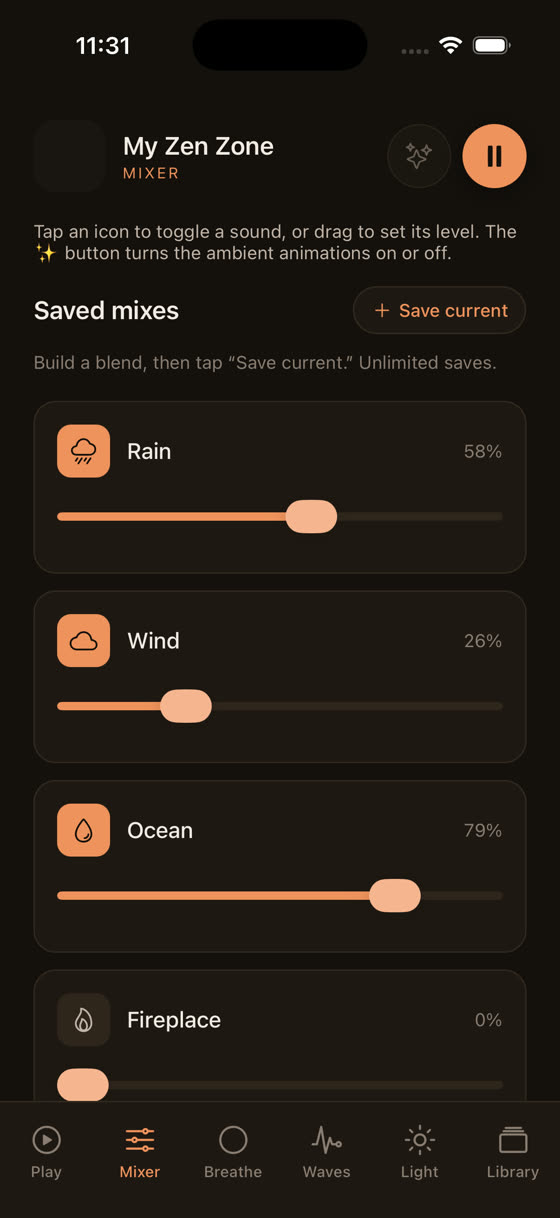
That's the sound mixer with three nature layers each sitting at a different level, which is the fastest way to find the balance that works for your room and your ears rather than accepting whatever one engineer decided sounded right in a studio. Pair it with the sleep timer so the mix fades out rather than looping all night at full volume, and if you want a starting point beyond rain altogether, our broader rundown of best music for sleep covers the tempo and instrumentation side of the same problem.
The short version worth remembering
Rain isn't white noise. It's closer to pink or brown noise depending on intensity, which is exactly why it tends to feel gentler than a synthetic hiss over a long night. Don't get stuck on the label. Judge the sound by how your ears feel after twenty minutes, not by what category it technically falls into, and don't be afraid to layer rather than settle for one fixed track. New recordings get added to the library roughly every fortnight, so if tonight's rain isn't quite right, there's usually something new within reach at myzenzone.app or through the app itself.
Common questions
Is pink noise better than white noise for sleep?
There's no solid proof either is reliably better across the board. Pink noise tends to feel gentler on the ear over long stretches because it has less high-frequency energy than white noise, which is why many people find it more comfortable for a full night, but comfort varies person to person and the research is thin.
Does rain sound count as brown noise instead?
It depends on the intensity. Light rain on leaves sits closer to pink noise, while heavy rain on a hard surface, like a roof or window, pushes lower in frequency toward brown noise. There isn't one fixed category for "rain," which is part of why some rain tracks feel heavier than others.
Why does rain with thunder keep waking me up?
Thunder is a sudden, irregular spike in volume and low-frequency energy, and your brain treats sudden changes as events worth checking on even during sleep. Steady rain without storm elements avoids this because nothing in the recording breaks the pattern your ear has already tuned out.
Can I mix rain with music instead of using it alone?
Yes, and it's often more effective than rain by itself over a long night. A thin rain layer under slow, low-tempo music gives your ear texture without anything sharp. The app's mixer lets you set rain and music at separate levels rather than relying on a single fixed recording.