Short answer: no, not in the way most people hope, and the Reddit threads on r/sleep and r/SleepCycleApp mostly agree once you read past the headline complaints. The app is reasonably good at telling you when you were asleep versus awake. It is much weaker at telling you which sleep stage you were in, and it can be fooled by something as ordinary as a restless partner or a phone left on a soft mattress topper. That gap between what the graph implies and what it can actually measure is the whole story.
What people on Reddit actually say
Search the app's name on Reddit and you get two recurring threads. One is people whose "deep sleep" percentage dropped to near zero overnight for no reason they can explain, and who assume something is medically wrong. The other is people comparing it against a Fitbit, Oura ring or Apple Watch on the same night and getting wildly different numbers from each device. Both threads point at the same underlying issue: none of these consumer tools are measuring brain activity, so any two of them can disagree by an hour of "deep sleep" and both can still be functioning as designed.
What Reddit gets right is the skepticism. What it gets wrong, occasionally, is assuming the app is broken. Usually it's working exactly as built. The building itself just has a lower ceiling than the pretty graph suggests.
How the app actually measures you
Sleep Cycle, like most phone-based sleep trackers, relies on your phone's accelerometer and microphone rather than anything worn on your body. It sits on the nightstand or under your sheet and picks up movement and sound, then runs that through an algorithm that guesses your sleep stage from patterns of stillness, motion, and snoring or breathing noise. There is no EEG, no measurement of brainwaves, nothing that reads what your brain is actually doing. It's an inference layer built on movement data, which is a reasonable approach and also an inherently limited one.
This matters because sleep stages aren't defined by how still you are. Someone can lie almost motionless while wide awake, and REM sleep itself involves very little large-muscle movement despite being a distinct, active brain state. A motion sensor has no way to tell the difference between calm wakefulness and REM. It can only guess based on statistical patterns from other people's sleep, applied to you.
What "accurate" even means here
Research comparing consumer trackers of this kind against lab-grade polysomnography (the wired, brainwave-monitoring gold standard used in sleep clinics) tends to find the same pattern across brands: these tools are fairly good at the binary call of asleep versus awake, and noticeably less reliable once you ask them to split sleep into light, deep and REM. That's not a knock on any one app. It's a limit of the underlying method, whether the sensor sits on your wrist or your nightstand. If a Reddit post shows two apps disagreeing on deep sleep percentage by 20 points on the same night, that's consistent with what the research literature already expects, not evidence that one of them is defective.
Where it goes wrong in practice
A few situations reliably break phone-based tracking, and they come up constantly in the complaint threads:
- A partner or pet moving in bed gets picked up as your motion, especially if the phone is on a shared mattress rather than a solid nightstand.
- A phone charging across the room, or on a very soft surface, either misses your movement entirely or amplifies vibrations that aren't you.
- Fans, air conditioning units, or a partner's snoring get logged as your own breathing or snoring pattern.
- Naps and fragmented sleep (a 2am wake for water, a half-asleep scroll through your phone) confuse the wake-detection logic, since it's tuned around one continuous overnight session.
None of this means the app is useless. It means the number in the morning is a rough estimate shaped by your bedroom conditions that night, not a clinical readout.
The one thing it's genuinely good at
Where phone-based tracking earns its keep is the smart alarm. Waking you during a lighter stretch of sleep within a chosen window, rather than at a fixed minute, does seem to make the wake-up feel less jarring for a lot of people, and that's a much easier claim to trust because it doesn't depend on precisely labeling which stage you were in. It only needs to detect relative stillness versus relative movement, which is exactly the thing accelerometers are decent at. If you're using the app mainly for that alarm feature, the accuracy question matters less than the threads make it sound.
What to actually do differently tonight
If the graph is stressing you out more than helping you, that's worth noticing. A dropped deep sleep percentage after a hot night, a late coffee, or an argument before bed usually has an obvious cause you already know, and staring at a chart to confirm it rarely changes anything useful. The more productive move is to treat the data as a loose trend over weeks, not a nightly verdict, and to spend more attention on the hour before you actually try to sleep.
That's where sound does more than any tracker can measure. A consistent wind-down routine, played at the same low volume, at roughly 60-70 bpm, close to a resting heart rate, gives your body a repeatable cue rather than a diagnosis. We cover the mechanics of tempo and instrumentation in more depth in our guide to music for sleep, but the short version is that the sound matters less as data and more as a signal you condition yourself to.
Layering sound instead of just picking a track
One thing a fixed playlist can't do is match your actual room. A single track of rain will either be too thin to cover a snoring partner or too loud once the house goes quiet. In My Zen Zone the mixer lets you build your own overnight sound from separate layers, each with its own level, so you're not stuck accepting whatever balance someone else chose.
Watch the levels move independently in that clip: rain up, a low drone underneath, a distant thunder layer barely audible. That's the difference between a preset and a mix you actually control, and it's worth adjusting on a night-by-night basis the same way you'd adjust a thermostat.
Preparing for sleep, not measuring it
We don't track your sleep stages at all, and we're not going to pretend that's a small omission. It's deliberate. Rather than competing with accelerometer-based apps at a job they're only partly equipped for, My Zen Zone focuses on the part before sleep starts: the wind-down.
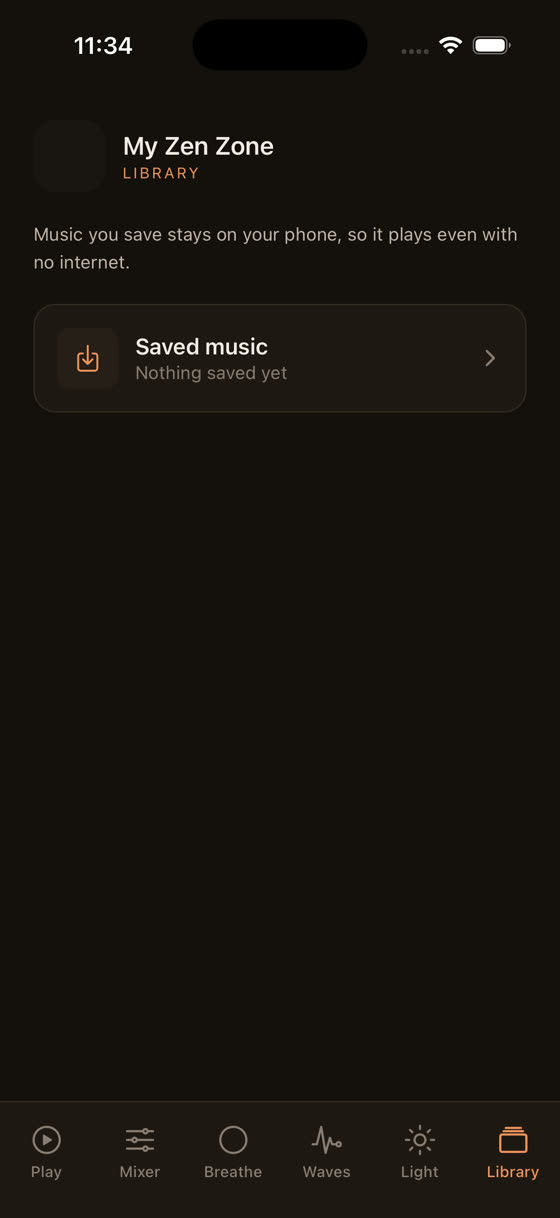
The light screen dims gradually while a track plays underneath, giving your eyes and your attention somewhere to settle before the room goes dark. Pair that with a sleep timer so the music fades out instead of looping all night, and you've built a routine that doesn't need a morning graph to tell you whether it worked. You'll know, because you'll remember less of the time it took you to fall asleep, which is really the only accuracy that matters. New tracks land in the library every two weeks if you want to keep the routine from going stale, and the full catalogue is available through the app or in a browser via myzenzone.app.
Common questions
Why does Sleep Cycle say I had zero deep sleep some nights?
Usually because you moved more than usual, a phone position shifted, or background noise (a fan, a partner, traffic) confused the motion and sound detection. It's rarely a medical signal. Compare it against how you actually felt that morning before assuming something's wrong; the graph is an estimate, not a diagnosis.
Is a smartwatch more accurate than a phone for sleep tracking?
Slightly, for the wake/asleep call, because it sits directly on your wrist and reads pulse alongside movement rather than inferring everything from a nightstand's vibrations. Neither reads brain activity, so both remain rough on stage detection. Treat either as a trend tool over weeks, not a nightly verdict.
Should I stop using sleep trackers altogether?
Not necessarily. The smart alarm feature genuinely seems to help some people wake up feeling less groggy, and trends over a month can flag real changes worth mentioning to a doctor. Just hold the nightly stage percentages loosely rather than treating them as clinical fact.
Can background music actually help me fall asleep faster?
There's limited but reasonably consistent evidence that slow, low-arousal music can support winding down, mainly by giving your attention somewhere steady to rest rather than through any direct physiological effect. It works best as part of a repeated routine, not a one-off fix on a bad night.
What's the difference between a sleep app and a sound app like this one?
A tracker like Sleep Cycle measures what happens after you've fallen asleep. My Zen Zone is built for the window before that, with layered nature sounds, a light screen, and a sleep timer designed to help you get to sleep in the first place, which no accelerometer can do for you.