Is There a Completely Free Meditation App?
Yes, a few exist, but "completely free" almost always means one of two things: a small rotating set of tracks paid for by ads, or a stripped-down version built to nudge you toward a subscription after a week or two. There is no widely used app that gives you a large, ad-free, constantly refreshed library for nothing at all. Someone pays for the recording, the mastering, the storage, the person who answers support email at 11pm. If you are not paying, an advertiser usually is, and that changes what the app is built to do. It is built to keep you scrolling, not to help you fall asleep in eight minutes.
The Three Kinds of "Free" You'll Actually Find
The first kind is ad-supported: a genuinely free tier with a handful of tracks, interrupted by audio ads that fade in exactly when your breathing has slowed and your jaw has unclenched. The second kind is freemium: a locked library where three or four sessions are free and the rest sit behind a paywall you hit the moment you're actually settling into the habit. The third, rarer kind is a nonprofit or public-health app with a genuinely small but permanently free catalogue, often just breathing exercises with no music at all. Each of these is honest about what it is. The dishonest version is the app that markets itself as "free" in the app store description and then gates almost everything behind a trial that auto-converts to a yearly charge.
The Real Cost of Free Isn't Money
Ads are the obvious cost, but the quieter one is repetition. A free tier with eight tracks on loop stops working after about two weeks, not because the music got worse but because your brain stopped treating it as new information and started treating it as wallpaper. There's decent everyday logic behind rotating your wind-down sounds the way you'd rotate what you eat: not because variety is a virtue in itself, but because familiarity dulls the physiological response you were relying on in the first place. This is one reason we release new music every fortnight rather than recording fifty tracks once and calling it done. A library that never grows is a library your nervous system eventually stops listening to.
The other hidden cost is control. Free apps rarely let you shape the sound to your own room and your own night. You get one fixed mix of rain and pads, take it or leave it. A proper mixer changes that.
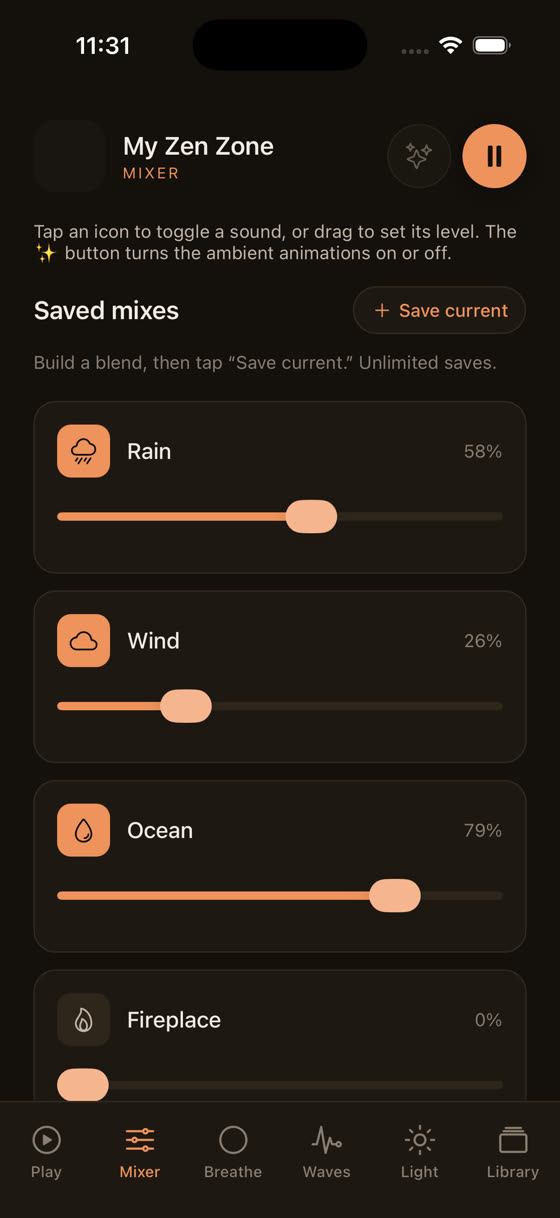
Being able to pull rain down to a whisper and push a low drone up half a level, live, while you're already lying down, is not a luxury feature. It's the difference between a soundscape that fits your specific bedroom, with its specific traffic noise or specific silence, and one that fits nobody in particular.
What Most Articles on This Topic Get Wrong
Most "best free meditation apps" roundups treat price as the main variable and barely mention fit. But the thing that actually determines whether meditation music works for you on a given night is far more specific than free-versus-paid: it's tempo, instrumentation, and whether a voice is involved at all. A track sitting at 60 to 70 beats per minute, roughly a resting heart rate, does something different to your body than one at 90. A guided voice layered loudly over music does something different to your focus than a voice you can barely hear under the pads. None of the roundup articles measure this, because most apps don't give you the controls to test it. They hand you one finished file and call the job done.
Where a Free Tier Genuinely Makes Sense
To be fair to free apps: if all you want is a two-minute breathing break at your desk, or you're testing whether guided meditation suits you at all before committing to anything, a free tier is a reasonable place to start. You don't need a subscription to find out if you like the format. This is also why most paid apps, including ours, let you explore a meaningful chunk of the library before you're asked to pay anything, rather than locking everything on install. Try the format first. Decide on habit, not on marketing copy.
What to Actually Look For Instead of the Word "Free"
Skip the price tag for a minute and check these instead, because they predict whether you'll still be using the app in three months:
- Offline downloads. If a track has to stream every time, it will stutter on a train, in a basement gym, or on a flight, exactly when you need it most.
- A sleep timer with a real fade. Music that cuts off mid-phrase at 20 minutes is worse than no timer at all.
- Separate levels for voice and music. A guided session that stops the music to talk, then restarts it, breaks the whole point of the exercise.
- New material on a schedule. Check whether the library has grown in the last month. A static "free" library from three years ago is not free, it's frozen.
- What happens after the trial. Read the actual renewal terms, not the headline price.
How We've Actually Built This
My Zen Zone isn't free, and we'd rather say that plainly than bury it. What a subscription gets you is one composer's growing catalogue, not a licensed stock library, so the sound is consistent across sleep, focus, meditation, and calm rather than four different vendors stitched together.
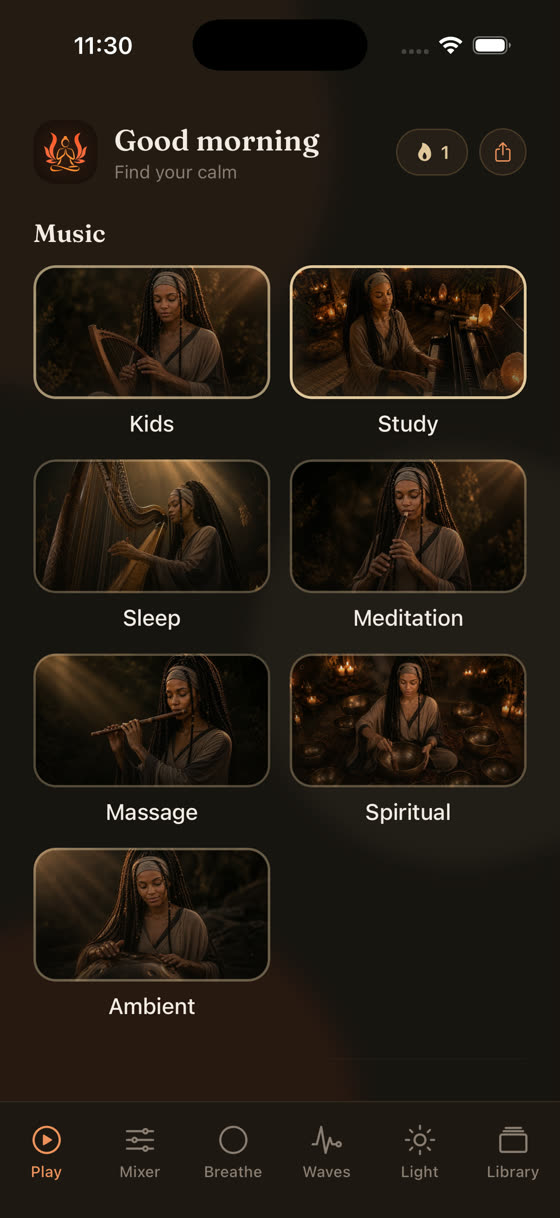
Each category is built as its own space rather than one long undifferentiated playlist, which matters more than it sounds: the tracks meant to help you concentrate for an hour are paced and structured completely differently from the ones meant to slow your breathing down before bed, something we go into in more detail in our piece on focus music specifically.
The part that most directly answers the free-app problem is the guided sessions. Almost every competing app stops the music, plays a voice track, then resumes the music, which is jarring in a way that undoes some of the calming effect. Ours don't work that way.
Voice, music, and nature sound each sit on their own level, so you can turn the guidance down to a whisper under the music, or mute it entirely and keep just the soundscape, without losing the session structure. That's the same mixer logic applied to a guided track instead of ambient sound, and it's worth trying even if you've written off guided meditation before because a previous app's voice was too loud or too flat.
What to Do Tonight
Don't chase the word "free" as if it's the whole decision. Try a genuinely free tier for a week if you want to test whether guided sessions or ambient music suit you better. Pay attention to whether the ads or the repetition start to grate before the two weeks are up, because that's diagnostic, not incidental. If you land on wanting a library that keeps growing, sound you can shape rather than accept as-is, and downloads that survive a dead phone signal, that's the point at which a subscription starts paying for itself rather than just costing you money. You can see the current library, including what's been added this fortnight, at myzenzone.app, or go straight to the download page if you already know what you're after. For the sleep side of this specifically, our guide to music for sleep covers tempo and instrumentation in more depth.
Common questions
Are free meditation apps actually effective?
They can be, especially for short breathing exercises or as a way to test whether guided meditation suits you. The limits show up over time: ad interruptions undercut the calming effect, and a small fixed library gets stale within a few weeks as your brain stops responding to familiar tracks the way it did at first.
What's the difference between free and freemium meditation apps?
Free usually means ad-supported with a genuinely open but small catalogue. Freemium means most content is locked behind a paywall from the start, with only a handful of sessions available before you're asked to subscribe. Read the app store listing carefully; the two get marketed with the same word.
Do I need a subscription to try guided meditation?
No. Most subscription apps, including ours, let you explore a real chunk of the library before charging anything, specifically so you can judge fit, voice, and pacing first. Use that window to test formats rather than assuming you need to commit before you know what you actually respond to.
Why does music-only meditation sometimes work better than guided sessions?
Some people find a voice distracting when they're trying to switch off, especially at night, while others need the structure of instruction to stay present. Neither is more correct. Apps that let you mix voice and music independently, rather than forcing one fixed blend, let you find your own answer instead of guessing.