The short answer
Yes. There are several free brown noise apps and plenty of free brown noise tracks on YouTube and Spotify. You do not need to pay anyone to hear a deep, steady rumble tonight. But "free" in this category almost always means one of three trade-offs: ads that cut in mid-loop, a single fixed track with no way to shape it, or a loop so short you can hear the seam every ten to fifteen seconds once your brain tunes in. None of those trade-offs are dealbreakers for casual use. They matter more than people expect once brown noise becomes something you rely on every night.
What brown noise actually is
Brown noise (technically Brownian noise, named for the random-motion physics, not the colour) has more energy in the low frequencies and rolls off sharply in the highs, roughly -6dB per octave. That is why it sounds like a waterfall, a low aeroplane cabin, or distant surf rather than the hiss of white noise or the sharper static of pink noise. The low-frequency weighting is why people describe it as "rounder" or less fatiguing on the ears over hours of listening.
The mechanism for why it helps sleep is masking, not magic. A steady, broadband sound raises the noise floor of a room so that a door closing, traffic, or a partner shifting in bed does not register as a sudden spike against silence. Your ear and brain respond to change, not to steady volume, so a constant rumble is easier to sleep through than the same sounds arriving out of a quiet room.
Why free gets complicated fast
Most free brown noise apps are built around one MP3, looped. That is cheap to make and cheap to host, which is exactly why it is free. The problem shows up around night four or five, when your ear has learned the loop point and starts anticipating it, which is the opposite of what you want from a masking sound. Ad-supported versions are worse for sleep specifically, because an ad breaking in at 2am with sudden volume and a different frequency profile can wake you more effectively than the traffic noise you were trying to mask in the first place.
There is also the question of offline access. Free tiers often stream, which is fine at home on wifi and a problem on a plane, in a hotel with bad reception, or anywhere your data is limited. If brown noise is part of a wind-down routine you actually depend on, it is worth checking whether a track downloads for offline play before you are standing in an airport at midnight discovering it does not.
The loop problem nobody mentions
A genuinely seamless loop is harder to make than it sounds. You need the waveform to match not just in volume at the splice point but in phase, so there is no click, no breath, no tiny gap. Cheap free tracks are often looped at whatever length keeps the file small, sometimes as short as eight to twelve seconds. Longer, well-mastered loops (two minutes plus, looped carefully) are much harder to notice, and that is the difference between a sound that fades into the background and one that becomes a metronome you cannot stop counting.
What most articles about this get wrong
Most "best brown noise app" roundups treat brown noise as a single fixed thing everyone needs identically. In practice, people want different amounts of it depending on the room, the night, and what they are trying to block. A studio flat on a main road needs more low-end rumble than a quiet suburban bedroom. Someone masking a partner's snoring wants something with a bit more presence around 200-400Hz. Nobody's needs are served well by one static file at one fixed volume, which is exactly what most free apps hand you.
Layering instead of settling for one file
This is where a mixer changes the experience rather than just the file quality. Instead of picking one brown noise track and living with it, you set brown noise as a base layer and bring in rain or distant surf underneath it at a lower level, so the mix has both the steady low rumble and enough texture that your ear does not lock onto a single repeating pattern.
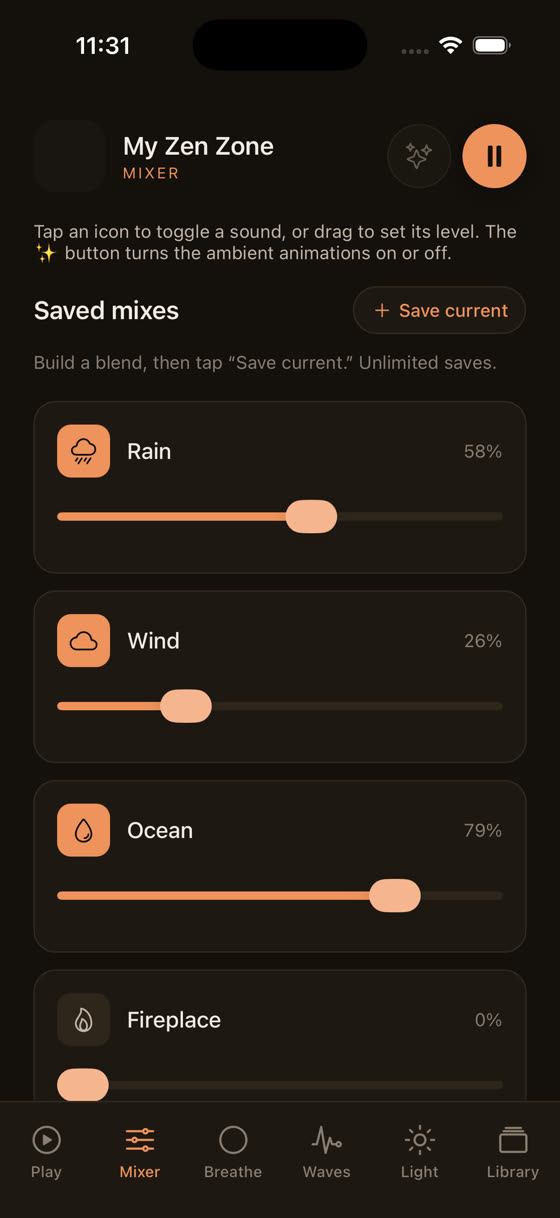
Watching the levels move against each other makes the point faster than describing it.
Brown noise for focus, not just sleep
The same masking logic applies at a desk. Open-plan offices, shared flats, and cafés all produce irregular noise, the kind that pulls attention every time someone laughs or a chair scrapes. A steady low rumble under a work session covers those spikes without adding anything melodic enough to compete for your attention, which is why brown noise shows up so often in focus and study playlists alongside more structured instrumental work. If you want the fuller argument for what to play while working, including tempo and instrumentation choices for deep work versus admin tasks, that is covered in music for focus and study.
What to actually do tonight
If you already have a free brown noise app and it is working, there is no reason to change anything. If you are noticing the loop, getting interrupted by ads, or wishing you could turn down the noise and bring up something else underneath it, that is the signal to look at an app built around a mixer rather than a single file. Set a sleep timer so the sound does not run all night at full volume once you are already asleep, since some people sleep more soundly once the room goes properly quiet again after the first hour or two. And if brown noise alone feels a bit stark, try it under a slow instrumental track rather than instead of one; the two do different jobs, one masks and one relaxes, and combined they cover more of what actually keeps people awake. For a broader look at what else belongs in that mix, best music for sleep goes into instrumentation and pacing in more depth.
How My Zen Zone approaches this
My Zen Zone is not a brown noise app specifically, it is a library of original relaxation music, all composed and recorded by one musician, with hundreds of tracks across sleep, focus, meditation and calm, and new music added every two weeks. Nature sounds and tonal layers, including brown-noise-style low rumble, sit inside the mixer alongside that music rather than as a single standalone file, so you can build the exact mix a free single-track app cannot offer.
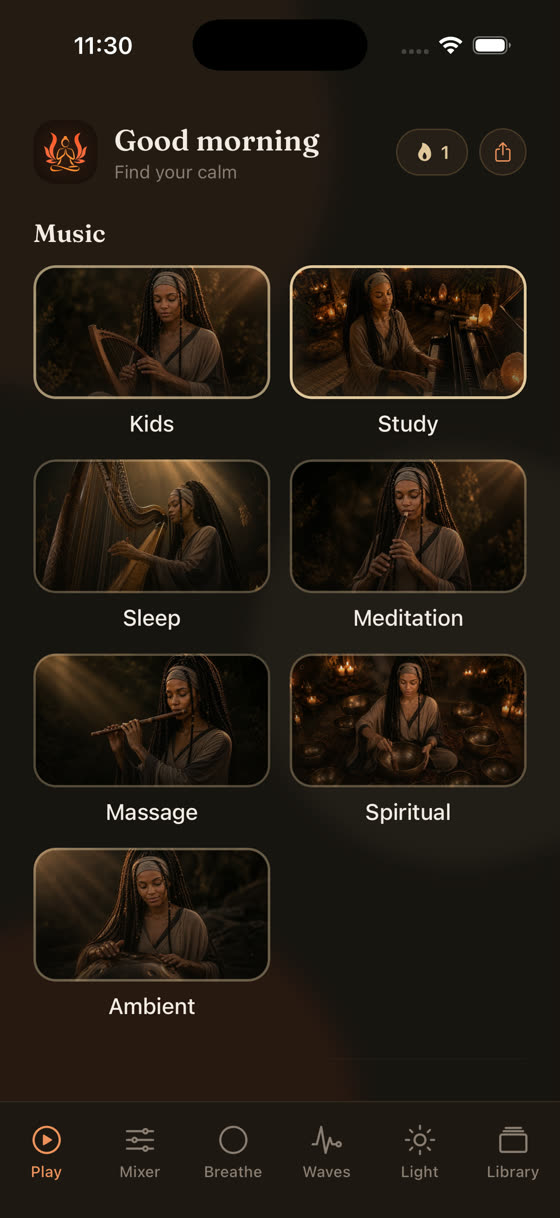
Each category is its own space rather than one long undifferentiated playlist, and everything downloads for offline listening, which matters as much on a delayed flight as it does at 2am. It is on iPhone and Android, with a subscription unlocking the same library in a browser, and you can see the full range at myzenzone.app or start directly at /get.
Common questions
Is brown noise better than white noise for sleep?
Neither is objectively better, they mask differently. Brown noise weights the low frequencies and sounds rounder, closer to surf or a waterfall. White noise is flatter across all frequencies and can sound hissier. Some people find brown noise less fatiguing over a full night, but this comes down to personal preference and the specific noises you're trying to cover, not a proven rule.
Can brown noise damage your hearing?
At sensible volumes, no evidence suggests brown noise is riskier than any other sound played at the same level. The usual hearing safety rules apply: keep it well below the volume of normal conversation, especially through headphones overnight, and there is no need to run it loud since masking works on steadiness, not volume.
Why does my free brown noise app keep cutting out?
Most free apps stream rather than download, so a weak connection or backgrounding the app can interrupt playback. Ad-supported versions also insert breaks at intervals regardless of the time. If uninterrupted playback matters, look for offline downloads and an ad-free tier rather than assuming the app itself is broken.
Does brown noise actually help with tinnitus?
Some people find a steady low rumble makes ringing less noticeable by raising the background noise floor, which is the same masking principle used for general sleep. This isn't a treatment and isn't guaranteed to help everyone; if tinnitus is persistent or distressing, that's a conversation for a doctor or audiologist, not an app.