The Short Answer
Yes. There are free sleep music apps, and you can start listening tonight without paying anything. My Zen Zone has a free tier, so do most competitors, and YouTube has more eight-hour rain loops than anyone could listen to in a lifetime. The real question isn't whether free exists. It's whether the free version does what you need it to do at the exact moment you need it, which for sleep music is usually somewhere between 11pm and 3am, half-conscious, phone brightness turned down, patience at zero.
What "Free" Usually Means in Practice
Free sleep apps tend to work one of three ways. Some are ad-supported, which sounds harmless until an ad breaks in at full volume fifteen minutes after you've finally drifted off. Some give you a small rotating selection, maybe a dozen tracks, refreshed occasionally, with the rest locked behind a paywall. And some are free because the content is generic stock audio, licensed cheaply and reused across a hundred different apps and YouTube channels, which is why so much sleep music sounds interchangeable. None of this makes free bad. It just means "free" rarely means "complete."
My Zen Zone's free tier gives you a real slice of the library, not a locked demo screen. You can hear what the composition actually sounds like before deciding whether the fuller mixer and offline downloads are worth a subscription. That's a fair trade, and it's worth trying before you assume you need to pay for anything.
Why Free Can Work Against You at 2am
The mechanism that matters here isn't really about music theory, it's about interruption. Sleep is a fragile state to enter and an easy one to break out of. An ad, a notification banner, a track that ends and autoplays into something with a driving beat, a five-second silence while the app buffers, any of these can be enough to pull you back up toward wakefulness right when you were sliding under. Free apps that rely on ad breaks or unpredictable playlists are, structurally, built to interrupt you eventually. That's how the ad model pays for itself.
A sleep timer that fades out rather than cutting off, and downloaded audio that doesn't need a live connection, solve a problem most people don't notice until it's already ruined a night. This is one of the two places where mixing genuinely matters, and it's worth seeing rather than describing:
That's three separate sound layers, each faded up or down independently, rather than one fixed track playing at one fixed volume until it randomly stops.
What Actually Makes Music Work for Sleep
Most sleep music, free or paid, shares a few real characteristics. Tempo tends to sit around 50-70 bpm, close to a resting heart rate, because music at or below that pace doesn't give your body a reason to stay alert. There's usually no strong beat or percussion, since a beat is something your brain tracks, and tracking is the opposite of switching off. Harmonic movement is slow: chords change every few bars instead of every beat, and there are no sudden dynamic swells, no key changes designed to surprise you, nothing that would work well in a film score precisely because film scores are built to hold your attention. Lyrics are almost always absent, because language recruits parts of the brain that idle music leaves alone. We go into this in more detail in our piece on what actually makes music good for sleep, but the short version is: boring, on purpose, is the whole design brief.
The Difference Between a Playlist and a Mixer
This is where most free apps, and a lot of paid ones, fall short. They give you a track, or a playlist of tracks, and that's the extent of your control. But sleep environments aren't uniform. Someone in a flat above a bar needs more low-end coverage than someone in a quiet suburb. Someone who wakes at 4am wants rain, not piano, for the last stretch. A single fixed track can't flex to any of that.
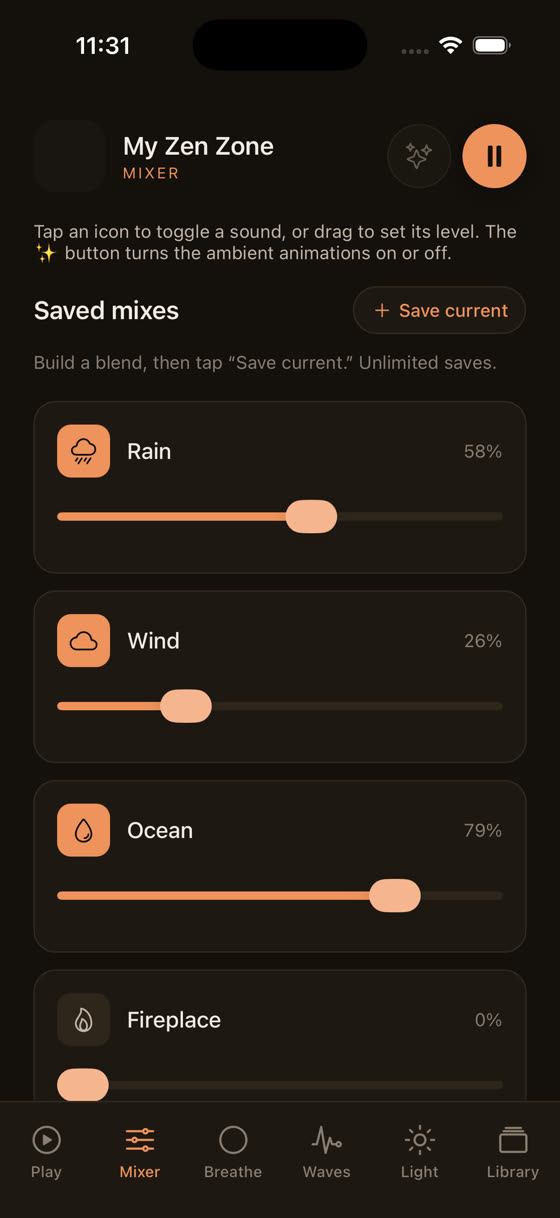
My Zen Zone treats sound as layers you build yourself: three nature sounds at three independent levels, sitting under or beside the composed music, so you're not choosing one preset but assembling your own. Rain a little louder than the drone, the drone barely audible, no birdsong at all. It sounds like a small thing until you've spent months tweaking the same fixed playlist volume up and down because none of the presets quite matched your room.
What a Subscription Actually Buys You
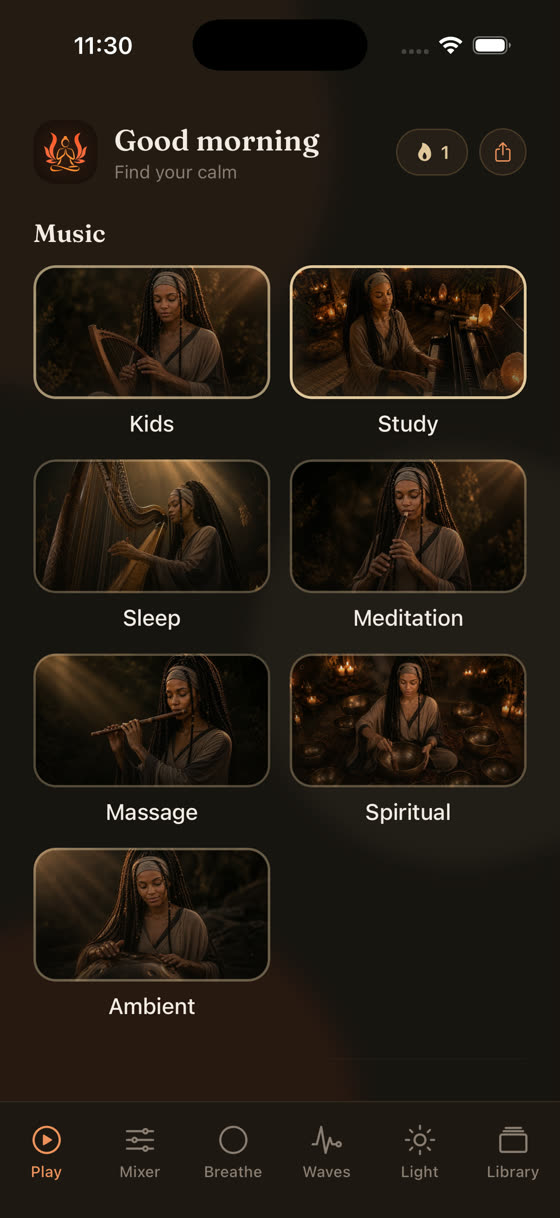
Being straightforward about this: the free tier will get you through most nights. What a subscription adds is depth and control. The full library runs to hundreds of tracks and grows every two weeks, all composed and recorded by one musician rather than licensed in bulk, so there's a consistency to it that stock libraries don't have. Offline downloads mean the plane, the tent, the basement flat with no signal, all still work. A proper sleep timer fades rather than stops. There are brainwave tone layers for people who want that underneath the music, and a light screen built specifically for winding the eyes down before the ears take over.
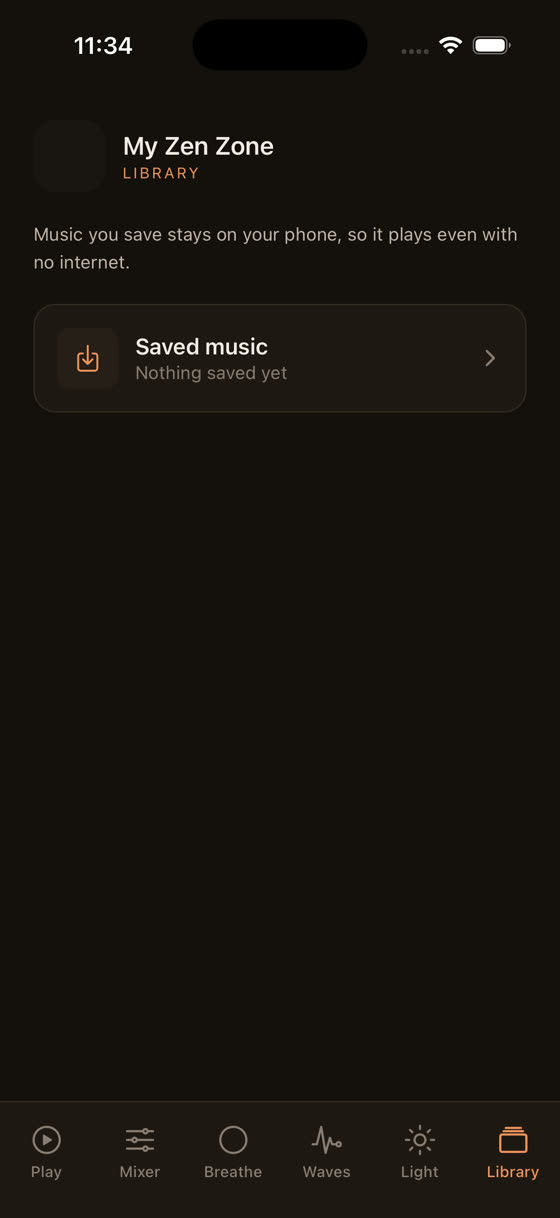
A subscription also unlocks the browser version, so the same mixer and library are available on a laptop, not just the phone, which matters if bedtime for you means reading in bed with a tablet rather than reaching for a phone screen. None of this is necessary to get some benefit from sleep music. It's necessary if the free tier starts feeling like it's holding you back on the same three tracks every night.
A Practical Way to Try It Tonight
Don't overthink the first attempt. Open the app, pick one sleep track from the free tier, and put the phone somewhere you can't easily reach it, not face-up on the pillow next to you. Turn the volume lower than feels necessary; music that's slightly too quiet is far less disruptive than music that's slightly too loud once you're actually asleep. Set a timer for 45 minutes rather than letting it run all night, since most people don't need music once they're properly under, and a timer avoids the risk of an autoplay track waking you at 3am.
If you find yourself lying there still alert after twenty minutes, that's not a failure of the music, it's a sign the tempo or instrumentation isn't matching what your body wants that particular night. Try a different track before giving up on the whole idea.
What Most Articles on This Get Wrong
A lot of "best sleep app" roundups treat this as a solved problem: download the app, press play, sleep. The evidence for music improving sleep is genuinely mixed, and mostly comes from small studies, self-reported outcomes, and short trial periods. Nothing here is a guaranteed fix, and nobody serious should claim otherwise. What does have some support is the general idea of a calm, consistent, low-stimulation pre-sleep routine, and slow instrumental music can be one part of that alongside darkness, a cooler room, and putting the phone down. Treat sleep music as one tool among several, not a substitute for the basics. If you're trying to work rather than sleep, the same logic about tempo and structure applies differently, which is covered separately in our piece on music for focus.
Where to Start
If you want to test this without committing to anything, start with the free tier, notice whether it's the music itself or the lack of control (ads, fixed volume, no offline option) that's the sticking point, and go from there. The app is available on iPhone, Android, and browser, and the free version is a genuine starting point, not a locked trial screen.
Common questions
Is free sleep music as good as paid?
For basic use, often yes. The composition quality on a decent free tier can be perfectly fine for sleep. Where paid tiers pull ahead is control: offline downloads, a proper fade-out timer, a mixer for layering sounds, and a much larger library that doesn't repeat the same dozen tracks every night.
Do sleep music apps actually work, or is it placebo?
The research is thin and mostly small-scale, so no one can honestly promise results. What's more defensible is that slow, low-stimulation sound as part of a wind-down routine seems to help some people relax, which may support sleep indirectly. It's a tool, not a guaranteed mechanism.
Why does the music stop working after a while?
Usually it's not the music, it's repetition. Hearing the same three free tracks nightly for months means your brain starts anticipating every change, which works against the goal of not tracking anything. A larger, regularly updated library, or the ability to remix sound layers yourself, avoids this.
Should I leave sleep music playing all night?
Not necessarily. Most people don't need audio once they're deeply asleep, and an unplanned track change or ad break later in the night can cause a brief wake-up. A sleep timer set for 30-60 minutes that fades out gently is usually a better approach than playing music for eight hours straight.
Can I use nature sounds instead of music for sleep?
Yes, and many people prefer it. Rain, ocean, or white-noise-style layers work by masking sudden environmental noises rather than by melody, which is a different mechanism from music. Combining a low level of nature sound with quiet music, adjusted independently, tends to cover more bases than either alone.