The honest answer
No, there's no switch that puts you to sleep in ten seconds, whatever the headline promised you. Sleep onset is a biological process, not a light switch, and anyone selling you a guaranteed instant method is selling you something. What you can do is cut the time it actually takes, often from twenty or thirty minutes of staring at the ceiling down to five or ten, by combining two levers: a breathing pattern that lowers your heart rate on purpose, and a sound environment that gives your brain nothing left to listen for. Neither is magic. Both are mechanical, repeatable, and work better the more often you use them, because your body starts to recognise the pattern as a cue.
Why "instant" misunderstands sleep
Falling asleep is a drop in arousal, not an event. Your nervous system has to move from a waking state, heart rate up, muscles slightly tensed, mind scanning, into a parasympathetic state where heart rate settles near resting and breathing slows and deepens. That transition has a floor on how fast it can happen in a healthy adult, and it's rarely under five minutes even for good sleepers. Most of the people who say they "fall asleep instantly" are simply very good at getting out of their own way: no phone in hand, no argument replaying, no bright light telling the brain it's still daytime. The real target isn't instant. It's removing every small thing that's currently adding minutes, because those minutes stack up fast.
The fastest lever: breathing
Of everything studied around falling asleep faster, slow controlled breathing has the clearest, most immediate physiological effect you can feel within a minute. A pattern like four seconds in, six seconds out, works because longer exhales activate the vagus nerve and nudge your heart rate down directly, whereas most other advice just removes distractions. You don't need to count in your head, which is itself a small cognitive task keeping you awake. Follow a visual instead and let your body do the counting.
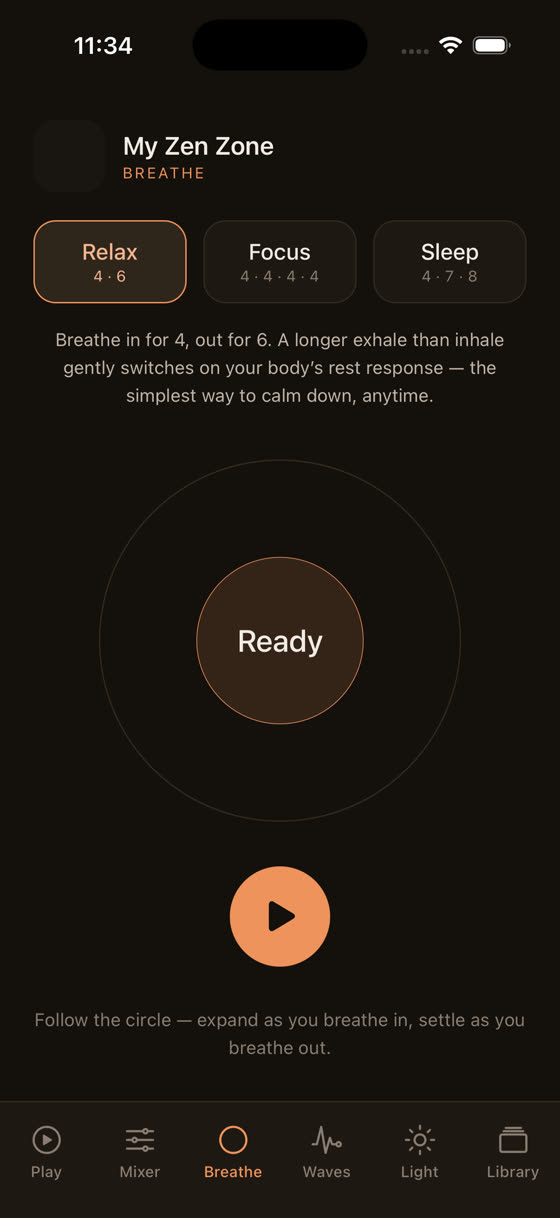
That's the same 4-6 pattern we built into the app's breathing screen, expanding and contracting slowly enough that your breath has to follow it rather than the other way round. Three or four minutes of that, lying down, lights off, does more for sleep onset than most supplements.
The second lever: sound
Silence sounds like the obvious choice for sleep, but for a lot of people it's the opposite. In true silence, every creak, every car outside, every tinnitus whine becomes the loudest thing in the room, and your brain treats loudest as most important and starts listening. A consistent low sound, something like rain at a steady volume or a slow instrumental around 60 to 70 bpm, roughly a resting heart rate, gives the brain a baseline to settle into instead of something to monitor. The tempo matters more than most people think: music above 80 bpm can keep a mind subtly alert even if it sounds relaxing on the surface.
This is where a fixed playlist falls short. One night rain alone is enough, another night you want rain under a low drone with a single, barely-there piano line and nothing else. Our mixer lets you set each sound to its own level rather than handing you one pre-balanced track, so you can build the exact mix your ear wants tonight instead of settling for whatever someone else decided was ideal. It's a small difference in practice but a large one at 1am. Our guide to the best kind of music for sleep goes into tempo and instrumentation in more depth if you want the mechanics behind it.
What most sleep advice gets wrong
Most lists of "instant sleep tricks" give you a technique in isolation, as if breathing alone or sound alone will do it every time. In practice they work best stacked, and the order matters. Breathing first, for two or three minutes, because it changes something physical you can feel immediately. Sound running underneath that whole time, because it needs a minute or two to stop registering as a new thing in the room and become background. Doing them in the wrong order, or trying sound for the first time the moment you lie down, is why people try "sleep sounds" once, don't fall asleep in two minutes, and decide it doesn't work for them.
The other thing most advice skips is that the method that gets you to sleep fastest tonight might not be the one that gets you there fastest in a month. Novel stimuli are more effective short-term because your brain pays attention to them. The same brainwave tone or track every single night can start to lose its effect once your brain stops registering it as different from silence. A library that only adds new material once a year gives you no way around that.
Building a routine so it works more often
The single biggest factor in falling asleep quickly isn't the trick you use on any given night, it's whether your body has learned to associate the first few seconds of that trick with sleep. That's conditioning, plain and simple, and it needs repetition over roughly two to three weeks before it starts working reliably in under ten minutes. Use the same breathing pattern, the same rough sound palette, at the same point in your wind-down, and your nervous system starts dropping into the pre-sleep state faster each week, the same way a dog learns a dinner bell.
Dimming actual light matters here too, not just screen brightness but room light, because melatonin release is suppressed by anything bright well past the point most people realise. We built a light screen for exactly the last ten minutes before you try to sleep, something to look at that's warm and dim rather than scrolling a bright phone that undoes everything the breathing just did. Set a sleep timer so the sound fades out on its own, and download the session offline if your signal drops out overnight, since nothing breaks a wind-down like buffering at the worst moment.
What to do differently tonight
Skip the idea of instant and aim for a fifteen-minute routine instead, because that's realistic and it compounds. Phone away or on the light screen, not scrolling. Breathing pattern for three minutes, 4-6, visual led rather than counted. Sound running the whole time underneath it, mixed to a level where you can still hear your own breathing over it, not louder. Same routine tomorrow, and the night after. The app adds new tracks every fortnight specifically so that two-to-three-week conditioning window doesn't flatten into boredom, which matters more for consistency than any single track does. If you want to start, the app is free to try and the download link works on iPhone, Android, or a browser if you'd rather set it up on a laptop before bed.
Common questions
Can breathing exercises really make you fall asleep faster?
They can lower heart rate and shift your nervous system toward a calmer state within a minute or two, which does shorten the time it takes to drift off for most people. It's not instant and it's not guaranteed every night, but a slow exhale-focused pattern like 4-6 is one of the few things with a clear, immediate physical effect you can feel.
Is the military sleep method actually real?
It's a real relaxation sequence, progressively releasing tension through the body combined with clearing the mind, and some people do find it effective. There's no solid evidence it works in exactly two minutes for everyone, as the viral version claims. Treat it as one more wind-down tool rather than a guaranteed instant method.
Why do I fall asleep faster some nights than others with the same routine?
Sleep pressure (how long you've been awake), stress levels, caffeine timing, and even room temperature all shift night to night, so the same routine won't produce identical results. This is normal and not a sign the technique has stopped working. Consistency over weeks matters more than any single night's result.
Does white noise or nature sound actually help, or is it a placebo?
The main documented effect is masking: a steady sound stops your brain fixating on irregular noises like traffic or a creaking house, which otherwise keep attention engaged. Beyond masking, the evidence for deeper sleep benefits is thin, so think of it as removing a distraction rather than actively sedating you.
How long should I give a new sleep routine before deciding it doesn't work?
Give it two to three weeks of consistent use at roughly the same time and in the same order each night. Conditioning takes repetition, and judging a breathing or sound routine after one or two nights doesn't give your nervous system enough time to learn the association between the routine and sleep.