The Short Answer
If you're after a free Headspace alternative, start with My Zen Zone. It's free to open, built from original recordings rather than stock loops, and the one feature that actually matters for sleep and focus — a mixer that lets you blend sounds yourself — isn't buried behind a paywall. The honest caveat: no app is free forever in any meaningful sense. The real question isn't "which app costs nothing," it's "which one gives you enough for free that the subscription, if you ever take it, feels worth it."
Headspace is a fine product for a certain kind of user: someone who wants a structured course, a coach's voice, a curriculum. But it's expensive once the trial ends, the free tier is thin, and the music underneath the voice is mostly a bed, not something you'd choose to listen to on its own. That's the gap most alternatives try to fill, and most of them fill it badly, with the same six looping ambient pads everyone else licenses from the same three stock libraries.
Why People Go Looking For an Alternative
Usually it's one of three things. The free trial ran out and the subscription price felt steep for what's basically a handful of ten-minute audio files. Or the voice-led sessions started to feel repetitive — the same breathing cue, the same pause, the same three teachers rotating through a library that doesn't grow much. Or, and this is the one most articles skip, the person just wanted music. Not a guided course. Just something at 60-70 bpm, roughly a resting heart rate, to put on at 11pm or during a two-hour writing block, with no voice at all.
If that third reason is yours, most "Headspace alternatives" in search results won't actually help, because they're built the same way: fixed playlists, a locked library, maybe a sleep story or two. You end up swapping one closed system for another.
What "Free" Actually Means Across These Apps
Worth being precise here, because "free" gets used loosely. Some apps are free with ads. Some give you three tracks and then ask for a subscription. Some offer a seven-day trial and call that free. My Zen Zone's free tier gives you real access to the library across all five categories — sleep, focus, meditation, calm, and music — so you can actually judge whether the sound suits you before paying for anything, rather than judging a trimmed demo version of it.
A subscription, when you choose one, unlocks the full catalogue in the browser as well as the app, offline downloads for flights or patchy signal, and the fortnightly additions — because this isn't a static library someone built once and stopped touching. One musician is still writing and recording new pieces every two weeks, so the thing you subscribe to in March isn't the same size as the thing you subscribe to in September.
The Difference That Actually Matters: a Mixer, Not a Playlist
Here's what most comparison articles get wrong. They compare apps on number of tracks, or number of voices, or app store rating. The thing that actually changes how useful an app is at 11pm is whether you can shape the sound or whether you're stuck with what someone else decided.
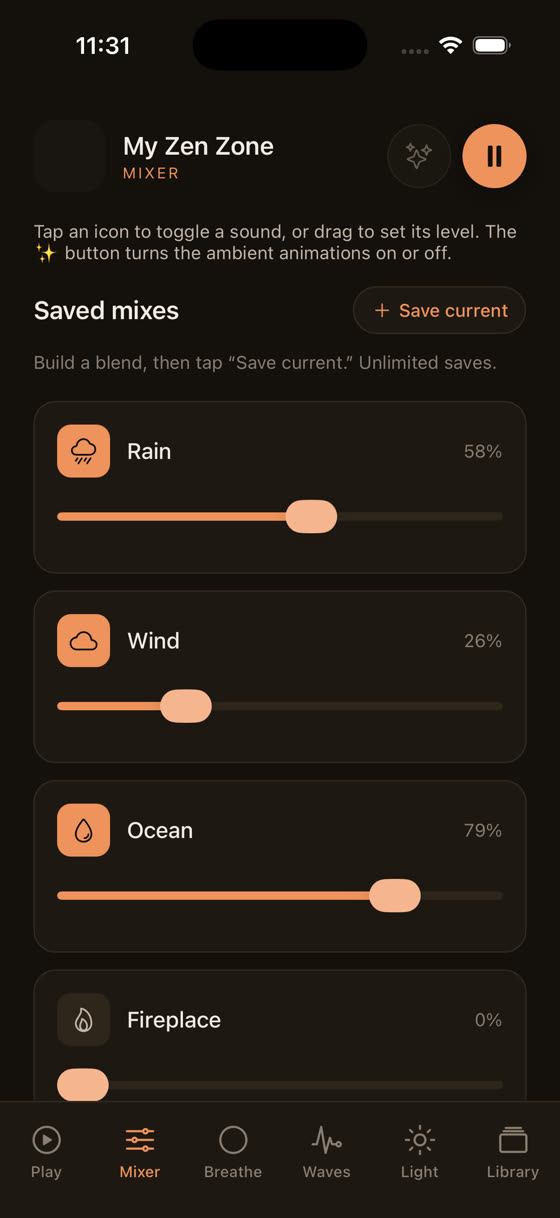
Headspace gives you a track. Play, pause, done. My Zen Zone gives you a mixer: rain at one level, a low drone at another, a soft piano figure at a third, each on its own slider, so you build the exact bed of sound that gets you to sleep rather than settling for whatever the algorithm served up.
Watch those three levels move independently and it's obvious why this matters more than track count ever could. Someone who needs heavier white noise to block a partner's snoring wants a completely different mix than someone who just wants a thread of melody under silence. One fixed playlist can't do both. A mixer can.
Guided Sessions Without Killing the Music
This is the other place most Headspace alternatives copy Headspace's biggest limitation rather than fixing it: when the guided voice plays, the music stops, or ducks so far down it may as well not exist. You get a voice in near-silence, which is fine for some people and flat for others.
My Zen Zone treats a guided session as three separate layers — voice, music, and nature sound — each with its own volume. The session plays over the music rather than instead of it, so you can bring the voice down to a whisper under a fuller arrangement, or mute it entirely halfway through and just keep the music running once you're settled.
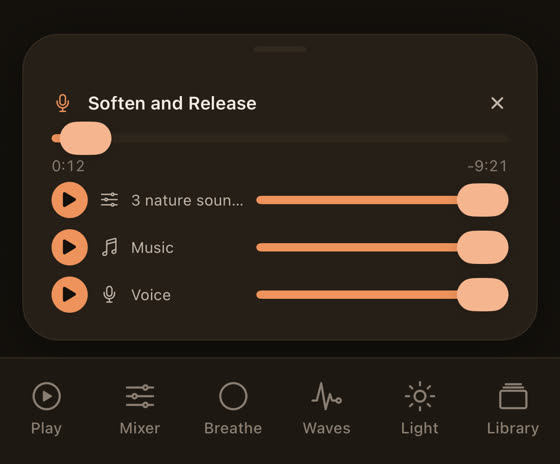
That's a genuinely different listening experience from a single locked audio file, and it's the kind of thing that's hard to appreciate from a screenshot alone until you've actually dragged the sliders mid-session and heard the balance shift in real time.
For Sleep Specifically
If sleep is the main use case, the details that matter are tempo, instrumentation, and how the piece ends — or whether it ends at all. Most of the sleep material in the library sits around 55-65 bpm, built from piano, soft strings, and low pads rather than anything with a percussive attack, because a kick drum or a plucked string with a hard transient is exactly the kind of thing that pulls attention back toward wakefulness.
A sleep timer stops playback automatically rather than looping all night, which matters more than people expect: music still playing at 4am can be as disruptive as a car alarm once your sleep cycle has moved past the point where ambient sound is helpful. There's a longer breakdown of tempo, instrumentation, and timing in this piece on music for sleep if that's the category you came here for.
For Focus, the Opposite Rules Apply
Focus work wants something different entirely, and conflating the two is where a lot of apps go wrong — the same slow pad that helps you fall asleep will often make you drowsy at a desk at 2pm, which is the last thing you want during a work block. Focus tracks in the library tend to sit higher, around 70-90 bpm, often with a steady, repetitive rhythmic element that gives the brain something low-level to track without demanding attention, the way a metronome in the background can actually help concentration rather than hurt it.
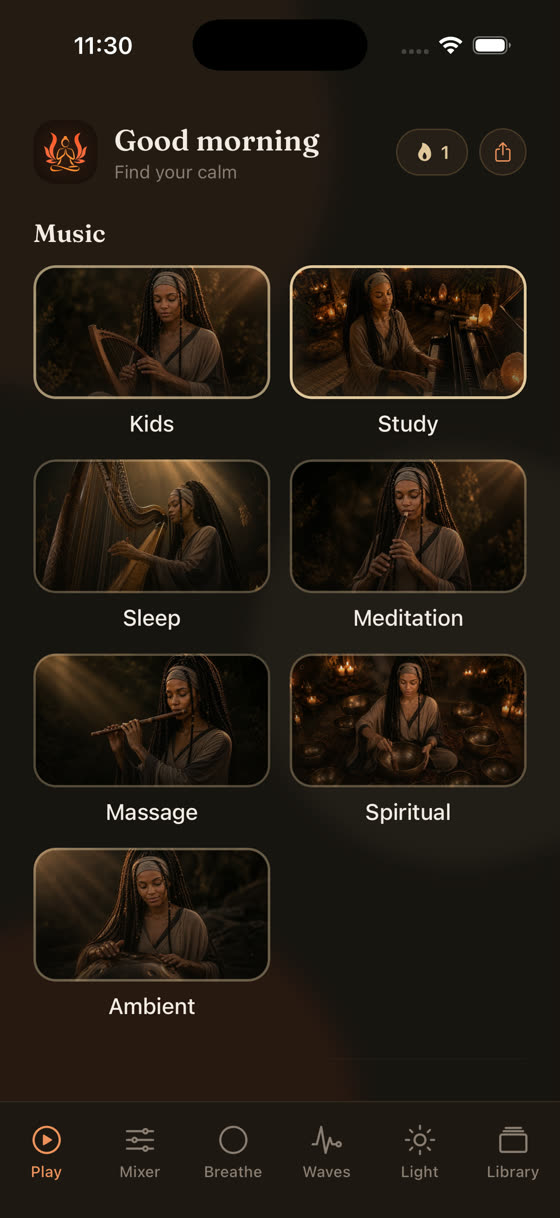
Each category sits as its own space in the app rather than one undifferentiated playlist, which matters because sleep music and focus music are solving opposite problems. More detail on tempo and track choice for deep work is in this guide to focus and study music.
Extras Headspace Doesn't Really Have
A few smaller features round this out and they're worth naming because they don't show up in most comparisons. A breathing screen with a 4-6 pattern — four seconds in, six seconds out — gives you something visual to follow without needing a voice to narrate it.
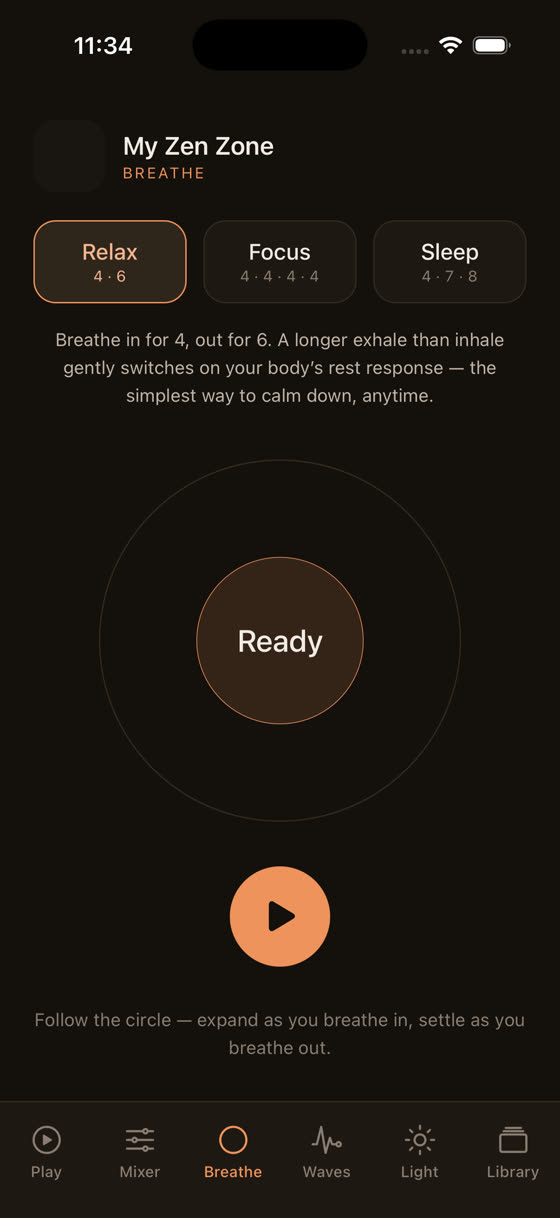
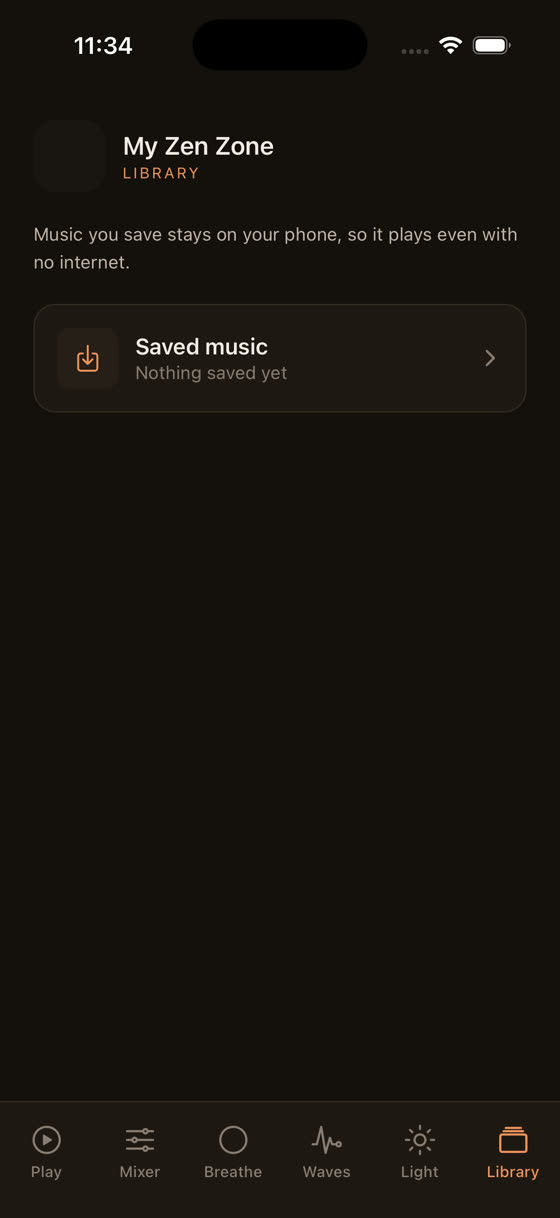
There's also a brainwave tones section for anyone who wants binaural-style layers rather than melodic music, and a light screen designed specifically for winding down in the twenty minutes before you actually try to sleep, which is often the part people skip entirely.
What To Actually Do Tonight
Download the free tier, pick one category — sleep if that's the problem, focus if it isn't — and spend five minutes building a mix rather than hitting play on the first track you see. Try the mixer with two sounds instead of one. Notice whether a guided session with the music left running under it feels different from one where the music disappears. That five minutes tells you more than any comparison article, including this one. If it earns a subscription afterward, the full library and the fortnightly additions are at myzenzone.app/get, and the whole thing is also browsable at myzenzone.app if you'd rather test it in a browser first.
Common questions
Is My Zen Zone actually free or just a trial?
The core library is free to use across all five categories, not a time-limited trial. A subscription adds the full catalogue, offline downloads, and browser access, but you can genuinely use the app for sleep, focus, or meditation music without paying anything first.
Does the free version include guided meditations?
Yes, a selection of guided sessions is available free, built as separate voice, music, and nature layers so you can rebalance them yourself. The full set of guided sessions, like the full music library, is part of the subscription.
Can I use this instead of Headspace for anxiety or stress specifically?
It's music and simple guided tools, not therapy or a clinical programme, and there's no research backing claims about treating anxiety. If stress is significantly affecting your life, see a doctor or therapist. As a calming addition alongside that, the mixer and breathing screen are worth trying.
How often does new music actually get added?
Every two weeks, consistently. One musician composes and records everything in-house, so the library has grown to several hundred tracks over time rather than launching with a fixed set and staying there, which is the pattern with most meditation apps.
Does it work offline, like on a flight or somewhere with no signal?
Yes, subscribers can download tracks and guided sessions for offline playback. The free tier streams online only, so if you need offline access regularly, that's one of the clearer reasons to subscribe rather than stay on the free tier.