The short answer
Neither one is better across the board. Autofocus wins on speed, on tracking anything that moves unpredictably, and on getting a usable shot when you have half a second to react. Manual focus wins on control, on repeatability, and on situations where the camera's sensors get confused by low contrast, glass, or a busy background. The honest answer to "which is better" is: it depends what you're shooting and how much time you have to think before you shoot it.
That's the photography answer. But the question carries a second, quieter meaning worth sitting with, and we'll get to it, because the same tension between a system that reacts for you and a setting you hold deliberately shows up the moment you try to do any sustained piece of work.
How autofocus actually works, and where it wins
Modern autofocus uses one of two main methods, sometimes both at once. Phase detection compares light hitting different parts of the sensor to judge distance almost instantly, which is why it's so good at tracking a cyclist or a dog running toward you. Contrast detection hunts back and forth until it finds the sharpest edge, which is more accurate in stillness but visibly slower and prone to "hunting" in flat light or low contrast scenes, like a foggy field or a plain white wall.
Autofocus is the right call for street photography, sport, wildlife, and anything where the subject decides the timing, not you. A toddler doesn't wait for you to turn a focus ring. Neither does a bird lifting off a branch. In those moments the camera's reaction speed beats your hand every time, and pretending otherwise out of principle just costs you the shot.
Where manual focus wins, and why it's not stubbornness
Manual focus earns its place in exactly the situations where autofocus struggles: through fences or glass, in macro work where the depth of field is a few millimetres deep, in low light where AF motors hunt audibly and visibly, and in video, where a focus pull needs to happen at a specific pace rather than the moment a sensor decides it's confident. Astrophotography is almost always manual, because there's no contrast for the camera to lock onto in a dark sky.
Most modern cameras also offer focus peaking, a highlighted outline around whatever's currently sharp, which makes manual focus far less guesswork than it used to be. This is worth knowing because a lot of older advice about manual focus being slow and imprecise predates peaking and doesn't hold up as well now.
Six real situations, six real choices
It helps to think in scenarios rather than absolutes.
- A football match through a chain-link fence: manual, pre-focused on the goal line, because autofocus will lock onto the fence.
- A dog running at full speed toward the camera: autofocus with continuous tracking, because no human hand is fast enough.
- A macro shot of a flower with a shallow depth of field: manual, using peaking, because the margin for error is a couple of millimetres.
- A dim concert with fast-moving coloured lights: often manual, because AF hunts in low, changing light.
- An interview on video with a planned focus pull from face to background: manual, because the timing needs to be yours, not the sensor's.
- A quick street portrait with seconds to react: autofocus, because hesitation loses the moment entirely.
Notice the pattern. Autofocus wins when the subject is unpredictable and speed matters more than precision. Manual wins when the frame is predictable and you have a moment to set it up properly. Skilled photographers switch constantly rather than picking a side and defending it.
The metaphor hiding inside the question
This is a photography question on the surface, but it describes a choice you make dozens of times a day without a camera anywhere near you. Autofocus is a reactive system: it hunts, it locks onto whatever is loudest or brightest or moving fastest in the frame, and it does this automatically without asking permission. Manual focus is deliberate: you decide what matters, you set it, and you leave it alone until you choose to change it.
Attention works almost exactly the same way. Left alone, it behaves like autofocus, locking onto notifications, movement in your peripheral vision, a new tab, a sound from another room. That's not a character flaw; it's how the attention system is built, tuned by evolution to react fast to anything new. The trouble is that a phone on the desk gives it something new to react to every few minutes.
Attention has an autofocus mode too, and it is exhausting
The cost of staying in reactive, autofocus-style attention all day isn't obvious in the moment, but it shows up as a particular kind of tiredness: you've been busy, you've responded to plenty, and yet nothing feels finished. That's the attention equivalent of a camera that never stops hunting for a lock. Each re-lock has a small cost, and those costs add up across a working day into something closer to fatigue than progress.
Deliberately held, manually set attention is slower to establish and takes more effort at the start, exactly like turning a focus ring by hand instead of trusting the sensor. But once it's locked, it tends to stay locked longer and cost less to maintain, because you're not re-deciding what matters every few seconds.
Setting your own focus ring: what actually holds a lock
A few things reliably help attention stay manually set rather than sliding back into autofocus. A single task on screen rather than six open tabs. A closed door or headphones, which remove the visual and auditory movement that attention reacts to. And sound that stays steady rather than sound that keeps surprising you, because a track full of sudden dynamic swings behaves like a scene full of movement, constantly giving your attention something new to react to.
This is where instrumental music with a narrow dynamic range and a tempo around 60-70 bpm, roughly a resting heart rate, tends to work better for sustained focus than a shuffled playlist with lyrics and drops. It's the difference between a locked frame and a camera that keeps hunting. We wrote about the mechanics of this in more detail in our piece on music for focus and study, if you want the fuller argument.
Tools that help you hold it
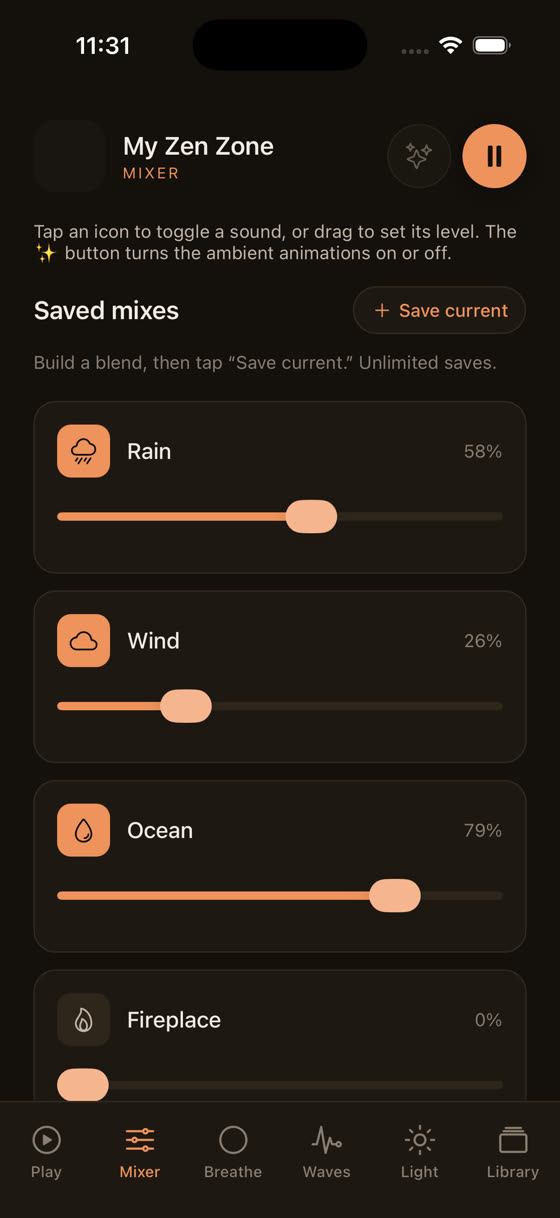
Inside the app, the Focus world is built around this idea directly: long, steady instrumental tracks without the swells and key changes that pull attention back to the surface. The mixer lets you layer a track with rain or low static hum and set each one at its own level, so you can build a sound environment rather than accept whatever a single fixed track gives you.
Watching the levels move live is a better explanation than any description: three separate sounds, each nudged up or down until the balance disappears into the background and stops asking for attention.
A sleep timer and offline downloads matter here too, in a smaller way. Knowing the sound will stop, or that it won't cut out mid-session because a connection dropped, removes two more things your attention might otherwise be watching for. And because the library adds new tracks every fortnight, you're less likely to habituate to one loop and start half-listening for the next change, which is its own small drift back toward autofocus. If sleep rather than work is the actual problem tonight, our guide to music for sleep covers the tempo and instrument choices that matter there specifically.
What to try tonight or at your next desk session
Pick one task, not a list. Put the phone somewhere you can't glance at it. Choose a track with a steady tempo and let it run rather than skipping every 90 seconds, because skipping is itself a small autofocus habit. Give the lock 10 minutes before deciding whether it's holding. If your work involves an actual camera and an actual subject that won't sit still, use autofocus and don't feel a need to prove anything. If the subject is predictable and you have a moment to prepare, set the focus yourself and leave it. The whole skill, in a viewfinder or at a desk, is knowing which situation you're in before you decide which mode to use. You can try the mixer and the Focus tracks yourself through the app, or browse the full library at myzenzone.app.
Common questions
Does manual focus make you a better photographer overall?
Not by itself. It makes you more deliberate in situations where deliberation pays off, like macro or landscape work, but it won't help you catch a fast-moving subject faster than a good autofocus system will. Skill shows in knowing which one to reach for, not in preferring one permanently.
Is manual focus faster once you've had practice?
It gets faster with focus peaking and practice on a fixed scene, but it still won't beat modern phase-detection autofocus on anything moving unpredictably. Practice narrows the gap for static or slow-moving subjects; it doesn't close it for sport or wildlife.
What is focus peaking and do I need it for manual focus?
Focus peaking highlights the sharpest edges in your frame in a bright colour as you turn the focus ring, so you can see the exact point of sharpness rather than guessing. It's not mandatory, but it makes manual focus considerably faster and more reliable, especially in dim light.
Can steady background music genuinely improve focus, or is that overstated?
Evidence here is thin and mostly self-reported rather than clinically proven, so it's worth being honest about that. What's reasonably well supported is that sudden, unpredictable sound disrupts concentration, and steady, low-variation sound is less disruptive than silence-with-notifications for most people.
Is back-button focus manual or automatic?
It's a hybrid. The autofocus system still does the work of finding sharpness, but you decide exactly when it fires by pressing a separate button instead of the shutter. It gives you the speed of autofocus with the timing control usually associated with manual focus.