If you typed this because a bird outside your window won't stop and you want to know what it is, the answer is Merlin Bird ID, free, made by the Cornell Lab of Ornithology, and genuinely good at matching a recording to a species. If you typed this because you want nature sounds that help you fall asleep, concentrate, or come down after a bad day, identification isn't actually the tool you need. Those are two different jobs, and most articles chasing this search term blur them together.
Two different questions hiding in one search
"Identify" is doing a lot of work in this phrase. One reading: an app that listens through your microphone and tells you that's a wren, that's a stream over gravel, that's wind through pine rather than oak. That's a real category, built on audio recognition models trained on labelled recordings, and it's a genuinely useful thing to have on your phone on a walk.
The other reading, and the one I suspect brought most people here, is closer to: which app has good nature sounds and lets me pick the right one. That's not identification in the technical sense. It's curation and control, and it's a completely different problem to solve.
The apps that actually do sound ID
For birds specifically, Merlin Bird ID is the standard, and it works offline once you've downloaded a regional pack. BirdNET, from the same research group, does something similar and is used widely in citizen science projects. Beyond birds, general environmental sound identification is much patchier. Shazam works on music, not on "is this rain or a shower." There isn't a reliable, well-known app that will confidently tell you "that's a red fox" from a scream in the dark, and I won't pretend one exists just to answer the query neatly.
Why naming a sound works against relaxation
Here's the part worth slowing down on. Identifying a sound is an analytic task: you hear something, your brain searches memory for a match, compares candidates, settles on an answer. That's active cognition, the same kind of process you use solving a crossword. It's a fine way to spend attention on a walk. It's close to the opposite of what you want at 11pm or mid-deadline.
What actually helps you sleep or focus is a sound that your brain stops analysing, because it's decided the sound is safe, unchanging, and not worth further attention. Rain does this well because it has no melody to follow and no single event to fixate on. A specific bird call, oddly, can do the reverse, because a call that repeats unpredictably keeps pulling your attention back to check what it was. This is one reason a lot of "real nature recording" tracks, however lovely on a hike, are worse for sleep than a steadier, engineered loop.
What actually matters when you're choosing a nature sound app
Once you drop "identify" and think about what you're really shopping for, the useful questions change:
- Does the loop actually loop, or is there an audible seam every 90 seconds that yanks you out of a doze?
- Can you combine sounds, or is it one file at a time?
- Is there a way to set how long it plays, so you're not woken by silence at 3am or a jarring auto-next track?
- Can you take it offline, for a flight or a house with patchy signal?
- Is it free of ads that cut in over a thunderstorm loop right as you're drifting off?
Most of the well-known ambient sound apps answer maybe two of these. Fewer let you actually build a mix.
Building your own mix instead of picking one track
This is the bit where I'll say plainly how My Zen Zone handles it, because it's the actual difference worth knowing about. Instead of one nature sound at a time, the mixer lets you bring in several and set each one's level independently: rain at the front, a low, almost subliminal thunder rumble underneath, maybe a thread of wind through trees, no birdsong at all if that's what keeps pulling your ear.
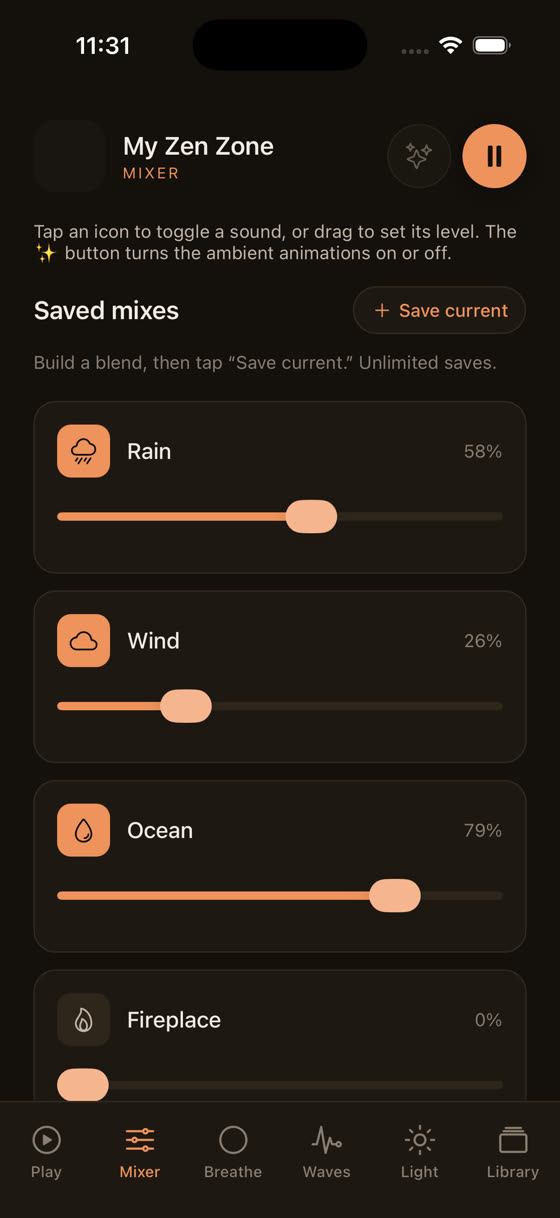
Watching the levels move is more useful than reading about it, so here's what that actually looks like in practice, three sounds each rising and falling under your thumb rather than one fixed track playing on a loop.
The point isn't more sounds. It's control over exactly which ones and how loud, because the wrong balance, too much white noise hiss under too little rain, is often what makes a "calming" track quietly annoying after ten minutes.
Nature sounds for sleep versus nature sounds for focus
The mix that works for sleep is not the mix that works for a two-hour writing session, and treating them the same is a common mistake. For sleep, you generally want something closer to unbroken, low-frequency, and slightly duller than real life, nothing with a sharp transient like a snapping twig or a close-by owl. For focus, you can tolerate, sometimes even benefit from, a bit more texture and higher frequency content, because the goal isn't to switch attention off entirely, just to stop it wandering to the office next door. If you want the deeper version of that distinction, including which tempos and instruments tend to help each, it's worth reading our piece on music for sleep and the one on focus and study side by side, since the contrast is more useful than either read alone.
Where nature sounds sit in a bigger library
Nature sounds work best, in my experience, as one layer among several rather than the whole track. A composed piece at 60 bpm with a rain layer mixed low underneath tends to hold attention better over 40 minutes than rain on its own, because the ear has something structured to settle into rather than pure texture. That's how the library is built: hundreds of original tracks, composed and recorded by one musician rather than licensed stock, organised by what you're actually trying to do rather than by instrument or mood word.
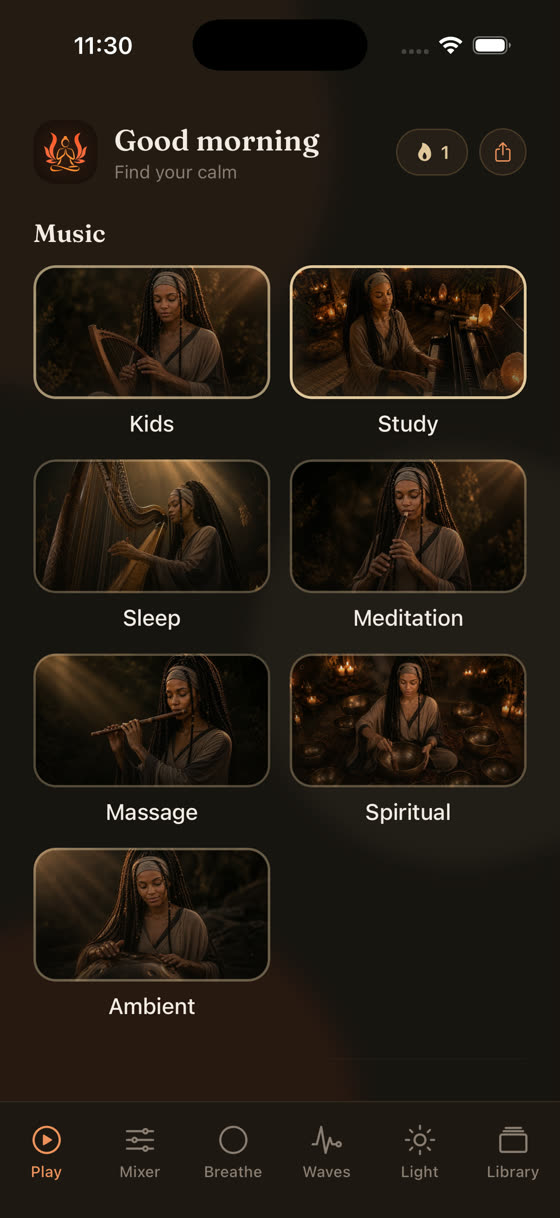
New material goes in every two weeks, so the rain-and-drone combination you like this month sits alongside genuinely new compositions rather than the same forty loops recycled with a different cover image, which is the pattern in a lot of ambient sound apps that haven't added anything since launch.
What to actually do tonight
Skip the identification question entirely if what you're after is rest, not curiosity. Open a nature sound layer, bring in one composed track underneath it at low volume, and use the level controls rather than accepting a fixed preset. Set a sleep timer so the audio has somewhere to stop rather than running all night. If you're testing this for the first time, the app is free to try, and the fastest way to see whether the mixer approach actually changes how a nature sound lands for you is to go build one yourself rather than read about it further, which you can do from this link.
Common questions
Is there an app that identifies animal sounds, not just birds?
Reliable, widely-used options are much thinner outside birds. Merlin Bird ID and BirdNET cover birdsong well because of large labelled datasets from citizen science projects. For mammals, insects, or general environmental noise, there isn't yet a well-established equivalent, so treat any app claiming broad animal sound ID with some scepticism.
Does My Zen Zone identify what nature sound I'm hearing?
No. My Zen Zone is a library of original composed music and nature sound layers you choose and mix yourself, not an audio recognition tool. If you want to know what species made a sound outside, an app like Merlin Bird ID is built for that specific job and does it well.
Is white noise better than nature sounds for sleep?
Neither is universally better; it depends what disturbs you. White noise masks sudden noises (traffic, a snoring partner) more evenly because it has energy across all frequencies. Nature sounds like rain feel less clinical to some people but mask less consistently. Many find a low mix of both, at a comfortable level, works better than either alone.
Why does a real recording of rain sound worse than an app's rain loop?
Field recordings often have variable volume, wind noise on the microphone, or a single loud event (a car, a dog) that pulls your attention back. Engineered loops are deliberately levelled and looped seamlessly, which is part of why a composed or edited rain track can hold attention better through a full night than a raw recording.
Can I download nature sound mixes for offline use?
Yes, within My Zen Zone tracks and layers can be downloaded for offline listening, which matters most on flights, in areas with poor signal, or if you'd rather not have your phone pulling data overnight. Set your mix, download it, and it plays without needing a connection.