The best calming sounds for anxiety are low, steady, and predictable: brown noise, steady rain, a droning cello line, or music built around 60-70 bpm, roughly a resting heart rate. What matters less than the specific sound is its shape. Anxiety runs on unpredictability, so a sound that never surprises you gives your nervous system something safe to hold onto instead of scanning the room for the next threat.
That's the short answer. The longer answer is about why some "calming" playlists make anxious people feel worse, why silence isn't the neutral option it seems to be, and what to actually do the next time your chest goes tight at 11pm or ten minutes before a meeting.
What's Actually Happening in Your Body
Anxiety is a state of heightened vigilance. Your auditory system, in particular, gets more sensitive: a fridge hum, a car door, someone's footsteps upstairs, all of it gets flagged as potentially relevant. This is useful if there's an actual threat. It's exhausting when the threat is a deadline or an unanswered text.
Steady, low-frequency, unchanging sound works because it gives that hypervigilant system a single, safe thing to track. Once your brain stops darting between the fridge hum and the footsteps and the ticking clock, it has spare capacity to settle. This is the same reason white noise machines work for babies and why people with tinnitus often prefer a fan running to true silence. The sound isn't blocking anxiety directly. It's reducing the number of things your brain feels it needs to monitor.
The Specific Sounds That Work
Not all calming sounds are equal, and the differences matter more than most wellness content admits.
- Brown noise is deeper and less hissy than white noise, closer to distant surf than static. Many people find it less fatiguing over long stretches.
- Rain, without thunder, is close to ideal: constant, textured, no sudden peaks.
- Music at 60-70 bpm, especially with sustained tones rather than plucked or percussive ones, tends to slow breathing gradually rather than through any lyrics-driven relaxation.
- Low string drones and soft piano with long decay work well because there's nothing sharp in the attack of the note. A sudden cymbal or a bright plucked harp, however pretty, can pull an anxious mind straight back to alert.
What doesn't reliably help: anything with lyrics, anything that builds toward a chorus, and anything with an unpredictable structure, however soft it starts. A quiet track that suddenly swells is worse for anxiety than a louder track that stays exactly where it started.
Why Total Silence Can Make Anxiety Worse
This is the part most articles skip. Silence is often recommended as the gold standard for calm, but for a genuinely anxious brain it can backfire. Total silence removes the external noise your brain was tracking, and it fills the gap with internal noise instead: your own heartbeat, your thoughts, the small sounds of a quiet room that now feel loud by contrast. This is why some people feel more anxious lying in a silent bedroom than they do falling asleep with something playing.
The fix isn't to avoid quiet altogether. It's to replace unpredictable silence with predictable sound, so there's something steady to rest attention on instead of your own racing thoughts. This is also the logic behind pairing music with breathing patterns rather than using either alone, something we go into more in our piece on music for sleep, where the same mechanism applies at bedtime.
One Sound Rarely Works on Its Own
Here's where most advice stops short. A single looping rain sound is fine for twenty minutes. Over a longer stretch, especially at night, a mind that's anxious tends to notice the loop, and noticing the loop undoes the calming effect. The fix is layering: rain under a slow piano line, or brown noise under a distant, barely-there drone, so no single element repeats in an obvious pattern even though the overall texture stays constant.
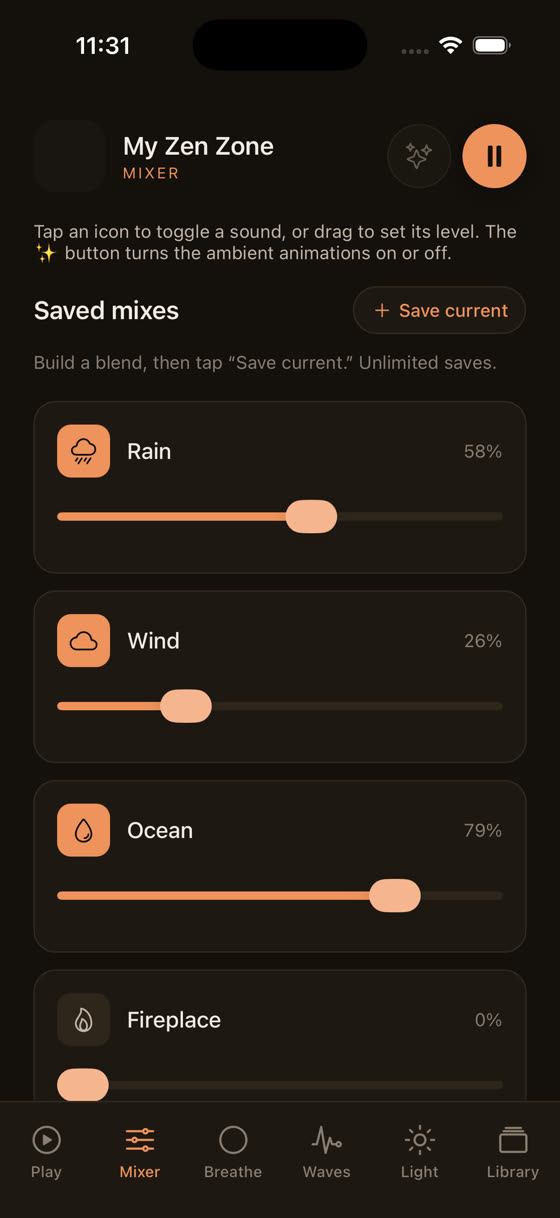
This is the whole idea behind the mixer in My Zen Zone. Instead of one fixed track, you set your own levels for several sounds at once, so the combination is unique to you and doesn't loop the way a single file does.
Watching the levels move live is the fastest way to understand it: rain up, a low drone barely audible underneath, a single soft chime almost inaudible in the background. Small adjustments, but they change how long you can sit with the sound before your brain starts anticipating it.
Morning Anxiety, Night Anxiety, and the Ten Minutes Before a Meeting
The right sound depends heavily on when the anxiety shows up, which is another thing generic "calming sounds" lists ignore.
Morning anxiety, the kind that arrives with the first thought of the day, usually responds better to something with a gentle sense of movement, like soft strings or a light piano figure, rather than a flat drone. It signals a change of state without being jarring.
Anxiety before a specific event, a meeting, a flight, a phone call, is often better served by something short and active rather than ambient: a few minutes of paced breathing with a very simple tone underneath, nothing that requires attention, just something to breathe against.
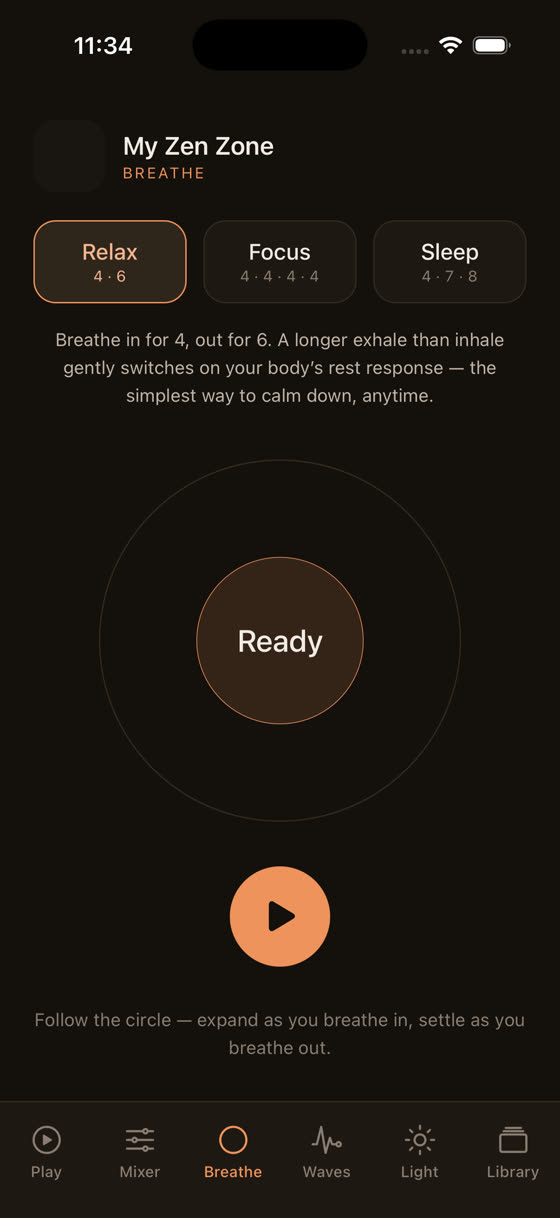
A 4-6 pattern, breathing in for four and out for six, is one of the more consistently useful techniques for this kind of situational anxiety, and it works better with a visual pace to follow than with music alone.
Night anxiety, the racing-thoughts-at-1am kind, needs the steadiest, least eventful sound of the three, ideally something you can leave running for hours without a track change disturbing you, which is where offline downloads and a long sleep timer matter more than the specific instrument.
What Most Advice on This Gets Wrong
Two things, mainly. First, most lists of "calming sounds" are just genre lists: rain, ocean, forest, piano, as though the category alone guarantees the effect. It doesn't. A piano piece with sudden dynamic swells is not calming just because it's piano. Second, most advice treats calming sound as something to consume passively, when the more useful approach is to treat it as something to adjust in real time based on how you're actually feeling in that moment, louder rain when your mind is loud, softer and sparser as you settle.
It's also worth being honest about the limits here. Calming sound can help you settle a racing nervous system in the moment and make it easier to fall asleep or get through a difficult ten minutes. It isn't a treatment for an anxiety disorder, and nothing in this piece should be read as a substitute for speaking to a doctor or therapist if anxiety is a regular, disruptive part of your life.
A Routine to Try Tonight
Start with a mix rather than a single track: something low and constant as a base, one gentle melodic layer well underneath it, both around 60-70 bpm if there's any tempo at all. Dim your phone or use a wind-down light screen rather than the full brightness of your device.
Set a sleep timer for longer than you think you need, an hour rather than twenty minutes, so the sound doesn't cut out right as you're finally settling. If your anxiety tends to spike specifically at bedtime, five minutes of paced breathing before the music starts, rather than during it, seems to help more than combining both at once.
Keep the Right Sound Within Reach
The practical part of all this is availability. The calming effect of a specific sound depends partly on familiarity, so having a library you can return to, rather than searching for a new video every night, matters more than people expect. Every track in My Zen Zone is composed and recorded in-house, the library runs to hundreds of tracks across sleep, focus, meditation and calm, and new music is added every two weeks so it doesn't go stale the way a single looping playlist does. You can build and save your own mixes, download them for offline use, and reach for the same combination you know works rather than starting from scratch each time. If focus rather than sleep is the more immediate problem, the same layering logic applies, covered in more detail in our piece on music for focus and study. You can try the full library at myzenzone.app/get or see what's inside at myzenzone.app.
Common questions
Does brown noise work better than white noise for anxiety?
For most people, yes, though it's a preference rather than a rule. Brown noise is deeper and less hissy, closer to surf than static, and tends to feel less fatiguing over long periods. White noise can feel harsh or tinny to sensitive ears. Try both for a week each and notice which one you stop noticing sooner.
Can calming sounds stop a panic attack?
They can help you get through one by giving your attention somewhere steady to rest, especially combined with slow breathing, but they won't stop a panic attack outright. If panic attacks are frequent or severe, that's worth raising with a doctor rather than relying on sound alone.
Is it bad to fall asleep with sound playing every night?
No evidence suggests this is harmful for most people. The main practical concern is dependency on a specific device or app being available, which a downloaded offline mix solves. If you'd rather not rely on sound at all, a sleep timer that fades out gradually is a reasonable middle ground.
What's the difference between calming sounds and binaural or brainwave tones?
Calming sounds like rain or brown noise work by giving your attention something steady to track. Brainwave tones use two slightly different frequencies in each ear, and the theory is that the brain entrains to the difference between them. The evidence for brainwave entrainment is thinner, but many people still find the tones pleasant to layer under other sound.