The Short Answer
Apple Music's curated focus playlists, "Pure Focus," "Deep Focus," "Instrumental Study," are competently assembled and free if you already pay for the service. They work fine for maybe forty minutes of light admin work. For actual deep work, two or three hours at a stretch, they tend to break down for a specific reason: they were built for listening, not for working alongside. The tracks still have musical arcs, builds, occasional vocal samples, mood shifts, because somebody wanted them to be enjoyable on their own merits. A focus track that's enjoyable on its own merits is usually one that pulls your attention at some point, which is the opposite of what sustained work needs.
What actually helps is music composed specifically to recede: steady tempo, no key changes, no surprise swells, nothing that asks your brain to notice it. Apple Music has some of this scattered through its library, but you're hunting through playlists designed for general listening and hoping the algorithm agrees with your definition of "focus." That's the gap this post addresses, including what to listen for and why a purpose-built library is a different brief than a curated streaming playlist.
What Apple Music's Focus Playlists Get Right
Fair's fair. The editorial team behind these playlists understands a few real things. Instrumental tracks outperform lyrics for concentration, the research on this is modest but fairly consistent, so they default to piano, ambient pads and electronic textures over songs with words. They also tend to avoid extreme tempo, nothing much above 120 bpm, which keeps you from unconsciously speeding up your typing or reading to match a beat.
They're also free with an existing subscription, updated regularly, and varied enough that if lo-fi piano bores you after a week, there's a jazz-adjacent or ambient-adjacent playlist sitting right next to it. For someone who wants background sound for an hour of email, that's genuinely enough. The failure mode shows up in longer, harder blocks: writing, coding, studying for an exam where you need two or three consecutive 90-minute stretches rather than one.
Where They Fall Apart
Three things happen over longer sessions. First, playlist order isn't built around your work, it's built around listening flow, so you get a quiet ambient piece followed by something with a bigger low end or a sudden string swell, and your attention snags on the transition even if you can't name why. Second, most playlists mix tracks from different artists and sessions, so the tonal character jumps around, tape hiss here, a brighter digital synth there, a warmer analog pad two tracks later. Small, but your ear notices even when you're not consciously listening. Third, there's no way to blend in anything else. If you want a thread of rain or a low mechanical hum under the music, you're opening a second app and hoping the volumes don't fight each other.
None of this makes Apple Music's playlists bad. It makes them general-purpose, which is a different thing from built-for-work. For a fuller breakdown of the actual research on tempo, genre and task type, see music for focus and study.
The Tempo Mechanism Nobody Explains Properly
Most focus-music advice stops at "slow music helps." It's more specific than that. For sustained concentration, the useful range is roughly 50 to 70 bpm, close to a resting heart rate, which seems to reduce the chance that your work pace, typing speed, reading rhythm, gets pulled along by the beat. Above about 85 bpm you start to get entrainment effects where people unconsciously speed up or feel mild restlessness, useful for repetitive admin tasks, less useful for anything needing sustained reasoning.
The bigger issue is variability within a track, not just its average tempo. A piece that sits at 60 bpm for four minutes then builds to a swell at minute five has, for focus purposes, failed, even though its metadata still reads 60 bpm. This is why a lot of ambient music marketed for focus doesn't actually hold up over an hour: it's composed to be interesting, and interesting means change, and change means a moment where your brain checks back in.
One Mixer, Three Layers, No App-Switching
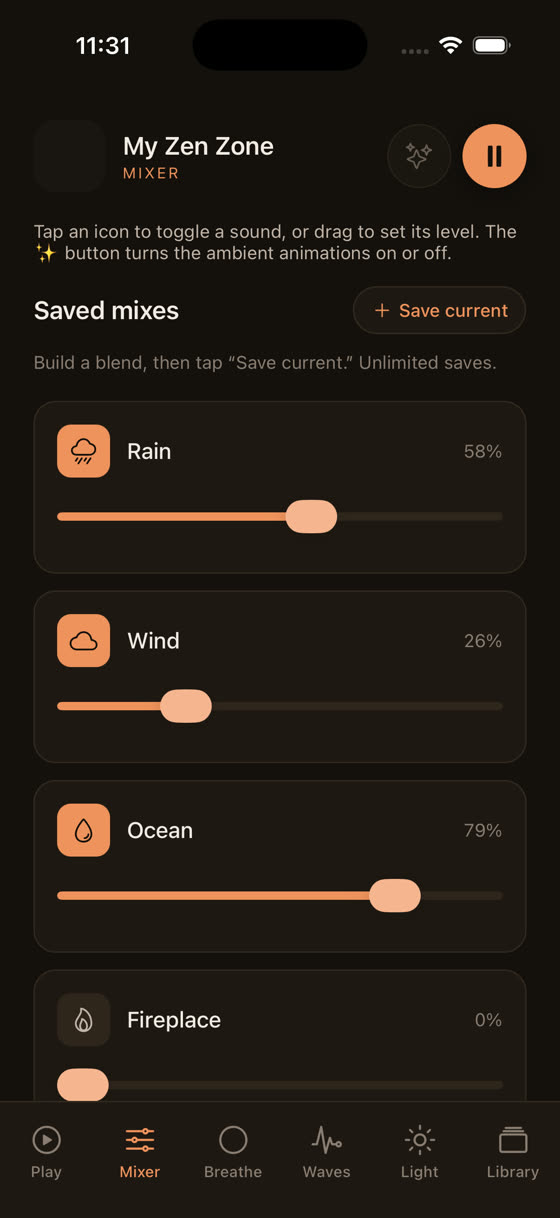
The practical fix is building your own sound rather than accepting someone else's fixed track order. A low, stable instrumental bed at a steady tempo, underneath it a thread of something textural like rain or a low room tone, balanced against each other so neither is loud enough to pull focus on its own.
That's the mixer in My Zen Zone: each nature sound and the music track get their own independent level, so you're not toggling between two apps or accepting a fixed blend somebody else chose. Turn the rain down to a whisper under a piano piece, or drop the music out almost entirely and let a steady hum carry the session, whichever your ear prefers that day. It sounds like a small feature until you've worked three hours with it against three hours with a single static playlist. The difference is less about any one sound and more about control: you can correct a mix that's distracting you in five seconds instead of living with it.
Brainwave Tones, and Being Honest About What We Know
Brainwave entrainment tones, often labelled binaural or isochronic, show up constantly in focus-music marketing with bold claims attached. The honest position is that evidence for specific cognitive effects is thin and mixed, not absent, but nowhere near strong enough to promise concentration or memory gains. What they reliably do is give you a steady, textureless layer of sound with no musical event to get distracted by, which for some people is useful in itself, independent of any claimed brainwave effect.
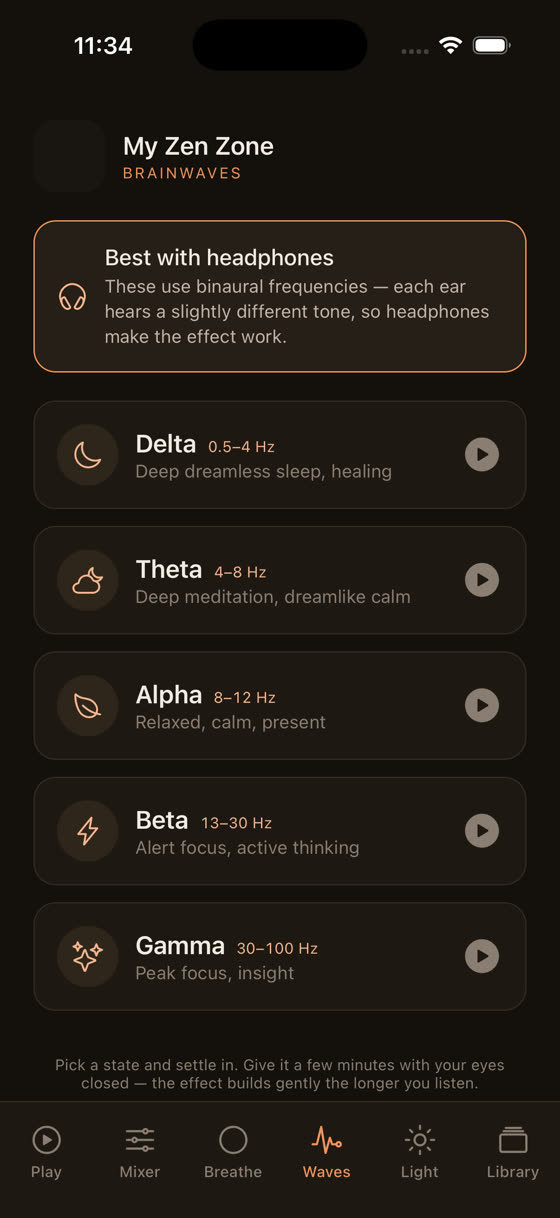
We include them in My Zen Zone as one more layer in the mixer, not as a headline cure. Try one under a quiet instrumental bed at a low level and judge it on whether your own session actually feels steadier, not on a claim printed somewhere else.
A Better Routine For Tonight's Work Session
Here's what to actually do differently tonight, rather than opening Apple Music and pressing play on whatever's first. Pick one instrumental track with a tempo in the 55 to 70 bpm range and no vocal samples. Layer one steady textural sound under it, rain, a low drone, light static, at roughly a third of the music's volume. Set a timer for 50 minutes rather than leaving it open-ended; a defined end point reduces the temptation to keep fiddling with the mix once you've started working, which is its own distraction. If the track ends mid-timer, let it loop or move to a tonally similar track rather than something that jumps character, the continuity matters more than variety here.
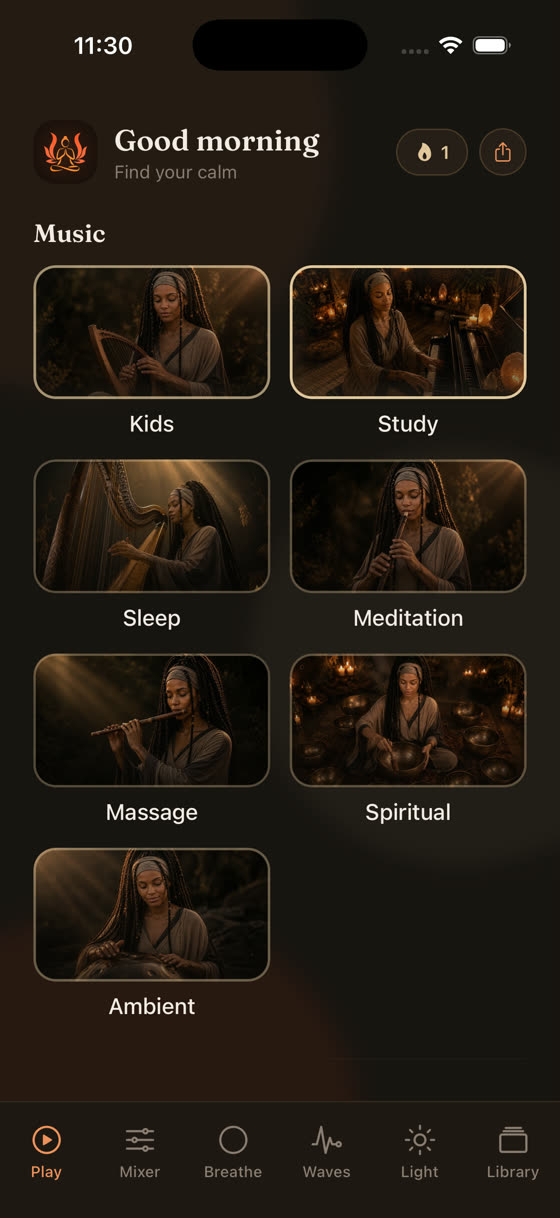
My Zen Zone's library is organised by category rather than mood-of-the-week, so Focus sits as its own section with hundreds of tracks sorted for this kind of use, and offline downloads mean a weak office wifi signal doesn't interrupt a session three tracks in. New material gets added every two weeks, composed and recorded by the same musician rather than licensed in from wherever, so the tonal character stays consistent from one track to the next instead of jumping around the way a multi-artist playlist does.
What To Do When Focus Music Stops Working
Sometimes the problem isn't the playlist, it's that you've been staring at the same task for ninety minutes and no amount of steady tempo fixes that. Worth noticing the difference: if you find yourself fiddling with the mixer or switching tracks every few minutes, that's often restlessness rather than a bad sound choice, and a short break does more than reshuffling the music will. On the other end, if you're using focus music to wind down from a long work day rather than power through one, the transition into rest deserves its own approach, covered at best music for sleep if that's where the evening's heading.
For the library itself, including the full Focus category, head to /get, with a browser version available through a subscription if you're working from a desktop and don't want another tab open. Full details on how the catalogue is structured are at myzenzone.app.
Common questions
Is instrumental music really better than lyrics for focus?
For most verbal or language-based tasks, yes, roughly, because your brain processes sung words with some of the same machinery it uses for reading and writing, which creates competition. For purely visual or repetitive tasks the effect is weaker. If you notice yourself reading a lyric instead of your work, that's the mechanism showing up directly.
What bpm is best for studying versus doing admin work?
For deep reading or problem-solving, aim for 50 to 70 bpm, close to resting heart rate, so your pace doesn't get pulled along by the beat. For repetitive admin, filing, data entry, something slightly faster, 80 to 100 bpm, can actually help you move through tasks without feeling sluggish.
Can I use Apple Music and My Zen Zone at the same time?
There's no technical reason you couldn't run both, though it defeats the purpose of either. Apple Music's playlists are already a finished mix; adding a second app's sounds on top just recreates the layering problem this post describes. Better to pick one source and build the mix from there.
How long should a single focus session actually be?
Most people hold real concentration for 45 to 90 minutes before quality drops, regardless of what's playing. Setting a timer for that window, rather than leaving music running indefinitely, tends to matter more than the specific track choice, and it stops you from treating playlist-browsing as a break in itself.
Does background sound reduce distraction or just mask it?
Mostly masking, and that's fine, that's the job. A steady layer of rain or low tone covers sudden, unpredictable noises, a door, a notification, traffic, that would otherwise snap your attention. It doesn't improve concentration on its own; it just removes some of the random interruptions competing for it.