The short answer
There isn't one free app that beats all the others, because "free" almost always means one looping sound at a fixed volume, wrapped in ads or a locked library. What actually matters for falling asleep is whether you can layer more than one sound and control each one separately. Rain alone is fine. Rain under a low drone with a distant fan is better, because it gives your ear more to settle into and fewer gaps where a stray noise from outside cuts through.
So the real question isn't which app is free, it's which free tier gives you enough control to build a sound that actually masks your bedroom rather than just filling silence. Most don't. A few do, and My Zen Zone's free download lets you try the mixer and a rotating slice of the library before deciding whether the full catalogue is worth a subscription.
Why a single looping sound isn't enough
White noise masks by covering a wide, flat band of frequencies, which is why it's useful against traffic or a snoring partner. But a single loop, especially a short one, has a rhythm your brain learns fast. Most free rain or ocean tracks loop every two to four minutes. You might not consciously hear the seam, but your attention snags on it slightly each time, which is the opposite of what you want at 11pm.
Layering breaks that pattern. Put a slow rain layer under a low pad tone tuned somewhere around 55-65Hz, and the loop points no longer line up, so there's no repeating pattern to notice. This is basic audio engineering, not a trick specific to any app, but it only works if the app lets you control more than one sound at once. Most free ones don't.
The mistake almost everyone makes at night
People turn the volume up when a sound isn't working, when the actual fix is usually to add a second, quieter layer instead. A loud single sound competes with your thoughts. A soft blend of two or three sits underneath them. This is the same logic behind why a 60-70 bpm tempo, roughly a resting heart rate, tends to work better for winding down than something faster and more melodic. It isn't about volume, it's about texture and how many things your ear has to track.
If you've read our piece on what actually makes music good for sleep, you'll know tempo and instrumentation matter more than most people assume. The same logic applies to ambient and nature sound, not just composed music.
What a proper mixer actually does
Watch what happens when three sounds are moving at once, each on its own fader, rather than one track playing at a fixed level. That's the difference between a sound app and a sound toy. In My Zen Zone the mixer lets you set rain, a low drone and something like distant thunder each at a different level, save the blend, and let it run all night without repeating in an obvious way.
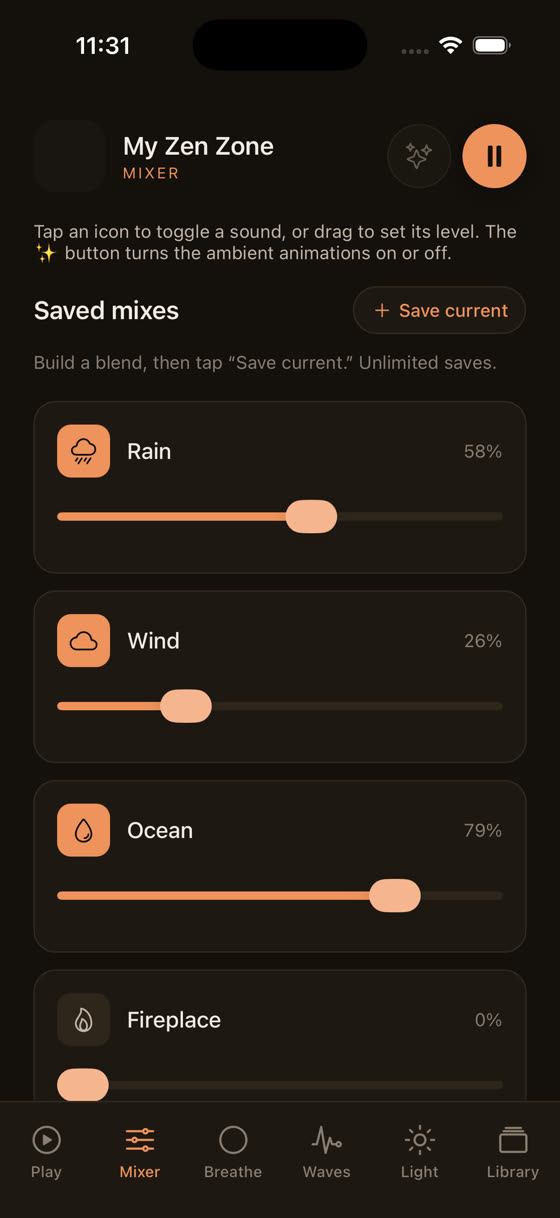
Free apps rarely offer this because it's more engineering work than it looks: each layer needs its own seamless loop point, and they all need to sit well together in frequency without one masking another badly. It's a small thing to build but it's the single feature that separates a genuinely useful sleep app from a looping mp3 with a nice icon.
When you want a voice guiding you down, not just music
Some nights you don't want ambient sound, you want someone talking you through slowing your breathing. Most apps handle this by stopping the music and playing a spoken track instead, which means you lose the bed of sound you'd built and get silence, then a voice, then silence again when it ends.
Here the guided voice is just another layer, sitting over the music rather than replacing it, with its own level next to the music and nature sound.
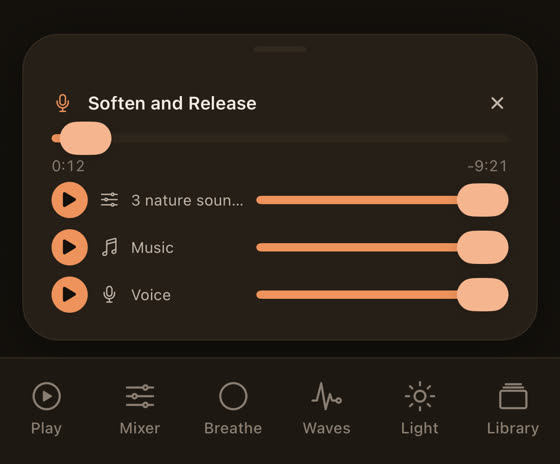
You can bring the voice up while it's talking and fade it under once you're calmer, without the music cutting out and leaving you suddenly alone with your thoughts, which is often the exact moment people reach for their phone again.
The small tools that matter more than people expect
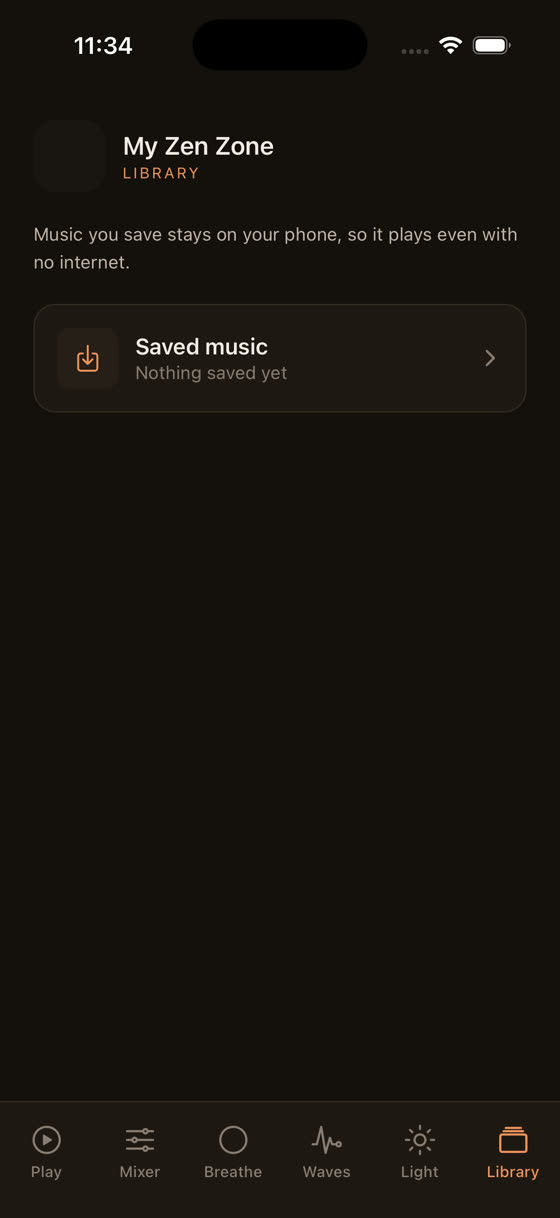
A sleep timer sounds obvious until you realise most free apps either don't have one or cap it at 30 or 60 minutes, which is rarely enough for someone who takes longer to actually fall asleep. Offline downloads matter too, since a buffering sound at 3am, right when your phone drops onto weak wifi, is worse than no sound at all.
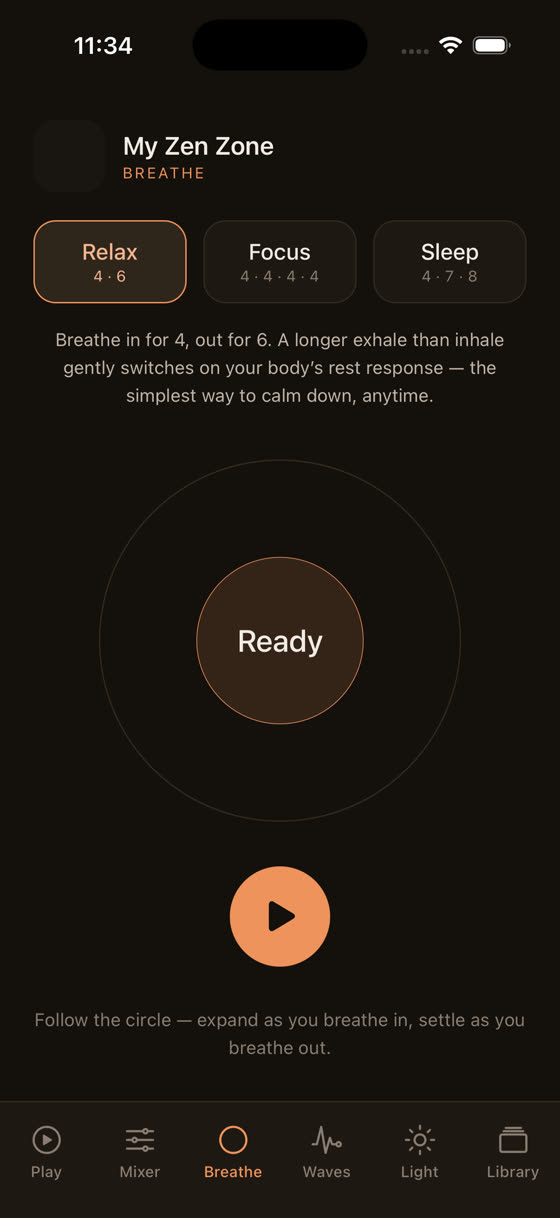
A slow breathing pattern, in for four counts and out for six, does something a looping sound can't: it gives your body an actual physical rhythm to follow rather than just something to listen to. Paired with a screen that dims the light your phone puts out as you use it, rather than a bright white interface at midnight, these are unglamorous but they're the parts of an app you actually feel the benefit of.
Why library size and freshness matter more than people think
The other quiet failure of free apps is repetition. Twenty tracks looked fine on day one. By week three you know exactly when the loop point comes, and the sound stops working precisely because you've stopped not-noticing it. That's the whole mechanism of ambient sound for sleep: it has to sit below conscious attention, and familiarity drags it back up.
My Zen Zone runs to hundreds of tracks and adds new ones every two weeks, all composed and recorded by one musician rather than licensed in bulk, which keeps the catalogue consistent in tone rather than a grab-bag of unrelated styles. If you're building a wind-down routine that also needs something for the working day, the same logic about tempo and repetition applies to focus music, just at a faster pace and with fewer long pauses.
How to actually choose one tonight
Be honest about what you need before you download anything. If you just want plain white noise for five minutes while you drift off, almost any free app will do the job and there's no need to overthink it. If you've tried that and it stops working after a few weeks, or you wake at 3am and need something more layered to get back down, that's the point where a mixer and a bigger library start to earn their keep.
Try the free tier first. Build one blend, use it for a week, and notice whether you're reaching for your phone less at night. The app is on iPhone and Android, and a subscription opens the same full library in a browser too, so the routine isn't tied to one device. If it's working, get the full library rather than staying on a handful of loops that will eventually go stale on you.
None of this is backed by rigorous sleep research specific to app design, and it's worth saying so plainly. The evidence for white noise and ambient sound generally is thin and mixed. What's here is engineering logic and what tends to hold up in practice, not a clinical claim.
Common questions
Is white noise actually proven to help you sleep?
The research is thin and mixed. Some small studies suggest it can help mask disruptive noise and speed up falling asleep in noisy environments, but there's no strong evidence it improves sleep quality on its own. It's best thought of as a masking tool, not a treatment, and works best alongside decent sleep habits generally.
Do I need a subscription or is the free version enough?
If you just want basic looping sound for a few minutes while drifting off, a free tier is usually enough. A subscription matters more if you want the full library, offline downloads for unreliable wifi, and unlimited use of the mixer and guided sessions rather than a limited rotating selection.
What's better for sleep, nature sounds or music?
Neither is universally better; it depends on what keeps your mind from wandering. Nature sound works well for masking outside noise, while slow instrumental music around 60-70 bpm can be more effective if your issue is racing thoughts rather than noise. Many people do best combining both at low, separate levels.
How long should I run sleep sounds for?
Long enough to fall asleep, not necessarily all night. A sleep timer set for 45-90 minutes covering the time it typically takes you to drop off is a reasonable starting point. If you wake in the night and need it again, restarting a short session is usually better than leaving audio running for eight hours straight.