The best guided meditation app is the one where the voice plays over the music instead of instead of it. That sounds like a small distinction. It isn't. It's the difference between a session that feels like one continuous piece of sound and one that feels like a podcast interrupting a playlist every ninety seconds.
Most apps you've tried do the second thing. A narrator talks for a stretch, the music fades under them, then fades back up when they stop, then fades down again for the next instruction. You can hear the seams. Your attention follows the seams. That's the opposite of what a guided session is supposed to do.
Why the stop-start model is the wrong default
Think about what guided meditation is actually asking of your nervous system. You're trying to lower arousal, slow the breath, let the shoulders drop a centimetre. Every fade-down-fade-up cycle is a small jolt, a tiny re-orientation. Your brain has to notice the change in volume and decide whether it matters. That's attention being spent, not saved.
The apps that get this right treat the voice as one layer among several, mixed at a level you choose, sitting on top of music that never stops. The My Zen Zone library works this way: a guided session has its own Voice, Music and nature-sound levels, each on its own slider, so the narration sits inside the track rather than interrupting it.
Watch what happens when you pull the voice down to almost nothing partway through: the music is still there, full and unbroken, because it was never paused to begin with. That's the mechanism. It's not a gimmick, it's just better engineering of the same two ingredients every app already has.
What actually makes a guided session work, musically
A narrator's voice sits in a fairly narrow frequency band, roughly 100-300 Hz for most speech with harmonics up into the low thousands. Music written to sit underneath a voice needs to leave that band alone, or at least leave room in it. That means low pads, not low melody. Slow attack on anything in the mid-range. Tempo around 50-65 bpm if the goal is to slow the breath down with it, because that's close to a relaxed resting heart rate and the body tends to entrain toward a beat that's only slightly slower than its own.
This is also why a single composer matters more than people assume. When one musician writes the whole library, the mix decisions are consistent. The pads sit at the same depth every time, the reverb tail doesn't suddenly get longer on one track, the low end doesn't creep up into the voice band on a different composer's piece. Every track in this app is written and recorded by the same person, which is partly a stylistic choice and partly a practical one: the guided sessions and the music were built to sit together, not licensed separately and smashed together afterward.
What to look for if you're choosing an app
Four things are worth checking before you commit to a subscription:
- Does the voice stop the music, or layer over it? Open a session and listen for fades. If the music cuts out, you're getting the old model.
- Can you control the balance yourself? A fixed mix assumes everyone wants the same amount of narration. Some nights you want a lot of guidance, other nights you want ninety seconds of instruction and twenty minutes of quiet.
- Does the library actually grow? A lot of apps ship with three hundred tracks and never touch them again. This one adds new music every fortnight, so the guided catalogue and the instrumental one both keep moving.
- Does it work without a connection? Flights, basements, patchy hotel wifi. Offline downloads matter more than most reviews admit.
The mixer, and why nature sound belongs in it too
Guided meditation rarely works in isolation. Most people pair it with something underneath: rain, a low drone, distant waves. The mistake is treating that as a single extra track at a fixed volume. Three nature sounds mixed against each other, each at its own level, behaves completely differently from any one of them played alone.
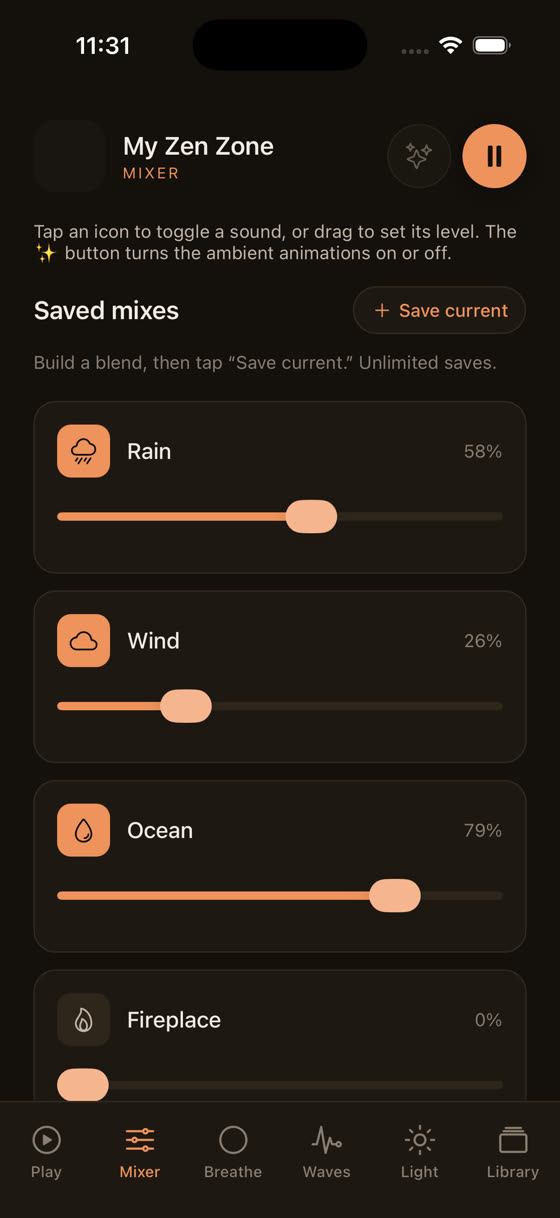
Run rain at a low level, add a thin layer of wind, and drop in a single sustained tone underneath both. None of those three is doing much on its own. Together they build a kind of sound floor that the guided voice sits on top of, and you built it yourself in about ten seconds. That's a different proposition to a dropdown menu of four preset ambiences.
A worked example: what to actually do tonight
Open the app around twenty minutes before you intend to be asleep, not the moment you get into bed. Pick a sleep-focused guided session, somewhere in the 15-25 minute range. Set the voice level moderate, not loud, because louder narration keeps your analytical brain more engaged than it needs to be at that hour. Add one nature layer underneath at low volume; rain is the obvious choice for a reason, it masks sudden household noise without being interesting enough to listen to.
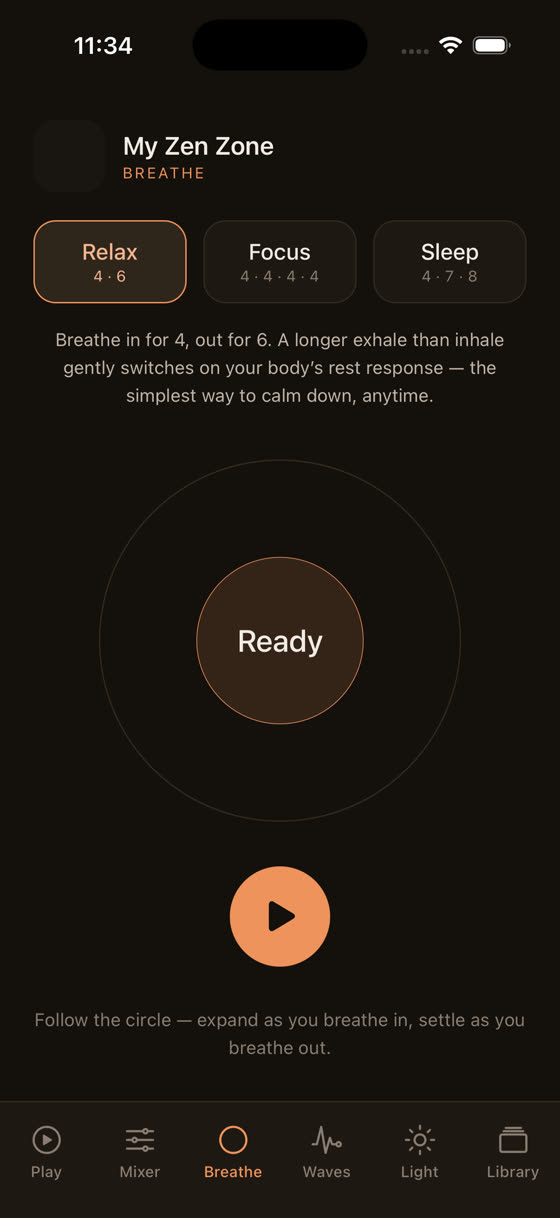
If you find yourself still awake when the session ends, don't restart it. Switch to the breathing screen instead, set to a 4-6 pattern, four seconds in, six seconds out. That ratio biases you toward the exhale, which is where most of the parasympathetic effect of slow breathing actually happens. Set the sleep timer for twenty minutes and let it fade out rather than stop abruptly. You want the room to go quiet gradually, not all at once.
Where guided meditation fits next to the rest of the day
It's worth saying plainly: guided meditation isn't the only tool, and treating it as the only lever you have is a common mistake. If you're trying to concentrate during work, a narrated session is usually the wrong choice; instrumental tracks without lyrics or speech work better, and we've written about that specifically at music for focus and study. If the goal is purely falling asleep faster, the tempo and instrumentation of the music matter more than whether there's a voice at all, which is covered in more depth at best music for sleep.
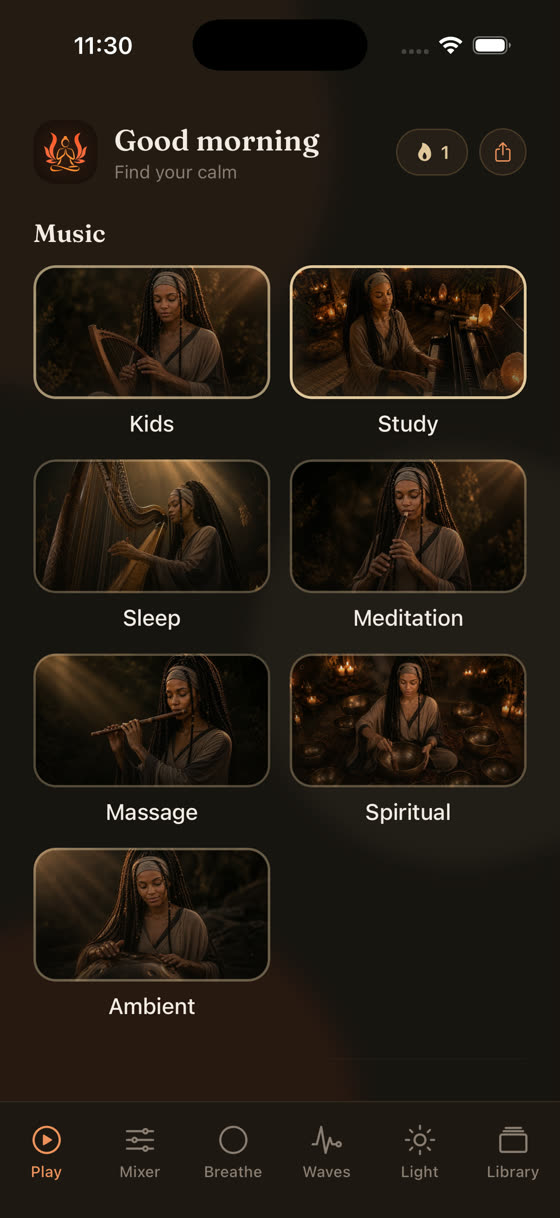
Treating sleep, focus, calm and meditation as genuinely different jobs, with different music built for each, is why the home screen is organised the way it is: four separate worlds, not one undifferentiated playlist with a search bar.
What most reviews of these apps get wrong
Most
The evidence is genuinely mixed. Some studies show modest reductions in self-reported stress and improvements in sleep onset; others find little effect beyond what quiet rest alone provides. Nobody should promise results. It's a tool worth trying, not a guaranteed fix, and how it's delivered (voice over music, not instead of it) seems to matter for how usable it actually is night to night. It's personal preference more than anything measurable. Some people find a lower-pitched voice easier to stay with over twenty minutes simply because it sits further from the music's mid-range and feels less effortful to track. Try a couple of different narrators in the same app before deciding; most libraries offer more than one voice. Yes, and for sleep it's usually better without them. Headphones add detail you don't need at that hour and can be uncomfortable lying down. Nature sound layers and a low-volume speaker work fine for most guided sessions; save headphones for focus sessions during the day where more detail genuinely helps. Ten to twenty minutes covers most situations. Shorter sessions, five minutes or so, suit a quick reset between meetings. Sleep sessions can run longer, fifteen to twenty-five minutes, because the goal is to still be listening when you drift off rather than finishing and lying there awake. Because you're not just following the voice for the whole session. Attention wanders, and when it does, it lands on whatever's underneath. If that's a generic loop, your mind notices the repetition and gets more alert, not less. Music written specifically to sit under narration, with no obvious loop point, gives your attention somewhere calmer to drift to.Common questions
Is guided meditation actually backed by research, or is that overstated?
Should the guided voice be male or female, and does it matter?
Can I use a guided meditation app without headphones?
How long should a guided meditation session be?
Why does the music matter if I'm just following the voice anyway?