The best handpan channels on YouTube right now lean toward uploads using words like "D Kurd scale," "Celtic minor," or "handpan meditation," usually from solo players recording in a room with natural reverb rather than a studio. Search those terms instead of just "handpan music" and you'll skip past a lot of generic stock-footage compilations. That's the direct answer. The longer answer is that YouTube is a decent place to discover handpan music and a frustrating place to actually use it, and those are two different problems worth separating.
Handpan has become one of those instruments that gets dropped into every "relaxing music" thumbnail with a sunset and a waterfall, which means the search results are flooded with mediocre loops dressed up with good SEO. A handful of real players rise above it. Look for channels built around one performer's own recordings rather than aggregators, and check whether the track is a continuous live take or a short loop stretched to an hour with a fade. The stretched loops are usually the problem, and I'll get to why.
Why handpan works for winding down in the first place
The instrument itself does something unusual acoustically. A handpan is tuned to a small scale, often eight or nine notes, and because the notes are all drawn from the same key, there's no way to play a genuinely jarring interval even if you hit the wrong note. Most makers tune to scales like D Kurd, Celtic minor, or Hijaz, all of which sit comfortably without a strong pull toward resolution the way a major scale does. Nothing demands to go anywhere. That's rare in music and it's a big part of why it reads as calming rather than just quiet.
There's also the decay. Strike a handpan and the note doesn't cut off, it rings and slowly loses energy over several seconds, often overlapping with the next note. Good players exploit that by playing at 55 to 75 bpm, slow enough that the overtones from one note are still fading when the next lands. The result sits closer to a drone than a melody. That overlapping decay is doing a lot of the relaxing work, more than the "theme" of the track. It's also exactly the kind of texture that layers well under other sound, which matters later.
The actual problems with using YouTube for this
Three things get in the way, and none of them are about the music itself. First, ads. A mid-roll ad breaking into a slow decaying handpan note at minute 40 undoes a half hour of settling down in about two seconds. Second, autoplay. YouTube's algorithm doesn't know the difference between "more handpan" and "loud EDM remix of handpan," and it will hand you the second one at 1am with no warning. Third, and this one's less obvious: most "10 hour handpan" videos are a 10 or 20 minute performance looped with a hard cut, not an extended live take. You can usually hear the seam if you listen for it, a tiny jump in the reverb tail every loop. It's not fatal, but it's the kind of thing your attention catches even when you're not consciously listening, which works against the point of putting it on.
There's also the practical issue of using a phone screen running a YouTube video as your sleep sound source. The screen has to stay on or the video stops in some browsers, your data gets used if you're not home, and there's no timer that fades out gracefully and then actually turns off, unless you build one yourself with a separate app.
What to look for if you stay on YouTube anyway
If you want to keep searching there, a few things improve the odds of landing on something worth your time. Favour uploads with a visible handpan in the thumbnail rather than stock nature photography, since that usually means a real recorded performance. Check the upload length against the claimed loop length; a genuine 45-minute continuous take is a better sign than a 20-minute piece stretched to 3 hours. Read a few comments, players and listeners who know the instrument will often name the scale and maker in the replies, and that tells you whether you're getting a cheap decorative loop or a proper performance on a tuned, resonant instrument.
Where this fits with sleep, focus, and calm
Handpan sits at an interesting midpoint. It's rhythmic enough to give your attention something to hold onto, which makes it genuinely useful for focus and study, especially instrumental work that doesn't pull your mind toward lyrics. But played slow and layered under something quieter, it also works as a wind-down track before sleep, closer to what we cover in our piece on music for sleep. The honest caveat: there's no solid research specifically on handpan and sleep outcomes, so treat the calming effect as a reasonable, experience-based observation rather than a proven result. What is well established is that slow, predictable, non-startling sound generally supports rest better than anything with sudden dynamic shifts, and handpan, played right, rarely has those.
What we do differently with handpan in the library
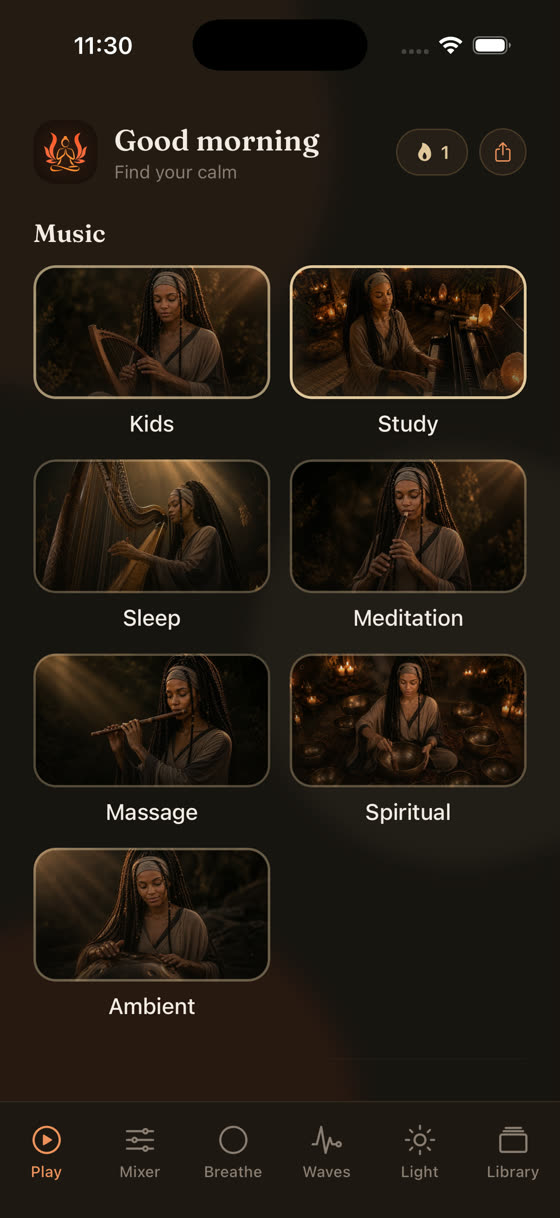
Our in-house composer records handpan pieces the same way as everything else in the library, one musician, one instrument, captured properly rather than looped from a short clip. New handpan pieces go into rotation alongside the rest of the fortnightly additions, so the library keeps growing instead of staying fixed the way a single YouTube upload does.
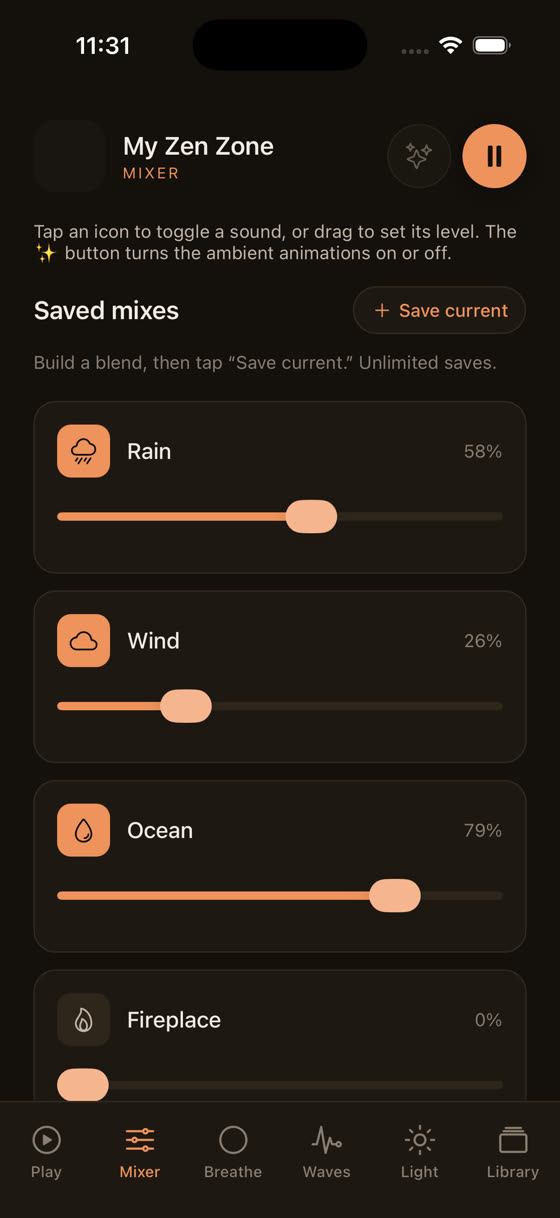
The bigger difference is what happens after you press play. Instead of one fixed track competing with ads and autoplay, you get a mixer where the handpan sits as its own layer, next to rain, a low fire crackle, or distant wind, each on its own slider.
Watch that and you'll see the handpan pulled up while the rain fades under it, then the balance reversed, all live, nothing re-rendered. That's the kind of control a YouTube video simply can't offer you, no matter how good the recording is.
Building a handpan wind-down session tonight
Here's a concrete way to use it rather than just letting it play. Start with the handpan layer at a moderate level and bring in a single nature layer underneath it, rain is usually the most forgiving pairing since it doesn't compete rhythmically. Set the sleep timer for however long you expect to take to fall asleep, 25 to 40 minutes is typical, so the fade-out happens on its own rather than you reaching for your phone at midnight.
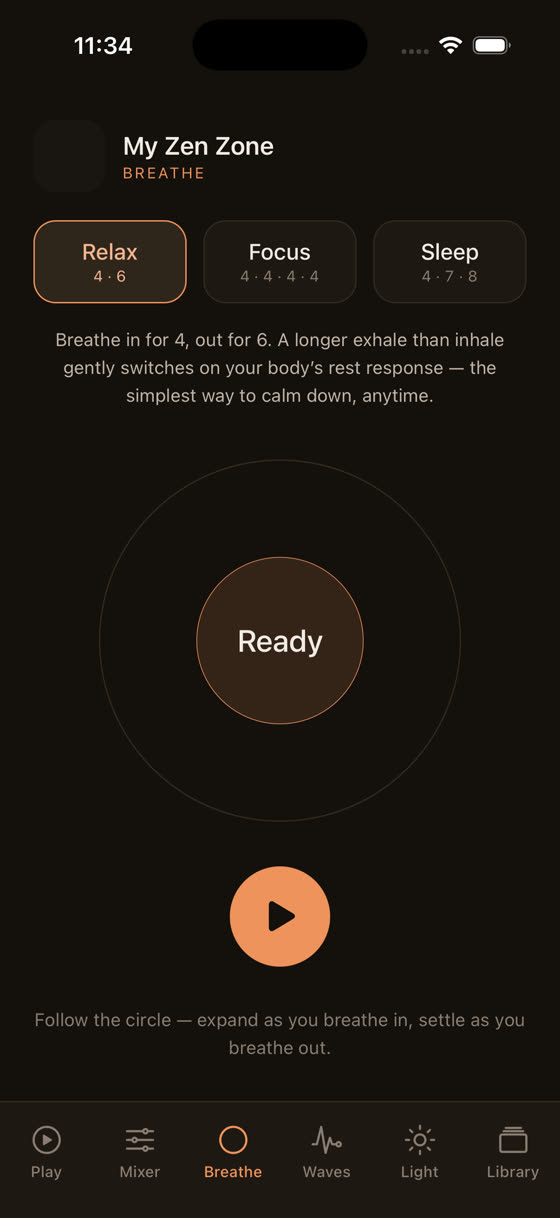
If you're using it to focus rather than sleep, drop the nature sound out entirely and keep the handpan on its own at a lower volume, it gives enough rhythmic texture to anchor attention without becoming a thing you notice. Pair it with a short breathing exercise first if your mind is still racing when you sit down to work.
A quick note on expectations
None of this is a claim that handpan music will fix sleep or fix focus on its own. It's one tool among several, and what matters more than the instrument is consistency: using the same kind of sound at the same point in your evening routine, night after night, so your body starts associating it with winding down. A good handpan recording helps that process along. A great mixer, offline downloads so a bad connection never cuts the track, and a timer that ends things properly, those are the parts that make the tool actually usable rather than just pleasant to discover once on YouTube. You can see the full setup at myzenzone.app.
Common questions
What scale is most handpan relaxation music played in?
Most commonly D Kurd, D Celtic minor, or Hijaz. These scales avoid strong pulls toward a "resolved" note, so there's no interval that sounds wrong or jarring, which is a big reason the instrument reads as calming rather than just slow.
Can I download handpan tracks from YouTube to listen offline?
Standard YouTube doesn't allow offline downloads without a premium subscription, and even then the track stays tied to the YouTube app. Apps built for this, including ours, let you download tracks directly for offline playback without needing a separate subscription layer for that feature alone.
Is handpan music good for studying or does it need to be silent?
Silence isn't necessary for everyone, and low, rhythmic instrumental sound like handpan often works better than silence for sustained focus, since it masks sudden background noises without introducing lyrics or melody that pull attention away from the task.
How long should a handpan wind-down track be before sleep?
There's no fixed ideal length. Most people fall asleep within 20 to 40 minutes once they're actually trying to, so setting a sleep timer to fade out around that mark, rather than leaving a track looping all night, tends to work better than an indefinite play.