The best meditation app for a beginner isn't the one with the most famous voice or the biggest course library. It's the one you'll actually open tonight, for five minutes, without reading instructions first. That usually means short unguided options sitting next to the guided ones, background sound you can shape yourself instead of a fixed mix, and enough new material that week three doesn't feel identical to week one.
I say this as someone who composes the music, not someone selling the app. Most meditation apps are built by people thinking about retention curves. They should be built by people thinking about what happens the first time someone sits down, feels awkward, and almost gives up.
What actually goes wrong for beginners
The failure point isn't willpower. It's the first ninety seconds. A new user opens an app, gets a ten-minute guided session with a voice they've never heard, instructions they don't understand yet ('notice the sensation of breathing without judgement'), and music that either disappears the moment the voice starts or was never there at all. They sit with racing thoughts, decide meditation 'isn't for them,' and delete the app within the week.
The jargon does real damage here. Words like 'non-attachment' and 'witness consciousness' are fine for someone five years into a practice. For someone who's never sat still on purpose, they're a wall. A beginner doesn't need philosophy. They need something simple enough to do badly and still feel slightly calmer afterwards.
Start with sound, not instruction
Before guided meditation, most beginners do better with something with almost no instruction at all: a slow tempo, a consistent texture, nothing that requires them to follow a script. Somewhere around 60-70 bpm is close to a resting heart rate, and a lot of the calmer tracks in the library sit right there — soft piano, low pads, occasionally a single sustained string line with nothing sharp or sudden in it. There's no narration to keep up with. You just let it run.
This matters because the first goal isn't 'learn to meditate correctly.' It's 'sit still for five minutes without hating it.' Music does that job quietly, without asking anything of you. Once that's comfortable, guided sessions make a lot more sense, because you're not learning two new skills — sitting still and following instruction — at the same time.
Why fixed playlists don't fit a beginner's actual evening
Here's something most articles on this topic skip entirely: two beginners at 9pm are rarely in the same state. One is wired from a bad commute and needs something with more texture to hold their attention. The other is already half-asleep and needs almost nothing. A single fixed track, however well produced, can't serve both.
This is where a proper sound mixer earns its place, rather than being a gimmick. Instead of one pre-baked audio file, you're layering three or four elements — say a slow piano line, rain, and a low drone — and setting each one's level yourself.
Watch what happens when the rain comes down and the drone comes up: the whole mood of the room changes without a single new note being added. That's the difference between a soundtrack and an instrument you're playing yourself, badly, at 9pm, in your pyjamas. It's a small thing, but it's the reason people stick with a practice past the second week: the tool bends to the evening instead of the other way round.
Guided sessions that don't fight the music
Most apps handle guided meditation the same way: the voice starts, and the music either stops or gets buried under it at a fixed, unchangeable level. If you find the narrator's pace too slow or the background too loud, you have no recourse. You either tolerate it or you skip the session.
The better approach treats the voice as one layer among several rather than the main event. Voice, music, and nature sound each get their own level, so a beginner who finds a particular narrator's cadence a bit much can drop the voice down and let the music carry more of the weight, or bring the rain up until the voice is a gentle presence rather than the centre of attention.
<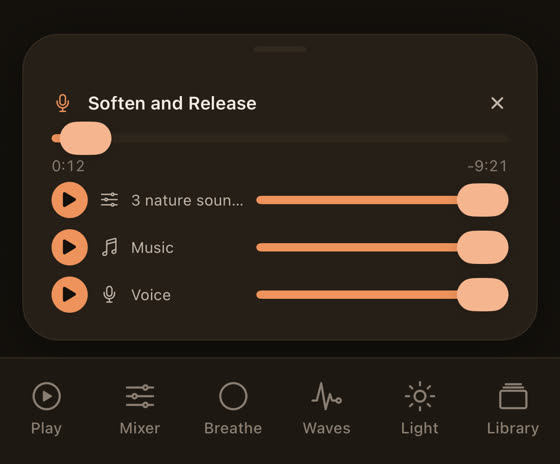
That video shows a guided session actually running with the music underneath it, each layer with its own play button and its own slider. Nearly every other app on the market stops the music the second the narration begins. Here it doesn't, and you get to decide how present each part is, night by night, depending on your mood.
Breathing as the real on-ramp
If meditation itself still feels too vague as a starting point, breathing exercises are a more concrete first step, and a good one for beginners specifically because they're finite. You're not trying to 'clear your mind' for an undefined stretch of time; you're following a pattern for a fixed number of cycles.
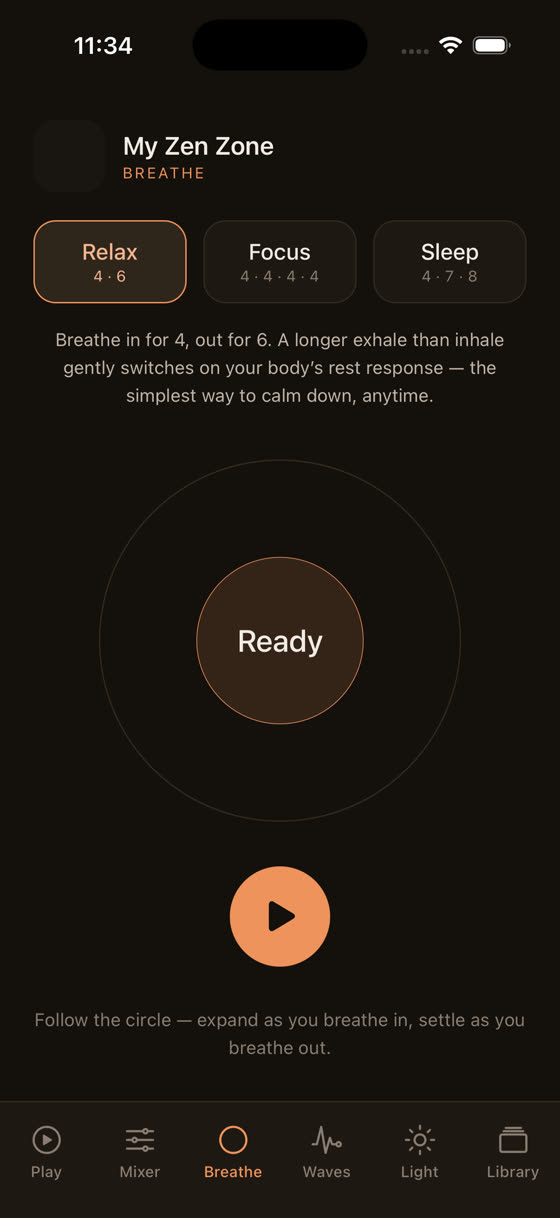
A 4-6 pattern — four seconds in, six seconds out — is a reasonable place to begin. The longer exhale does something measurable: it nudges the body toward the parasympathetic side of things, the 'rest and digest' state, rather than the alert side. You don't need to understand the physiology to feel the difference after six or seven rounds. It's also a good bridge into sitting meditation proper, because by the time the pattern ends, the racing-thoughts problem that scared you off in the first place has usually quietened on its own.
Consistency beats duration, and the app should reflect that
A beginner who does three minutes every evening will get further than one who does thirty minutes on a Sunday and nothing else all week. This isn't controversial, but a lot of apps are still built around long flagship sessions as if commitment were the main obstacle. It isn't. Friction is.
Practically, that means a few things matter more than they look like they should: a sleep timer so a session ends itself rather than requiring you to notice and stop; offline downloads so a patchy connection on the train doesn't derail the one window you had free; and a home screen organised so you're not hunting through menus at the exact moment your attention is at its shortest.
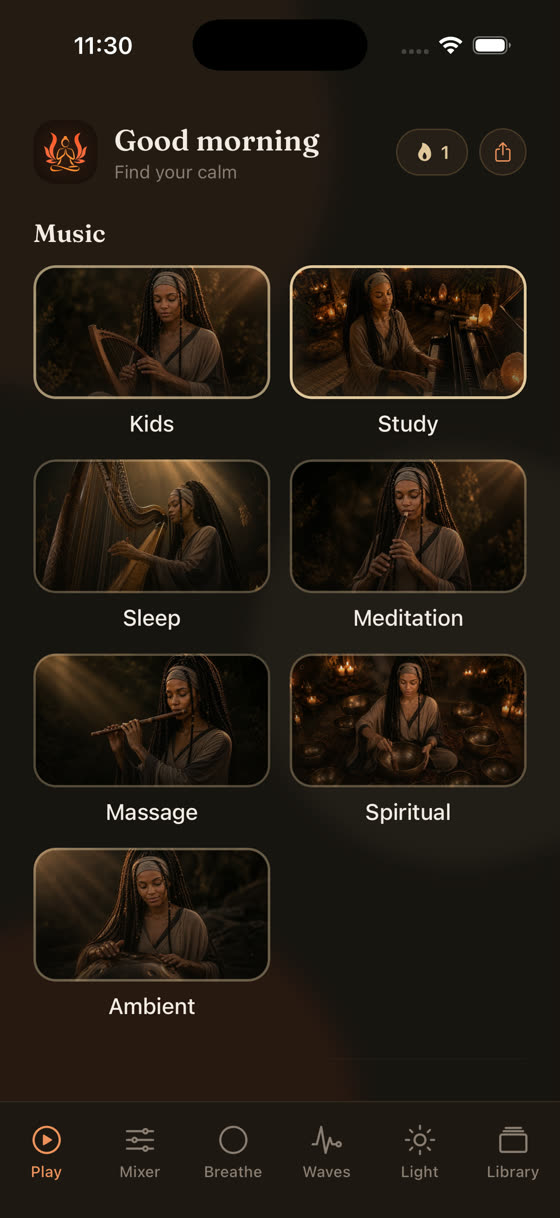
Each category sitting as its own space — sleep, focus, meditation, calm, music — means a beginner isn't wading through unrelated content to find the five-minute session that actually fits a Tuesday lunch break. Small design choices, but they're the difference between a habit forming and an app quietly forgotten on page three of your phone.
Not getting bored, which is the quiet reason people quit
Nobody mentions this one, but it's a genuine cause of dropout: after a month, the same twenty tracks start to feel like wallpaper. You stop noticing them, and once you stop noticing, the calming effect goes with it. New material every couple of weeks isn't a marketing feature, it's what keeps the sound doing its job. If you're pairing meditation with study or work, the same logic applies to focus music, and it's worth reading about what actually helps concentration rather than assuming louder or busier is better. And if the real goal is falling asleep faster rather than meditating in the traditional sense, it's worth looking at what to play at bedtime specifically, since the requirements are a bit different from a daytime sit.
What to actually try tonight
Skip the ten-minute guided session with the stranger's voice for now. Put on something slow and largely wordless for five minutes, sit or lie down, and just notice you got through it without checking your phone. Tomorrow, try the breathing pattern for six cycles before bed. By the end of the week, bring in one short guided session with the music turned up under the voice rather than buried beneath it. That order — sound first, breath second, guidance third — tends to stick better than diving straight into a course, and it's a genuinely different way in than most beginner guides suggest.
None of this requires special equipment or an hour you don't have. You can start with what's already on your phone at myzenzone.app, or go straight to the download and try the first session tonight rather than reading about the tenth.
Common questions
How long should a beginner meditate for?
Three to five minutes is plenty to start. The goal early on is building the habit of sitting still on purpose, not covering a certain amount of time. Extend the length only once five minutes stops feeling like an effort, which for most people takes one to two weeks of daily practice.
Is guided or unguided meditation better for beginners?
Neither is universally better; it depends on what you find harder. If sitting still is the struggle, unguided music-only sessions remove one variable. If your mind wanders constantly, a guided voice gives it something to hold onto. Many beginners do best starting with music alone and adding guidance in the second week.
Do I need silence to meditate properly?
No, and for most beginners silence makes it harder, since every small sound becomes a distraction. A steady, low background layer, like rain or a slow piano line, gives the mind something consistent to rest against instead of nothing at all.
Can meditation music actually help me fall asleep too?
Yes, though the requirements shift slightly for sleep versus daytime meditation, mainly around tempo and how long the track runs without changing. If falling asleep is the main goal rather than mindfulness itself, it's worth reading a piece focused specifically on that.
How is this different from apps like Calm or Headspace?
The main difference is control. Instead of a fixed audio file for each session, you get separate levels for voice, music, and nature sound that you set yourself, plus a library that adds new tracks every two weeks rather than relying on the same fixed catalogue indefinitely.