The best meditation app for insomnia is one that lets you build your own wind-down sound rather than forcing you into a fixed track. That's the short answer. The longer answer is about what happens in your body between lying down and actually falling asleep, and why most apps are built around the wrong assumption.
Insomnia isn't one problem, so one track won't fix it
Some nights the issue is a racing mind, replaying a conversation from work. Other nights it's physical restlessness, or a body that's tired but somehow wired. Occasionally it's just a noisy street or a partner's phone glowing on the other side of the bed. A single 20-minute guided meditation, however well written, is aimed at the first problem and does nothing for the other three. This is the part most articles skip: they recommend an app, not a toolkit. What you actually need on a bad night changes, and a good app should let you change with it, rather than handing you the same fixed playlist every time.
Where most meditation apps go wrong
Almost every meditation app on the market works the same way. You pick a session, a voice talks for a while over some music, and when the voice stops, the music usually stops too, or fades into silence at exactly the moment you need it to carry on. That's a strange design choice for something meant to help you sleep. Falling asleep isn't a single event that finishes when the narration ends; it's a slow drift that can take another twenty or thirty minutes. Cutting the sound off right as you're drifting is like turning the lights on halfway through a film.
We built things differently. In My Zen Zone, a guided session is three separate layers, voice, music, and nature sound, each with its own level and its own play button. You can fade the voice out early and let the music keep going, or drop the voice entirely and just use the underlying track once you know the pattern by heart.
That's the practical difference between a meditation app and a sleep tool. One talks at you for a fixed duration. The other keeps working after you've stopped listening.
The tempo and instrumentation that actually helps
As a composer, the number I come back to most is 60 to 70 beats per minute, roughly a resting heart rate. Music at that tempo doesn't ask anything of your attention. It's slow enough that your breathing tends to settle to match it, rather than the other way round. Above about 80 bpm, even soft instrumentation starts to feel like it's nudging you forward, which is the opposite of what you want at 11pm.
Instrumentation matters almost as much as tempo. Sustained pads, low piano voicings, and soft strings work because they have no hard attack, nothing that makes your ear prick up. Anything with a clear melodic hook is a bad idea for sleep, because a hook is designed to be remembered, and remembering is the last thing an overactive brain needs help doing at midnight. This is worth reading more on if you want the full breakdown of what separates sleep-friendly composition from everything else: our piece on the best music for sleep goes into the specific frequency ranges and arrangement choices we use.
Music alone, or music with a voice
People often ask whether they should use pure ambient music or a guided meditation for insomnia specifically. Our honest view: it depends on what's keeping you awake. If it's a specific anxious thought looping on repeat, a short guided session that gives your attention somewhere else to go, usually the breath or a body scan, can interrupt that loop more reliably than music alone. If you're already tired and just need to be carried the rest of the way down, music without narration is often better, because there's no voice for your brain to keep half-listening to.
The mistake is assuming it has to be one or the other every night. This is where the layered structure actually earns its keep. Start with voice and music together while your mind is busy, then let the voice drop away once you're calmer.
Building your own sound instead of picking a track
The single most useful screen in the app for insomnia, in my opinion, isn't a meditation at all. It's the mixer. Three or four nature sounds, rain, low ocean, a distant fan hum, each on its own slider, layered under whatever music or guided track you've chosen.
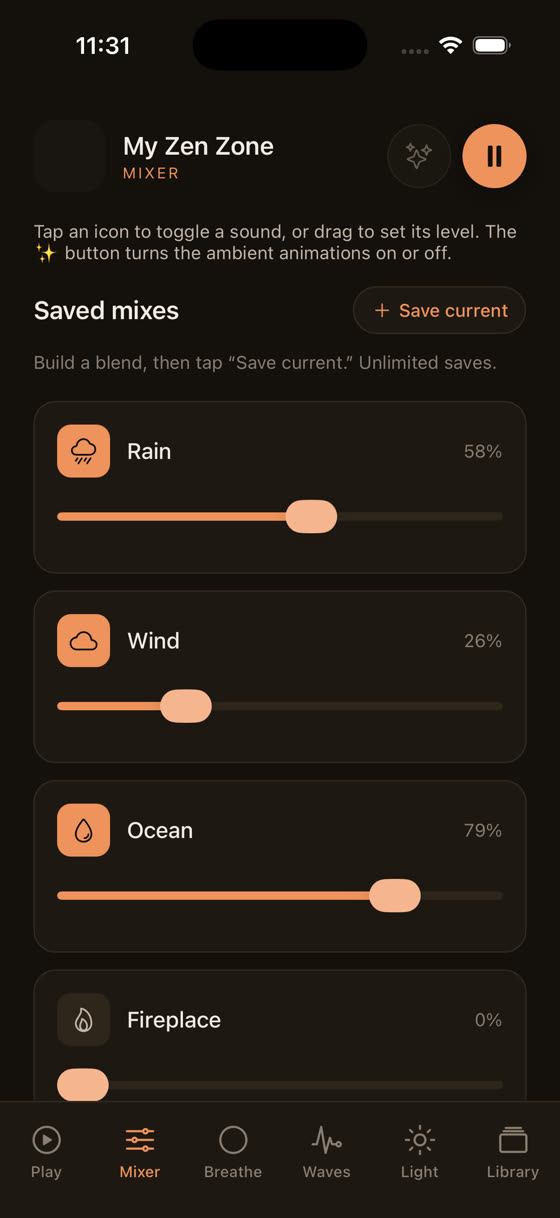
Why does this matter more than it sounds like it should? Masking noise is one of the few areas of sleep research with reasonably consistent findings: a steady, low-frequency background sound can make intermittent noises, a car outside, a creaking radiator, less likely to pull you back to alertness. A fixed playlist can't do that for you, because everyone's bedroom noise is different. Being able to dial in your own mix, quiet rain plus a touch of low hum, no music at all some nights, heavy layering on others, is a genuinely different thing from pressing play on someone else's preset.
Breathing and light, before you even reach for music
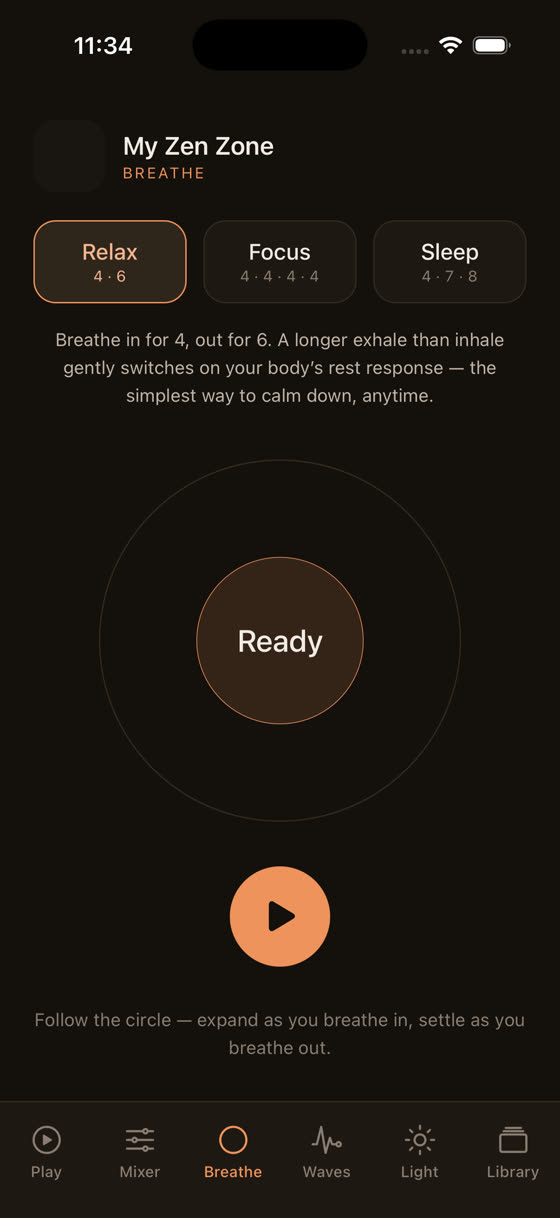
Two tools get used less than they should, and both work before you put a single track on. The first is paced breathing. A slow exhale-longer-than-inhale pattern, something like four seconds in and six seconds out, nudges the nervous system toward rest in a way that's simple, free, and doesn't require headphones.
The second is light. Screens an hour before bed are a genuinely well-documented problem, and dimming your own device rather than reaching for a brighter one matters more than people assume. We built a low-light wind-down screen for exactly this reason, something to look at in the dark that doesn't fight against the thing you're trying to do.
Brainwave tones and where the evidence actually stands
Binaural and isochronic tones come up a lot in insomnia discussions, often with confident claims attached. We include them, because plenty of people find them useful as one more layer in the mix, alongside music or on their own.
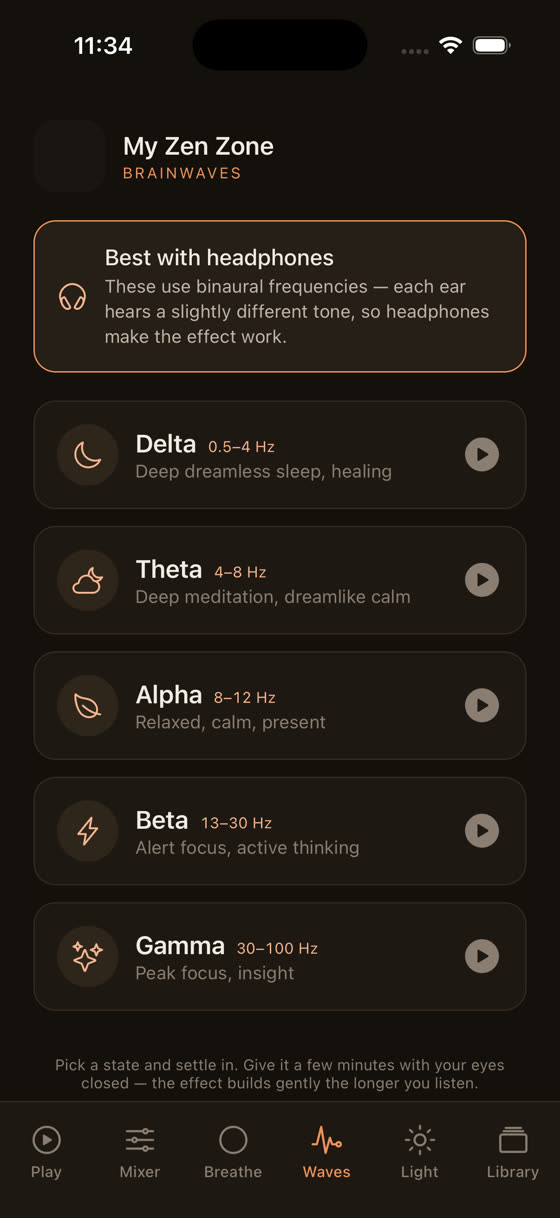
But we'd rather be straightforward than sell you certainty that doesn't exist: the research on brainwave entrainment for sleep specifically is thin and mixed, not the settled science some marketing suggests. Treat tones as a texture worth trying, not a mechanism guaranteed to switch your brain into a sleep state. The same honesty applies to any relaxation music. What we can say is that a calm, unhurried sound environment, one without jarring transitions or unpredictable volume, removes obstacles to sleep. What we won't say is that any track guarantees it.
What to actually do tonight
Put the phone down an hour before bed if you can, and if you can't, at least dim it using something like the light screen rather than staring at full brightness. Pick one thing that's most likely bothering you tonight: a busy mind, an anxious loop, outside noise, physical restlessness, and choose your layers accordingly. Busy mind, add a short guided session. Noise, build a mixer combination and forget about music entirely. Restless body, try the breathing screen first, then let a slow track run under it.
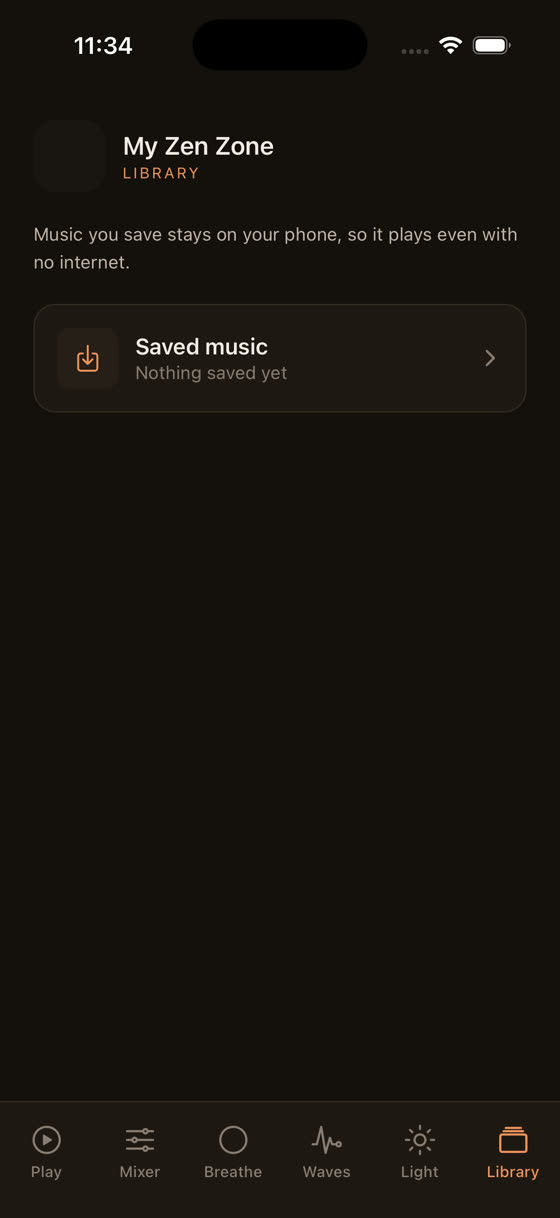
Set the sleep timer so the sound fades out on its own instead of running all night, and download the tracks you use most so a patchy connection or a dead wifi router at 1am isn't the thing that wakes you properly. New material gets added to the library every two weeks, which matters more than it sounds for insomnia specifically. The tracks that work for you tonight can go stale after a month of nightly repetition; having somewhere new to go keeps the whole routine from becoming another thing you associate with lying awake.
The actual takeaway
There isn't a single best meditation app for insomnia in the sense of one perfect track that solves it. There's a better or worse toolkit, and the difference between them is whether you can shape the sound to the specific night you're having, rather than the night the app assumed you'd be having. If you want to see what that looks like in practice rather than reading about it, the app is free to try, or have a browse of the full library first at myzenzone.app.
Common questions
How long before bed should I start using a sleep meditation app?
Somewhere between 20 and 40 minutes before you actually want to be asleep works for most people. That gives a guided session or wind-down routine time to finish while you're still settling, rather than ending abruptly the moment you're drifting off, which can jolt you back to alertness.
Is it bad to fall asleep with headphones on?
Not inherently, but over-ear headphones can be uncomfortable for side sleepers, and any headphone limits how much environmental noise you can still hear, which some people rely on for safety. A small speaker or phone speaker at low volume across the room is a reasonable alternative if headphones bother you.
Does binaural beat music actually work for insomnia?
Some people find it helps as part of a broader wind-down routine, but the research specifically on binaural or isochronic tones for sleep is limited and inconsistent. Treat it as one texture to try alongside slow music or nature sound, not as a proven standalone fix.
Should I use a guided meditation or just ambient music for insomnia?
If a specific anxious thought is keeping you awake, a short guided session can give your attention somewhere else to go. If you're already tired and just drifting, music without narration is often smoother, since there's no voice for your brain to keep tracking as you fall asleep.
What's the difference between this and other sleep meditation apps?
Most apps play a fixed track that stops when the narration ends. This one lets you layer voice, music, and nature sound separately with your own mixer, so the sound keeps running and adapting after the guided part finishes, rather than cutting out right as you're falling asleep.