Forty-five minutes into a deadline, lo-fi hip-hop looping in your headphones, and a snare keeps hitting just hard enough to pull your eyes off the screen every eight bars. That's the problem with most "focus music" playlists. The best music for focus and creativity sits around 60-85 beats per minute, has no lyrics, and avoids sudden dynamic swells. For deep, analytical focus you want it narrow and steady. For creative work you want a little more harmonic movement, so your mind has somewhere to wander without being yanked away from the page.
The instrument matters less than people assume. A piano can ruin a focus track if it's played with rubato and big dynamic jumps. A synth pad can support three hours of writing if it just sits there, slowly shifting, never asking for attention. The shape of the music is the whole game.
What "good" focus music actually looks like, structurally
Most focus playlists are built from songs that were written to be listened to, not worked to. They have intros, choruses, key changes, a bridge that builds to a climax around the two-minute mark. Every one of those moments is a small interruption, a place where your brain registers "something changed" and spends half a second checking whether it needs to care. Across a ninety-minute work block, that adds up to dozens of tiny attention taxes.
Music made specifically for focus is composed the other way round. It's built on a loop or a very slow-moving progression, often four or six chords repeated with small variations in texture rather than melody. Nothing resolves, because resolution is itself a kind of event. The track for deep work I come back to most often is one I wrote around a single sustained cello drone with a soft arpeggiated pattern on top, 68 bpm, and almost no change in volume for six minutes straight. It sounds boring described like that. In practice it disappears, which is the point.
Focus and creativity are not the same task
This is where most advice on this topic goes wrong: it treats "focus music" as one category. Sitting down to debug code, write an email, or get through a spreadsheet is convergent work — narrowing down to one right answer. Brainstorming, sketching, or drafting something from nothing is divergent work, and it benefits from a bit more openness in the sound.
- Convergent focus: steady tempo, minimal harmonic surprise, often a single instrument or two, low information density. Think a slow piano ostinato or a sustained pad with filtered white noise underneath.
- Divergent, creative work: a little more unpredictability is useful, not harmful. Open voicings, major seventh and ninth chords, field recordings woven into the mix, occasional instrument changes every few minutes. The goal is to keep the associative part of your brain loosely engaged rather than numbed.
If you only take one thing from this post, let it be that: match the music to the kind of attention the task needs, not just to the word "focus" on a playlist title. We go into the tempo side of this in more depth in our piece on music for focus and study, including why study sessions often need something even plainer than creative work.
The tempo question, and what the evidence actually says
You'll see plenty of claims that 60 bpm music syncs with a resting heart rate and pulls your physiology into a calmer state. There's some research on tempo and arousal, but it's thin, mixed, and mostly done on small samples in lab conditions that don't look much like an open-plan office or a kitchen table at 9pm. I'm not going to tell you a specific bpm will make you smarter. What I can tell you, from years of watching how people actually use these tracks, is simpler: steady tempo removes a source of unpredictability, and removing unpredictability frees up attention for the task. That's a mechanical effect, not a mystical one.
In practice this means a track anywhere from 55 to 90 bpm works for most focus and creative sessions, with slower numbers suiting repetitive or detail-heavy tasks and the higher end suiting energetic creative sprints. Past about 100 bpm you're usually listening to the music rather than working alongside it.
Build your own mix instead of trusting someone else's
The single biggest upgrade most people can make isn't finding the one perfect track. It's accepting that the perfect track doesn't exist for every situation, and building a blend instead. Rain at a low level under a slow piano pattern reads differently to your brain than the piano alone. A touch of distant thunder under a pad can mask office chatter without adding its own melody to compete with your thoughts.
That's the mixer in the app: three layers, each with its own level, adjusted live rather than picked once and left. You might run a sparse piano track at 70%, rain at 30%, and a low drone at 15%, then nudge the rain up when someone starts talking near your desk. No single pre-made playlist can do that, because it doesn't know what your room sounds like right now.
Brainwave tones: useful tool, not a magic switch
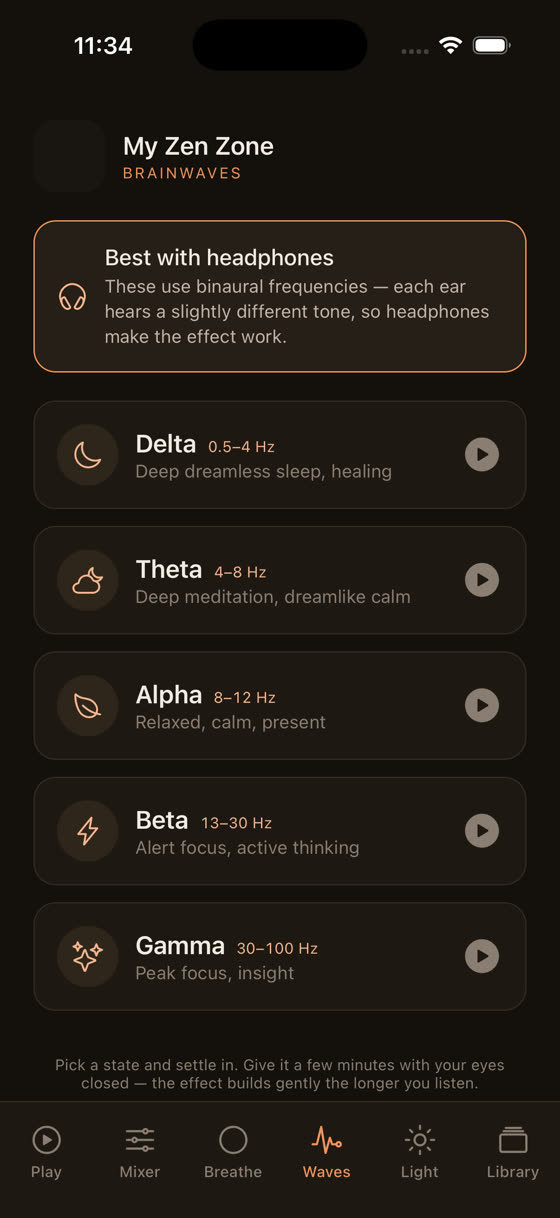
Binaural and isochronic tones get asked about constantly, usually with the assumption that a specific frequency will push your brain into a specific state. The honest answer is that the evidence for precise effects is weak, and I'd avoid anyone promising a guaranteed outcome. What these tones can offer is a very stable, low-information backdrop, similar in effect to white or pink noise, that some people find genuinely useful for masking distraction during long focus blocks. Treat it as one layer in the mix, not a solution on its own, and pair it with something you also just like the sound of.
Time of day changes what you need
Morning focus music can afford a touch more brightness, slightly more major-key harmony, because your attention is usually easier to hold early on. By mid-afternoon, when most people hit a genuine dip, denser or brighter tracks tend to backfire; they ask for more energy than you have to give. This is often the point where people reach for caffeine when what they actually need is five minutes of something slower, almost meditative, before returning to work with a clearer head. A short guided breathing pattern can do more in that slot than another coffee.
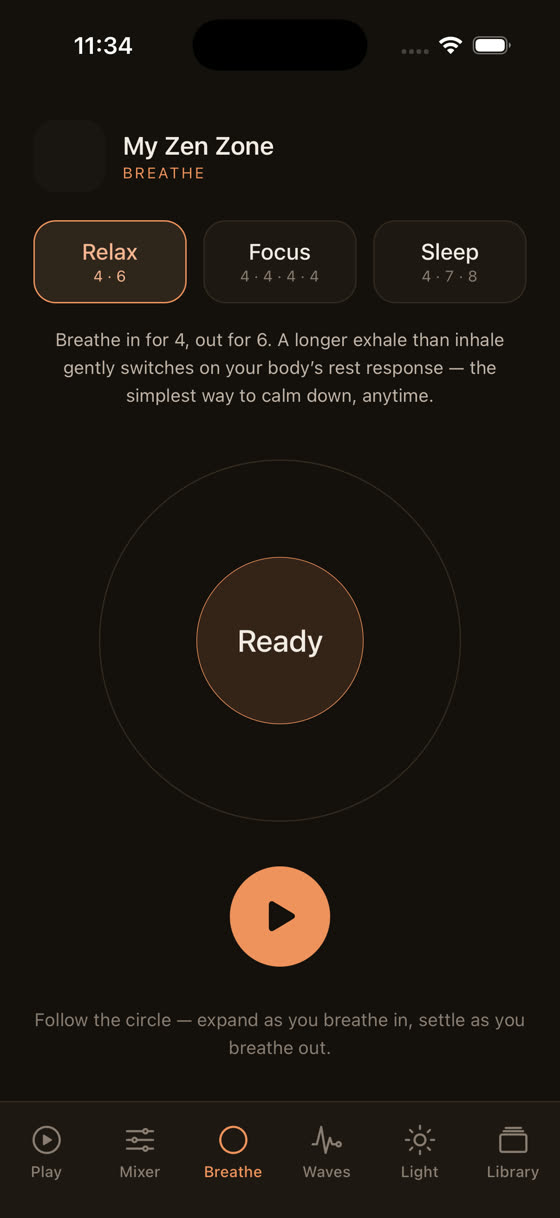
A 4-6 breathing pattern, four counts in, six counts out, run for three or four minutes, is enough to shift you out of the scattered, reactive mode that afternoon fatigue puts you in. It's a different tool to focus music, used right before it rather than during it.
What to actually do differently tonight
Stop opening a generic "focus" playlist and hitting shuffle. Instead, pick one track with a steady, unchanging structure, add a single background texture under it at low volume, and commit to it for a defined block of time rather than skipping every time your attention drifts, because skipping is often the distraction, not the music. If you're working late and focus bleeds into winding down, it's worth reading how the same principles apply at the other end of the day in our guide to music for sleep, since the structural rules are nearly identical, just slower.
Where this lives in the app
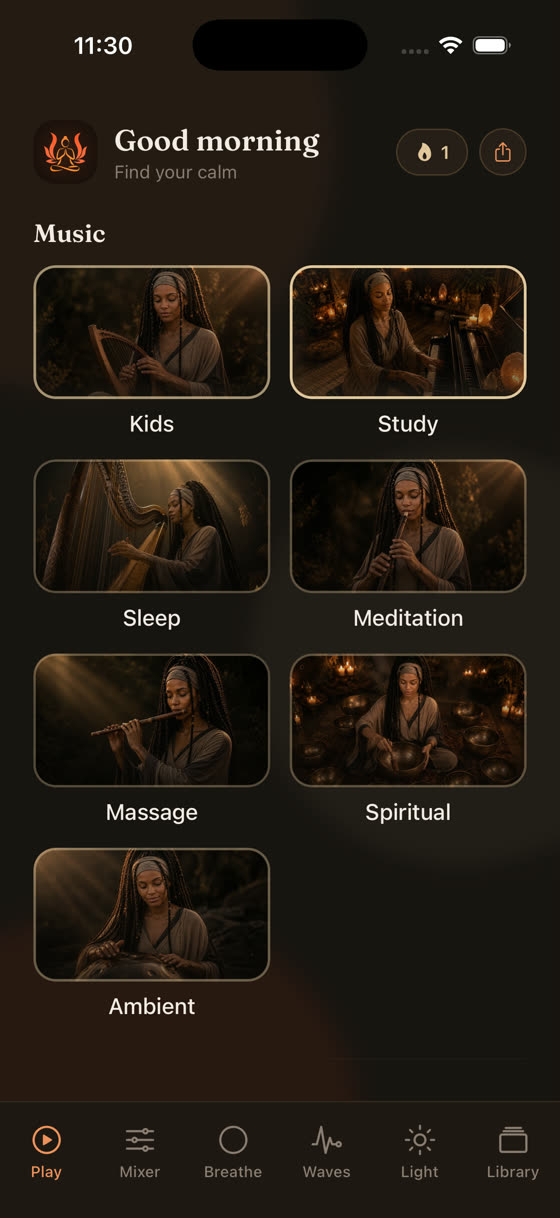
Inside My Zen Zone, Focus sits as its own world alongside Sleep, Meditation and Calm, each with its own library rather than one shared pile of tracks. Every piece is composed and recorded by one musician, so the structural choices described above — the steady tempos, the lack of dynamic swells, the deliberate repetition — are consistent across the whole catalogue rather than varying wildly from one upload to the next. New tracks are added roughly every two weeks, which matters more than it sounds for focus work specifically: music you've heard fifty times starts to carry its own associations and distractions, so having somewhere new to rotate in keeps the backdrop neutral. You can try the mixer and the full focus library through the app, or see the whole range at myzenzone.app.
Common questions
Does instrumental music actually help you focus, or is that a myth?
There's reasonable evidence that lyrics compete with verbal tasks like writing or reading, since both use the same language-processing part of your brain. For purely visual or mechanical tasks, lyrics matter less. Instrumental music with a steady structure is the safer default across most work, which is why nearly all focus-specific music avoids vocals entirely.
What tempo is best for creative brainstorming versus analytical work?
Analytical, convergent tasks tend to suit slower, steadier tracks around 55-70 bpm with minimal harmonic change. Creative, divergent work often benefits from slightly more movement, roughly 75-95 bpm, with a bit more harmonic openness. Neither rule is strict; it's about matching the music's unpredictability to how much mental wandering the task can tolerate.
Can I use the same playlist for studying during the day and sleeping at night?
Not ideally. Focus music needs enough presence to occupy background attention without distracting; sleep music needs to fade toward near-silence and slow further, usually below 60 bpm with longer, simpler phrases. Using one for the other often leaves you either under-stimulated at your desk or too alert in bed.
Do binaural beats or brainwave tones really change your mental state?
The research on precise effects is thin and mixed, so it's best not to expect a guaranteed outcome. What they reliably offer is a stable, low-information sound that can mask distractions similarly to white noise. Worth trying as one layer in a mix, not as a standalone fix for focus or creativity.
How do I stop focus music from becoming its own distraction?
Pick tracks with minimal change over time rather than ones you'd enjoy as standalone listening, and resist skipping every time your attention drifts, since skipping is often the real interruption. Setting a fixed block of time and letting the same track run throughout tends to work better than constant switching.