What "best" actually means here
The best rain sounds on Spotify are the plain ones: a single, steady rainfall at middle distance, not a thunderstorm stacked with hail and wind, and not a heavily compressed "rain and piano" mashup that ducks the rain every time a piano note lands. Search terms like "rain sounds," "rain on window," "rain on tent," or "distant thunder rain" tend to surface single-source recordings with a long, clean loop, and those are the ones worth keeping. The eight-hour and ten-hour uploads are usually a safer bet than the three-minute clips, because a longer master has more room to avoid abrupt volume jumps between loop points.
One honest caveat: nobody can promise a specific playlist will still be there next month. Spotify's catalogue shifts constantly for licensing reasons, and rain-sound channels get pulled or re-uploaded under new names all the time. If you've bookmarked a favourite, don't be surprised when it vanishes.
Why rain works as a sound, mechanically
Rain sits close to pink or brown noise: broadband energy weighted toward the lower frequencies, with no hard transients. That's the whole trick. It masks sudden sounds, a door closing, a car outside, a housemate in the kitchen, by keeping the background level roughly constant, so your brain doesn't get a sharp contrast to react to. White noise does something similar but it's flatter and more fatiguing over hours. Rain has movement, the texture of drops on different surfaces, gutters, leaves, a roof, so your ear doesn't flatten it out into pure hiss the way it does with synthetic noise.
This is also why rain pairs so well with slow music rather than replacing it. A track built around 55-65 bpm, close to a resting heart rate, sitting under rain at a lower level, does more for winding down than either sound alone. We go into the tempo side of this in more depth in our piece on music for sleep.
What most "best rain sounds" lists get wrong
Most round-ups rank playlists by follower count, not recording quality. A track recorded too close to the microphone sounds like static with no depth; one recorded with proper distance and some room tone has actual headroom and texture. Loop points matter more than people admit. Many streaming uploads are stretched from a three or four minute source loop, and once you've heard the seam, the exact moment it repeats, a few nights running, that small glitch is enough to pull a light sleeper back to alertness.
There's also a licensing problem nobody mentions. Because a lot of rain content on streaming platforms is licensed from stock libraries rather than recorded specifically for sleep or focus, you'll sometimes hear the same rain loop under five different playlist titles from five different accounts. It's the audio equivalent of stock photography: functional, but generic, and not tuned for the job.
The real limitation: you can't blend on Spotify
Spotify plays one track at a time. That's fine for music, but real rooms have layers, rain outside, a fan, distant traffic, and your brain settles faster with more than one texture at a controlled level rather than a single loud loop. This is the actual gap between a streaming playlist and a purpose-built app: a mixer where you set rain, thunder, and a soft drone each to their own volume, live, rather than accepting whatever balance the original recording engineer chose.
Watch what happens when you drop the rain a little and bring up a low, steady tone underneath it: the whole thing stops sounding like a recording and starts sounding like weather. That's the difference a proper mixer makes, and it's not something a static playlist can do no matter how well it's produced.
Building an actual rain mix, not just a rain track
If you're doing this yourself tonight: start with one dominant rain layer at a comfortable level, not loud, closer to how rain sounds through a closed window than standing in it. Add a second, quieter texture underneath, distant thunder or a low pad, at maybe a third of the main level. Avoid adding a third element with strong dynamics, like a fire crackle, because competing textures at similar volume make the brain work to separate them instead of letting them blur into background.
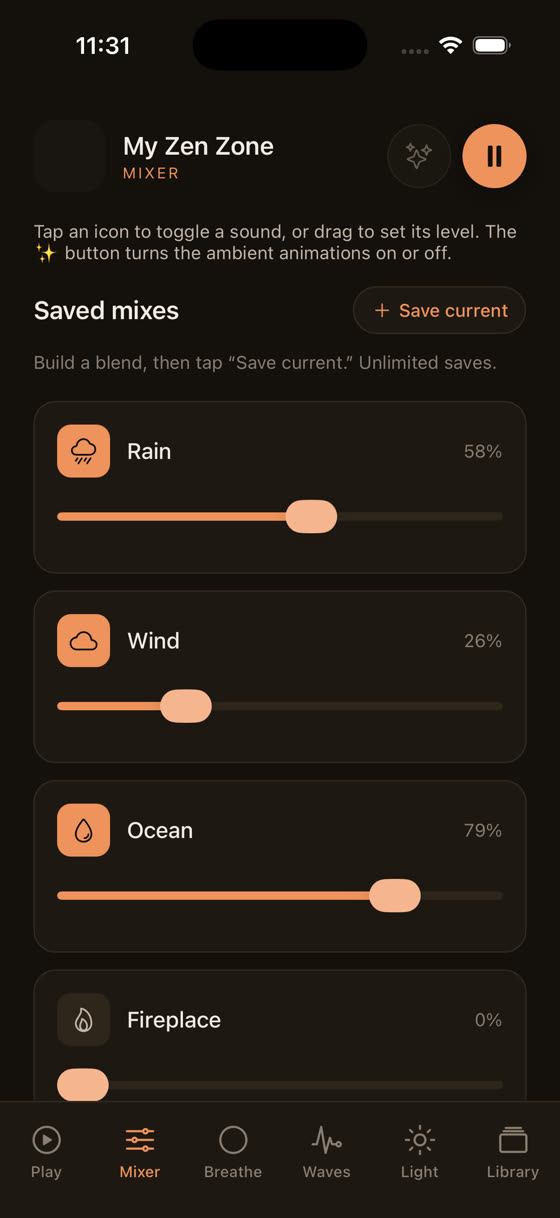
That's the screen worth looking at before you decide a single playlist will do the job: three sounds, three separate levels, adjustable in real time rather than fixed by whoever uploaded the track.
How My Zen Zone handles rain differently
Every track in the library, rain included, is composed and recorded in-house by one musician rather than pulled from a stock library, and the catalogue grows by new material every two weeks, so it isn't the same six loops recycled under different titles. The home screen splits everything into its own world, sleep, focus, meditation, calm, so you're not hunting through an algorithm-driven feed to find a rain sound that hasn't been buried by unrelated recommendations.
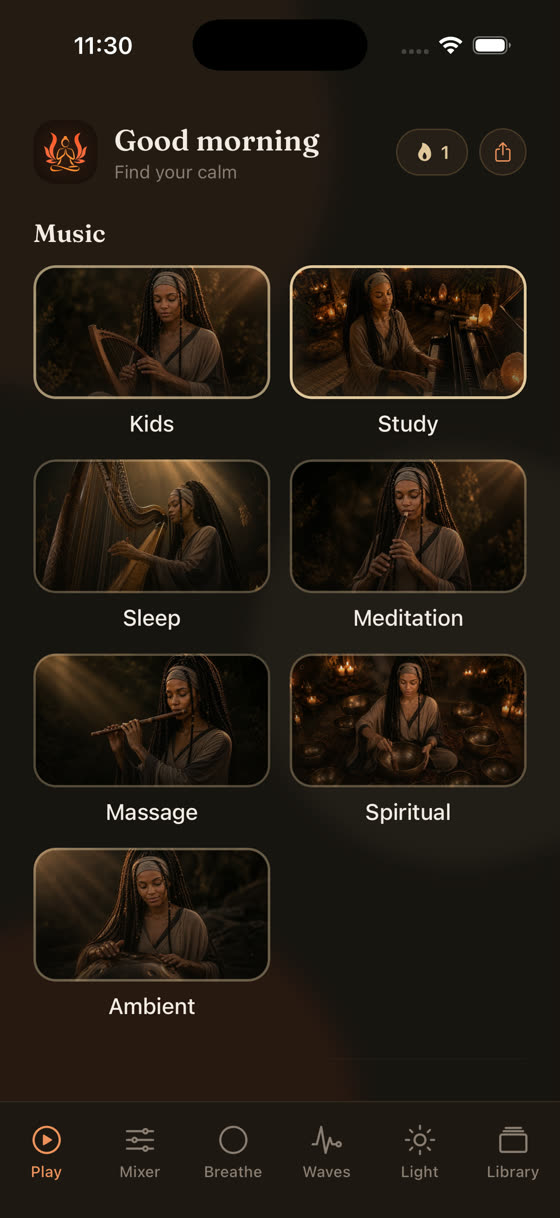
Offline downloads mean no buffering gap and no ad breaking the loop mid-storm, which matters more than people expect once you're three hours into a night's sleep. A built-in sleep timer stops everything cleanly instead of letting a rain loop run for six hours after you've already drifted off. None of that is dramatic, but it's the accumulation of small frictions removed that makes an app worth having over a saved playlist.
Rain for sleep versus rain for focus, they're not the same mix
At night you want less variation: a consistent, low-mid rain with minimal high-frequency detail, because bright, crisp elements like sharp raindrop transients or wind whistle tend to keep attention rather than release it. For focus work during the day, a slightly brighter rain with a touch more presence in the upper mids can help without demanding attention, especially layered under something rhythmic and simple rather than melodic. We cover that pairing, and why some music actively works against concentration, in our piece on focus and study music.
The mistake people make is using the same rain track for both. A storm mix that's perfect for blocking out an open-plan office at 2pm is often too textured and shifting for 11pm, when you want something closer to a flat, unchanging bed of sound.
A practical setup for tonight
Pick one rain layer as your base, set it to a level where you can still hear your own breathing faintly underneath it. Add one secondary texture at roughly a third of that volume, a distant rumble or a soft drone works better than a second, competing rain layer. Set a timer for 45 to 60 minutes rather than letting anything run all night; most people are asleep well before that, and the mind settles faster knowing there's an end point rather than an indefinite loop. Download the mix before bed if you're on wifi that drops out, so nothing cuts mid-sound. If you want to try the full mixer rather than rebuilding this from separate Spotify tracks each night, the app is available from the download page, and the whole library, including everything new added this fortnight, is also open in a browser through myzenzone.app if you'd rather listen at a desk.
Common questions
Is rain sound on Spotify free or do you need Premium?
Free accounts can play rain sound playlists, but you'll get ads breaking in every few tracks and you can't download for offline listening. For an uninterrupted night, either Spotify Premium or a dedicated app with proper offline downloads avoids the ad cutting through the loop just as you're falling asleep.
Why does the same rain track sound different on different apps?
Mastering and compression vary a lot. Some rain recordings are heavily compressed to sound loud and consistent on phone speakers, which flattens the natural texture. Others keep more dynamic range, which sounds better on headphones but quieter overall. Neither is wrong, they're just mixed for different listening setups.
Does rain sound actually help you fall asleep, or is that just placebo?
The evidence is mostly practical rather than clinical: rain's broadband, low-transient character is good at masking sudden noises that would otherwise wake you. There isn't strong research proving it improves sleep quality itself, but as a masking tool for a noisy environment, it does a clear, mechanical job.
Can I mix rain sounds with music instead of using them alone?
Yes, and it usually works better than either alone. Keep the rain as the quieter of the two so it sits behind the music rather than competing with it. Slow, simple music around 55-65 bpm with a rain layer underneath tends to hold attention just long enough to relax without becoming distracting.
Why do rain playlists on Spotify sometimes disappear?
Streaming platforms license a lot of ambient content from third-party libraries, and that licensing lapses or shifts regularly. A playlist built around specific uploaded tracks can lose half its content within months when those tracks get pulled, which is why saved playlists are unreliable long-term.